Capstone & Resources · Study deck
IoT Mathematics: Calculus, Exponents, and Logs
This first route starts with trustworthy calculation records, then develops calculus, exponential, logarithmic, Shannon-capacity, and decibel tools.
Sammy is your guide for this deck.

After studying this chapter
Learning objectives
You will be able to:
- Convert between linear and logarithmic scales (dB, dBm) and apply Shannon capacity to evaluate channel throughput
- Construct state-prediction matrices for sensor fusion using Kalman filter equations
- Analyze probability distributions (Gaussian noise model, 68-95-99.7 rule) to quantify sensor uncertainty
- Justify how modular arithmetic underpins public-key cryptography and Diffie-Hellman key exchange
Major section
In 60 Seconds
A formula can produce a neat number, but the number is useful only if its units, inputs, and limits match the real decision.
- A remote chart can help review trends, but it must not turn a weak estimate into an automatic dangerous action.
- This opening does not teach all of calculus, chance, or matrix work.
- Under the Hood derives rates, logs, probability, vectors, control terms, and the model limits behind common IoT choices.
Major section
Start With The Decision The Number Supports
A probability threshold is not just a percentage; it is a claim about false alarms, missed events, and sensor noise.
- A formula is useful only when it changes an engineering decision.
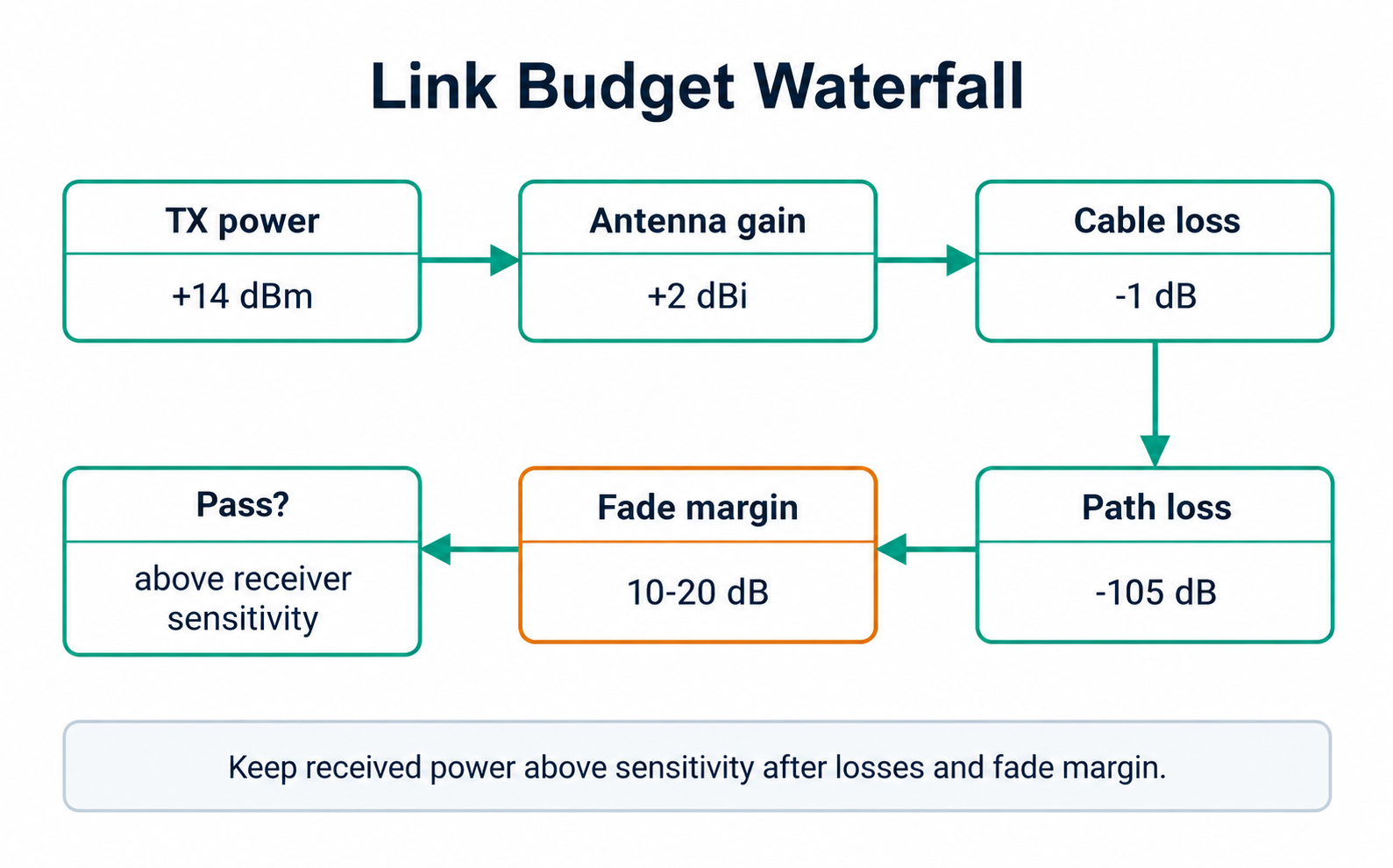
- A link budget is not just dBm arithmetic; it is a claim about range under named antenna, path-loss, receiver-sensitivity, and fade-margin assumptions.
- The later sections give the tools, but this habit decides whether the tool is being used honestly.
Major section
Deep Dive: Math Turns IoT Guesswork into Bounds
IoT math is useful when it turns an engineering question into a bounded decision.
- A derivative can say whether temperature is rising fast enough to trigger an alert.
- An integral can estimate whether a battery survives the duty cycle.
- A logarithm can compare received power and link margin.
- Mathematical models are compact state machines.
Major section
Deep Dive: Math Turns IoT Guesswork into Bounds (continued)
A PID loop stores current error, accumulated error, and rate of error change.
- The remaining vertical distance is fade margin rather than promised range.
- A battery estimate is weak until active current, sleep current, wake time, sensor warm-up, regulator loss, and temperature derating are visible.
- Every practical IoT calculation should preserve units.
Major section
Deep Dive: Math Turns IoT Guesswork into Bounds (continued)
A link budget stores transmit power, gains, losses, path model, receiver sensitivity, and required margin.
- Each step has a unit and an evidence source, so the visual shows the chapter's core pattern: a design claim strengthens only when every contributing term can be measured, specified, or challenged.
- A PID controller is weak until sample time, actuator limits, overshoot, accumulated error, and noise filtering are visible.
- Those states explain why measurement quality matters.
Major section
Deep Dive: Math Turns IoT Guesswork into Bounds (continued)
If the decision is sample rate, write the highest signal frequency, anti-aliasing filter behavior, ADC resolution, storage budget, and event latency.
- A Kalman filter is weak until process noise, measurement noise, timestamp alignment, and coordinate frame are visible.
- Mathematical foundations help a capstone team replace "it should work" with a bounded claim that someone else can test.
- A cryptographic exchange stores group parameters, private values, public values, and modular operations.
Major section
Deep Dive: Math Turns IoT Guesswork into Bounds (continued)
If the decision is gateway spacing, write a link budget in dBm/dBi/dB and include antenna orientation, mounting height, indoor attenuation, regional transmit limit, receiver sensitivity at the selected data rate, and fade margin.
- If the decision is battery size, write the current profile for boot, sensing, compute, radio join, transmit, receive window, retry, sleep, and worst-case temperature.
- A spreadsheet row, bench log, packet capture, datasheet value, spectrum reading, calibration curve, or field-trial measurement should back the terms that matter.
- A Kalman filter stores a state vector, covariance matrix, process noise, measurement noise, and update equations.
Major section
Deep Dive: Math Turns IoT Guesswork into Bounds (continued)
When an assumption is borrowed from a datasheet or standard, record the boundary: temperature range, supply voltage, antenna gain condition, packet size, spreading factor, duty cycle, or sensor accuracy class.
- A GPS reading with 10 m uncertainty and an IMU estimate with drifting bias should not be averaged blindly.
- A LoRaWAN link with a positive margin in free-space math can still fail under indoor attenuation, gateway duty-cycle limits, antenna orientation, and interference.
- A Diffie-Hellman exchange is useful only when parameters, authentication, random generation, and key handling are correct.
Major section
Math Makes IoT Claims Bounded
Mathematics in IoT is useful when it puts a boundary around a claim.
- The formula is not the final answer.
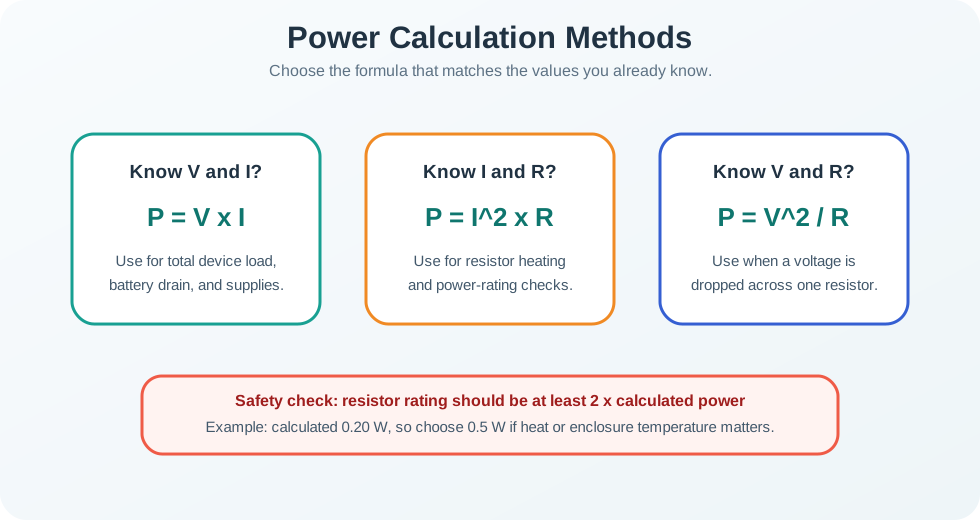
- The final answer is a design claim with units, assumptions, evidence, and margin.
- Complex numbers and information theory support radio, filtering, Fourier analysis, entropy, and channel limits.
Major section
Math Makes IoT Claims Bounded (continued)
Entropy, redundancy, noise, and channel capacity are not abstract labels in that chain; they decide how much uncertainty the message carries, how much protection the design adds, and what reliable rate the channel can support.
- The core habit is to write down what the calculation can and cannot prove.
- A link budget can prove a margin under the path-loss and receiver-sensitivity assumptions you used; it cannot prove antenna installation quality.
- A Kalman update can combine prediction and measurement uncertainty; it cannot prove that timestamps and frames are aligned.
- The selected equation is valid only when the input quantities and units are evidenced.
Major section
Build A Calculation Record
A link-budget record should include transmit power, antenna gain, cable loss, receiver sensitivity for the selected data rate, path-loss model, regional limit, installation height, measured RSSI/SNR, and fade margin.
- A battery record should include boot current, sensor warm-up, MCU active current, radio join, transmit, receive windows, retry behavior, sleep leakage, regulator quiescent current, temperature derating, and battery chemistry.
- A sampling-rate record should include the highest signal frequency, Nyquist margin, anti-alias filter cutoff, ADC resolution, data volume, and event-latency requirement.
- A Gaussian model is helpful only after outliers, saturation, missing data, and systematic drift have been checked.
Major section
Models Fail At Their Assumptions
An FFT peak is meaningful only when windowing, sampling rate, leakage, and calibration are understood.
- Shannon capacity is an upper bound for a channel with bandwidth and SNR; it does not include MAC overhead, duty-cycle rules, retransmissions, encryption overhead, buffering, or application latency.
- Control and sampling models have similar boundaries.
- Cryptographic math has its own boundary.
Major section
Models Fail At Their Assumptions (continued)
A derivative of a noisy signal amplifies noise unless filtering and sample time are chosen carefully.
- An integral of error can wind up against actuator limits unless the PID controller has anti-windup behavior.
- Nyquist sampling prevents aliasing only when the signal is band-limited or an anti-alias filter removes high-frequency content before the ADC.
- Modular exponentiation and Diffie-Hellman style exchange depend on secure parameters, randomness, authentication, freshness, key derivation, and key storage.
Major section
Models Fail At Their Assumptions (continued)
A Kalman filter needs a state vector, transition model, process noise, measurement model, measurement noise, timestamp alignment, and coordinate frame.
- If the GPS fix is one second old and the accelerometer frame is rotated, the matrix equations can still run while the result is physically wrong.
- Covariance is a promise about uncertainty; it must be updated when sensors saturate, drift, drop packets, or enter a different environment.
- The hard discrete-log problem does not stop a man-in-the-middle attacker unless the exchange is authenticated.
Major section
The Core Idea
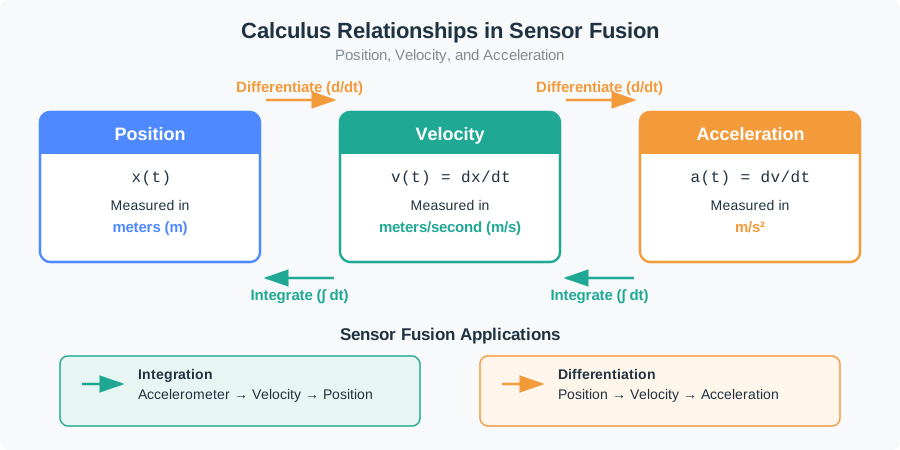
D term (dtde): How fast is the error changing? (prevents overshooting).
- A derivative measures how fast something is changing at any instant.
- Notation: dtdx means "the rate at which x changes with respect to time t".
- P term: Current error (how far off are we?).
Major section
The Core Idea
An integral adds up many small pieces to get a total.
- Notation: ∫f(x)dx means "sum up all the tiny pieces of f(x)".
- Intuition: Integration is like measuring water in a tank by tracking how fast it fills over time, even if the flow rate changes.
Deck summary
Key takeaways
A formula can produce a neat number, but the number is useful only if its units, inputs, and limits match the real decision.
- A probability threshold is not just a percentage; it is a claim about false alarms, missed events, and sensor noise.
- IoT math is useful when it turns an engineering question into a bounded decision.
- A PID loop stores current error, accumulated error, and rate of error change.
- A link budget stores transmit power, gains, losses, path model, receiver sensitivity, and required margin.
Retrieval practice
Recall check

Test Tessa says: answer from memory, then check your reasoning.
Q1A link-budget worksheet ends with positive fade margin. What should the review call that result?
Show answer
Answer: B The chapter presents the residual as fade margin rather than promised range.
Q2A team estimates battery use across a duty cycle. Which mathematical role matches that question?
Show answer
Answer: D The chapter assigns change and accumulation, including energy and current over time, to calculus.
Print reference
Answers
Answer key.
- B · The chapter presents the residual as fade margin rather than promised range.
- D · The chapter assigns change and accumulation, including energy and current over time, to calculus.