Applications & Use Cases · Study deck
Manufacturing IoT: OT Integration Boundaries
Test evidence should follow the complete loop, not just the device.
Blueprint Bina is your guide for this deck.

After studying this chapter
Learning objectives
You will be able to:
- Test ot integration boundaries with a concrete scenario and pass criteria.
- Validate putting numbers to it with a concrete scenario and pass criteria.
- test ot integration boundaries with a concrete scenario and pass criteria
- validate putting numbers to it with a concrete scenario and pass criteria
Major section
OT Integration Boundaries
A plant prototype must respect that production systems run under availability, safety, quality, cybersecurity, and change-control constraints.
- The safest prototype often reads first, writes later, and proves how data will be governed before it is allowed to affect control.
- Under the hood, the hard problem is usually not the sensor driver; it is preserving meaning across layers.
- Safety and cybersecurity boundaries must be explicit.
Major section
OT Integration Boundaries (continued)
If any layer changes the unit, timestamp, asset id, threshold, or missing-data rule without control, the final decision can be wrong even though every individual system appears healthy.
- Telemetry that only informs maintenance can often be read through OPC UA, MQTT, or a historian interface with limited risk.
- In IEC 62443 terms, the design should define zones, conduits, trust relationships, remote-access controls, certificate rotation, account ownership, patch windows, logging, and rollback.
- In production terms, the design should define who is allowed to acknowledge an alarm, override a recommendation, release a held batch, or defer a work order.
Major section
Motion Marley's Math Bridge: Sample Rate to FFT Evidence
The mathematical gist.: A 10.0 kHz sample rate has a 5.00 kHz Nyquist limit.
- A hypothetical 6.20 kHz component folds to 3.80 kHz, while a 16-bit ±5g input has a 0.000153g step—so sample timing, not amplitude resolution, sets this example’s main evidence risk.
Major section
The Four Pillars of Smart Manufacturing
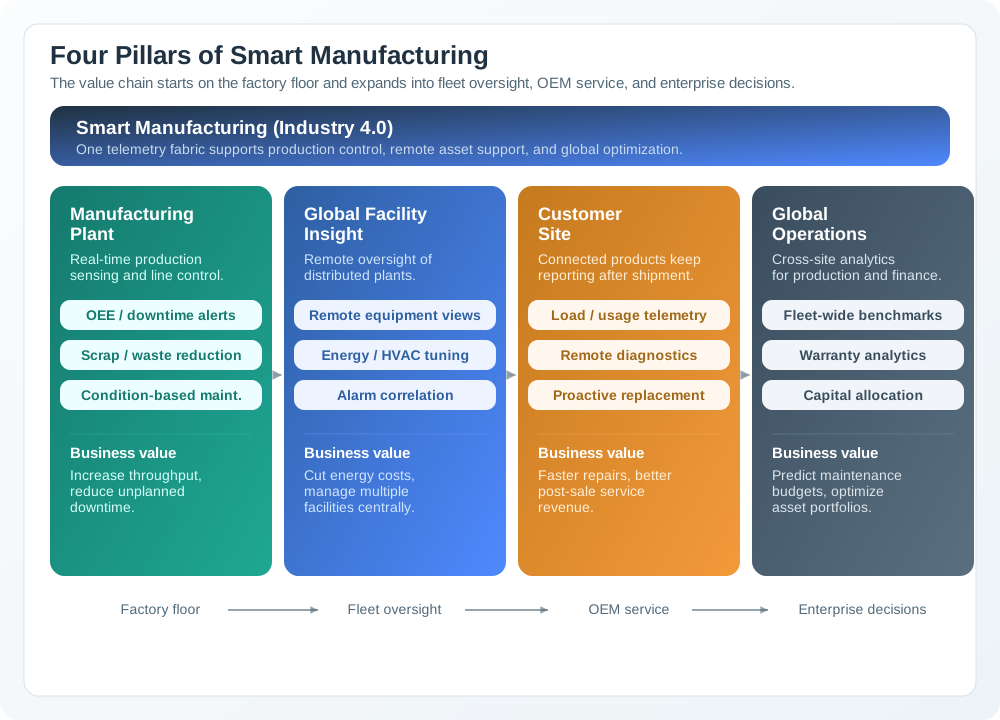
Global Facility Insight: Capabilities: Remote equipment management, temperature/energy optimization; Business Value: Cut energy costs 15-25%, manage multiple facilities centrally.
- Global Operations: Capabilities: Cross-site visibility, usage analytics, depreciation tracking; Business Value: Optimize capital allocation, predict maintenance needs.
Major section
CNC Predictive Maintenance
Current sensor on motor power line detects electrical anomalies (every 100 ms).
- Edge gateway sends alert to Manufacturing Execution System (MES): "Machine CNC-07 bearing fault detected, predicted failure in 10 days".
- MES checks production schedule: CNC-07 has planned downtime in 8 days for tool change.

Major section
CNC Predictive Maintenance (continued)
Avoided cost: Unplanned breakdown would have caused 48-hour production halt ($120K revenue loss) + emergency bearing ($200, expedited) + overtime labor ($500) + damaged spindle ($8K).
- Common Failure Point: Many factories install vibration sensors but send alerts only to a separate "condition monitoring dashboard." Maintenance teams check it weekly, by which time the bearing has already failed.
- The sensor data is correct, but the workflow integration is wrong.
- Key Insight: The vibration sensor didn't prevent the failure -- the integration with MES did.
Major section
Remote Food Safety Recalls
A powerful but underappreciated IoT capability: connected products that can refuse to work when safety issues arise.
- The same pattern can begin on the production line.
- A machine-vision check can detect a faulty food packet and stop the machine from pressing or sealing that packet.
- IoT-connected products can actively prevent consumption of recalled items.
Major section
Putting Numbers to It
If that monitoring reduces degradation to 3%, the new waste is 500,000 x 0.03 x $45 = $675,000, and the packaging program costs 500,000 x $0.85 = $425,000.
- Net annual savings are $5,625,000 - $675,000 - $425,000 = $4,525,000.
- The payback period is $425,000 divided by $4,525,000 / 12, or about 1.1 months.
- After payback, the monthly benefit is approximately $377,000.
Deck summary
Key takeaways
A plant prototype must respect that production systems run under availability, safety, quality, cybersecurity, and change-control constraints.
- If any layer changes the unit, timestamp, asset id, threshold, or missing-data rule without control, the final decision can be wrong even though every individual system appears healthy.
- The mathematical gist.: A 10.0 kHz sample rate has a 5.00 kHz Nyquist limit.
- Global Facility Insight: Capabilities: Remote equipment management, temperature/energy optimization; Business Value: Cut energy costs 15-25%, manage multiple facilities centrally.
- Current sensor on motor power line detects electrical anomalies (every 100 ms).
Retrieval practice
Recall check

Blueprint Bina says: answer from memory, then check your reasoning.
Q1A plant installs vibration sensors that correctly warn of a bearing fault, but the alert only appears in a separate condition-monitoring dashboard. What should the team fix first?
Show answer
Answer: A A smart-manufacturing loop is useful only when sensing, edge analysis, MES/ERP scheduling, work orders, and supply-chain actions connect.
Print reference
Answers
Answer key.
- A · A smart-manufacturing loop is useful only when sensing, edge analysis, MES/ERP scheduling, work orders, and supply-chain actions connect.