Emerging Paradigms · Study deck
M2M System Implementation
Imagine a water tank that asks a pump to start when the level falls.
Blueprint Bina is your guide for this deck.

After studying this chapter
Learning objectives
You will be able to:
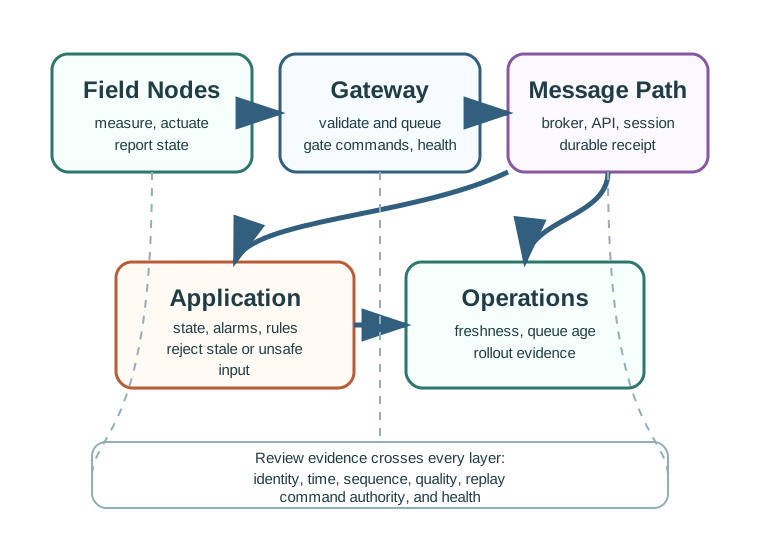
- Map an M2M implementation across devices, gateways, message services, applications, and operations.
- Define gateway responsibilities for protocol adapters, validation, normalization, buffering, replay, and command handling.
- Specify a durable message contract for readings, state changes, alarms, and commands.
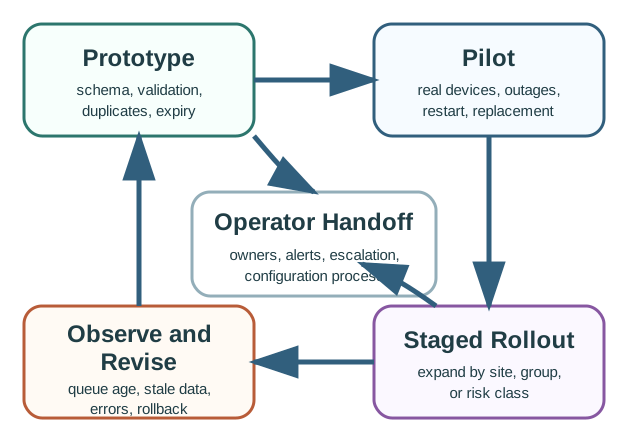
- Design a rollout path that tests degraded behavior before fleet-wide deployment.
Major section
Start Simple
No person should have to copy the reading into another screen.
- The tank sends a named event with a source, time, value, unit, and quality flag.
- The pump side checks those facts before it acts.
- It records the result, and the tank side can tell whether the request was accepted, refused, or left unknown.
- It must not quietly invent meaning.
Major section
Start Simple (continued)
A gateway is a unit that links one group of machines or message rules to another.
- It may change a wire format or field name.
- It also creates an evidence record that a support worker can follow from source to result.
- If they cannot follow the path, improve the names and evidence before adding more machines.
Major section
Start Simple (continued)
A small fixed test set makes drift visible and gives the team a safe starting point for a larger site.
- Clear names help people trace a fault when time is tight.
- The simple exchange does not cover every queue, timing race, or recovery case.
- Under the Hood shows why delivery can mislead and how code can enforce the boundaries.
Major section
Minimum Viable Understanding
Implementation starts at the boundary.: Name what runs on the device, gateway, platform, and operations side before choosing code or tools.
- Every reading needs a contract.: Identity, event time, receipt time, sequence, unit, quality, and source are not optional metadata.
- Gateways are active system components.: They translate, validate, buffer, replay, rate-limit, apply local fallback, and expose health records.
- Rollout is part of implementation.: Prototype, pilot, staged rollout, monitoring, rollback, and operator handoff must be designed with the technical path.
Major section
Boundary Decisions
The same device can be safe in one design and fragile in another depending on where responsibilities live.
- Adapter logs show which readings were received, retried, rejected, and mapped to canonical fields.
- Duplicate and replay tests do not create double actions or hidden gaps.
- Separate telemetry, alarms, state updates, commands, and configuration changes.
Major section
Message Pipeline
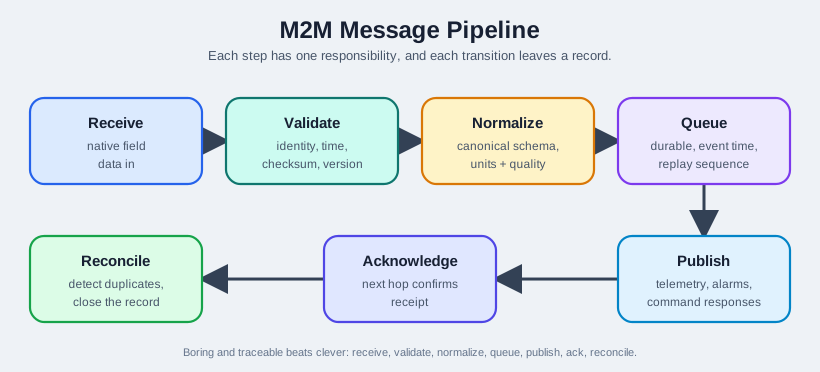
The core implementation path should be boring and traceable.
- Each step has one responsibility, and each transition leaves a record.
- This example is intentionally small.
- A production schema may include signatures, tenant routing, calibration state, location, or alarm classes, but extra fields should make the record easier to inspect rather than harder to understand.
Major section
Local Fallback
Some M2M deployments must keep a local machine process safe even when the platform is unreachable.
- Implementation should separate local fallback from normal remote command flow.
- Local fallback needs explicit exit rules.
- When connectivity returns, the gateway should reconcile queued events, reject expired commands, refresh configuration, and report how long the system was operating in degraded mode.
Major section
Worked Example: Mixed Site Gateway
Some devices speak a field protocol, some produce IP messages, and the operations team needs one reliable view.
- Field adapters: one adapter reads meter values on a schedule; another receives controller state changes; a third collects temperature alarms.
- The gateway rejects expired commands after reconnect.
- Local fallback: pump protection remains local during backhaul loss.
Major section
Worked Example: Mixed Site Gateway (continued)
Canonical events: every record includes device identity, gateway identity, event time, receipt time, sequence, measurement, unit, quality, and schema version.
- Validation: impossible readings are rejected; delayed but plausible readings are accepted with a quality marker; unsupported firmware mappings are quarantined.
- The gateway reports local-control state after recovery.
- Operations records: the dashboard distinguishes fresh telemetry, delayed replay, rejected records, offline devices, and local fallback.
Major section
Common Mistakes
A successful network write does not prove the platform accepted the event.
- Replacing original event time hides outages and turns delayed records into misleading live state.
- Rejected data should have a reason, count, and sample path.
- Commands that survive too long can execute against the wrong state after reconnect.
Major section
Summary
M2M implementation is the discipline of making machine communication traceable in code and operations.
- The gateway translates and preserves records.
- The message contract carries identity, time, sequence, quality, and provenance.
- The rollout path proves normal behavior, outage behavior, replay, rollback, and operator visibility before the design is trusted at fleet scale.
Major section
Concept Relationships
M2M design patterns provide the resilience and governance choices that this chapter turns into implementation responsibilities.
- M2M architectures and standards define the service-layer and gateway boundaries that implementation must respect.
- M2M communication defines the message path and authority model.
- M2M labs provide hands-on record tasks for queues, replay, validation, and diagnostics.
Deck summary
Key takeaways
No person should have to copy the reading into another screen.
- A gateway is a unit that links one group of machines or message rules to another.
- A small fixed test set makes drift visible and gives the team a safe starting point for a larger site.
- Implementation starts at the boundary.: Name what runs on the device, gateway, platform, and operations side before choosing code or tools.
- The same device can be safe in one design and fragile in another depending on where responsibilities live.
Retrieval practice
Recall check 1 of 3

Blueprint Bina says: answer from memory, then check your reasoning.
Q1A mixed-site gateway reads BACnet controllers, builds canonical temperature events, buffers during WAN outage, and forwards commands to field devices. Which first implementation record keeps the decision traceable?
Show answer
Answer: A A traceable M2M implementation names the device, gateway, message-service, application, and operations responsibilities before code turns boundary assumptions into fleet behavior.
Retrieval practice
Recall check 2 of 3

Blueprint Bina says: answer from memory, then check your reasoning.
Q2A gateway receives field readings during an outage and uploads them after reconnect. What implementation detail prevents the platform from treating old values as current live state?
Show answer
Answer: A Replayed values remain useful records, but the platform can identify them as delayed instead of live.
Retrieval practice
Recall check 3 of 3

Blueprint Bina says: answer from memory, then check your reasoning.
Q3Place each m2m implementations concept where it lives so you can trace a field event through mediation to an auditable operational record.
Show answer
Answer: A The three regions separate capture evidence, mediate safely, prove operation so you can trace a field event through mediation to an auditable operational record.
Q4Complete the event builder so the platform can identify freshness and duplicates during replay.
Show answer
Answer: A A replay-safe event keeps a stable identifier, original event time, device and gateway identity, and quality state.
Print reference
Answers
Answer key.
- A · A traceable M2M implementation names the device, gateway, message-service, application, and operations responsibilities before code turns boundary assumptions into fleet behavior.
- A · Replayed values remain useful records, but the platform can identify them as delayed instead of live.
- A · The three regions separate capture evidence, mediate safely, prove operation so you can trace a field event through mediation to an auditable operational record.
- A · A replay-safe event keeps a stable identifier, original event time, device and gateway identity, and quality state.