Emerging Paradigms · Study deck

M2M Design Patterns

Picture a water tank that asks a pump to start when the level falls.

Blueprint Bina is your guide for this deck.

patterns
Blueprint Bina, the module guide, in a scene from this chapter.
iotclass.org

After studying this chapter

Learning objectives

You will be able to:

  • Explain the main M2M pattern families and the failure modes they address.
  • Select store-and-forward, backoff, scheduling, duty cycling, edge filtering, dynamic configuration, authentication, and failover patterns for appropriate contexts.
  • Define acceptance records for each design pattern.
  • Check a pattern set for consistency across gateway, platform, operations, and device lifecycle responsibilities.
iotclass.org

Major section

Start Simple

Two machines can exchange that request without a person, but a late, repeated, or missing message could overflow the tank or run the pump dry.

  • The owner needs more than a normal-path demo.
  • A gateway is a boundary device that may translate or carry messages between unlike systems.
  • These states are a design runway, not a complete pattern library.
iotclass.org

Major section

Minimum Viable Understanding

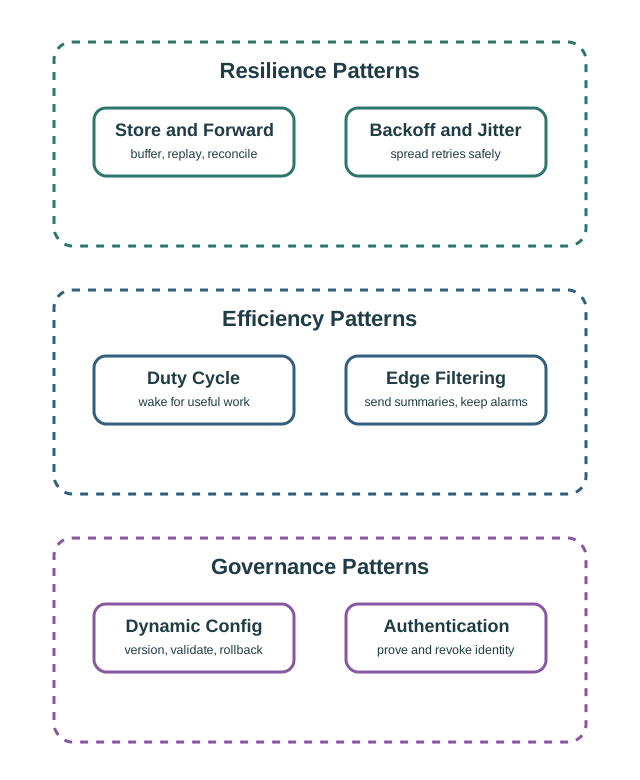
Efficiency patterns reduce unnecessary transmission, wake time, and duplicate work.

  • Resilience patterns preserve device records and safe behavior during outages.
  • Governance patterns keep deployed devices identifiable, configurable, updateable, and authenticated.
  • Patterns must be checked together.: Buffering without replay rules, authentication without lifecycle state, or edge filtering without quality markers leaves a hidden failure mode.
iotclass.org

Major section

Core Patterns

Network access is intermittent or the platform may be unavailable.

  • Many devices may reconnect, retry, or report near the same time.
  • Raw readings are repetitive, high volume, or only useful after local interpretation.
  • Server endpoints, thresholds, schedules, or policies may change after deployment.
  • The platform must prove which device or gateway produced a message.

Why it matters

Devices must conserve power or reduce radio wake time.

iotclass.org

Major section

Store, Retry, Reconcile

The most common M2M failure is not total device failure.

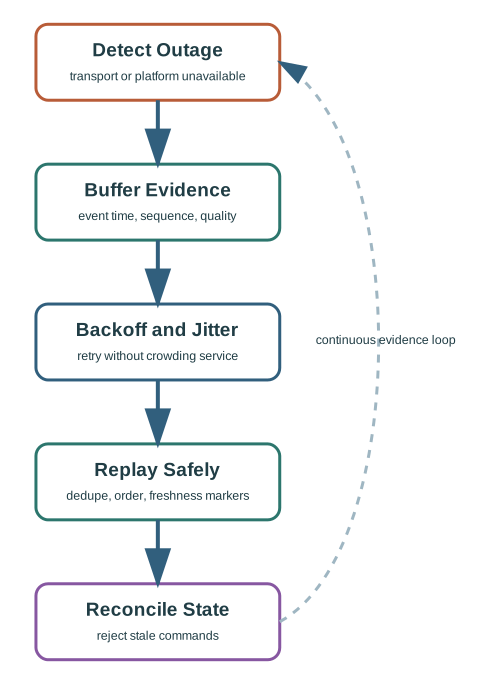
  • The design pattern should preserve the event and make delayed data visible after recovery.
  • Rewrite old readings as if they are current.
  • Resume commands without checking whether they are stale.
M2M recovery loop: detect outage, buffer records, apply backoff, replay safely, and reconcile state.
iotclass.org

Major section

Pattern Selection Flow

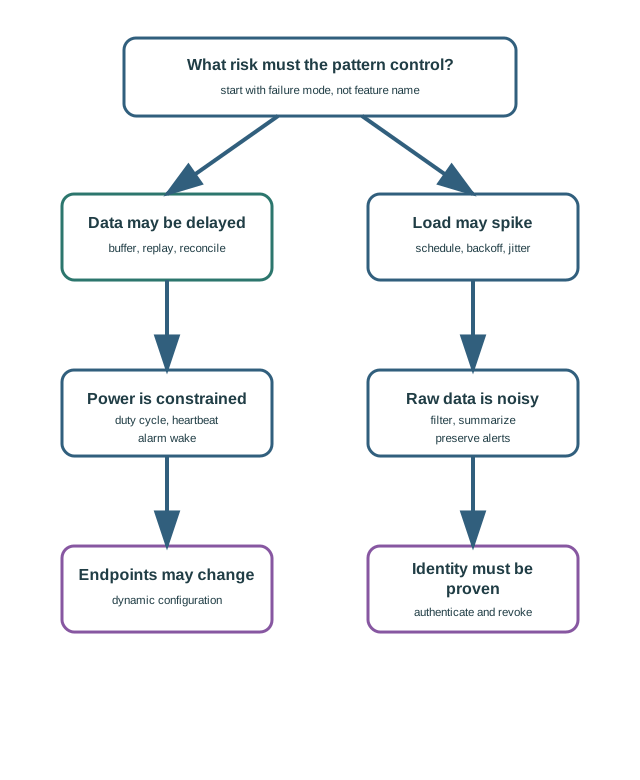
Pattern selection starts with the risk you are trying to control.

  • The same deployment may need several patterns, but each pattern should have a clear reason.
M2M pattern selection flow from risk question to resilience, efficiency, or governance pattern choice.
iotclass.org

Major section

Remote Cold-Storage Gateway

A cold-storage site has temperature sensors, a local controller, a gateway, and a platform connection.

  • The goal is not to send every raw reading forever.
  • The goal is to preserve safe operation, records, and maintainability.
  • Dynamic configuration for thresholds and endpoint changes.
  • Delayed readings remain marked as delayed after upload.
iotclass.org

Major section

Summary

M2M design patterns are practical safeguards against recurring field failures.

  • Backoff and jitter protect recovering services.
  • Dynamic configuration, authentication, and failover keep the fleet maintainable over its lifetime.
  • A pattern is only complete when the proof records show how it behaves during normal operation, degraded operation, and recovery.

Why it matters

Duty cycling and edge filtering reduce unnecessary work.

iotclass.org

Deck summary

Key takeaways

Two machines can exchange that request without a person, but a late, repeated, or missing message could overflow the tank or run the pump dry.

  • Efficiency patterns reduce unnecessary transmission, wake time, and duplicate work.
  • Network access is intermittent or the platform may be unavailable.
  • The most common M2M failure is not total device failure.
  • Pattern selection starts with the risk you are trying to control.
iotclass.org

Retrieval practice

Recall check 1 of 4

Blueprint Bina says: answer from memory, then check your reasoning.

Q1A cold-storage gateway must keep alarms local during WAN outages, replay buffered temperature records safely, avoid synchronized retries after recovery, and accept remote threshold changes without stranding devices. Which first pattern decision record is traceable?

ASelect store-and-forward, capped backoff with jitter, local alarm bypass, and versioned configuration with rollback
BEnable buffering and retrying without event timestamps because getting data to the cloud eventually is enough.
CRetry every device immediately after the WAN returns so the platform receives the full backlog quickly.
DLet edge filtering drop unusual readings because summaries are more efficient than raw records.
Show answer

Answer: A A traceable M2M pattern decision connects each selected pattern to its failure mode, acceptance records, owner, degraded behavior, and recovery test.

iotclass.org

Retrieval practice

Recall check 2 of 4

Blueprint Bina says: answer from memory, then check your reasoning.

Q2A gateway keeps collecting sensor events while the platform connection is down. When the connection returns, the platform must know which events are old and which commands are still valid. Which pattern set is most appropriate?

AStore and forward with event time, replay sequence, freshness markers, and command expiry checks.
BEdge filtering only, because the gateway can summarize the outage later.
CAlways-on reporting with no local queue, because the platform should receive data immediately.
DDynamic configuration only, because endpoint changes are the main issue.
Show answer

Answer: A Outage recovery needs store-and-forward, replay ordering, freshness markers, and command-expiry handling so old events and stale commands are not confused with current state.

iotclass.org

Retrieval practice

Recall check 3 of 4

Blueprint Bina says: answer from memory, then check your reasoning.

Q3Place each m2m design patterns concept where it lives so you can choose a recovery, traffic, or governance pattern without hiding the failure it controls.

AStore and Forward
BBackoff and Jitter
CEdge Filtering
DDynamic Configuration
Show answer

Answer: A The three regions separate buffer uncertainty, reduce traffic, govern change so you can choose a recovery, traffic, or governance pattern without hiding the failure it controls.

Q4Complete the retry delay function so reconnect attempts spread out and stay capped.

Acapped = min(growth, cap_seconds)
Bcapped = max(growth, cap_seconds)
Ccapped = base_seconds - cap_seconds
Dcapped = attempt / cap_seconds
Show answer

Answer: A A useful retry pattern grows delay after repeated failures, caps the maximum wait, and adds jitter so devices do not retry together.

iotclass.org

Retrieval practice

Recall check 4 of 4

Blueprint Bina says: answer from memory, then check your reasoning.

Q5A remote gateway buffers readings correctly during a WAN outage, but every device retries immediately after reconnection and the edge filter drops short temperature spikes. Which pattern-set change is most defensible?

AAdd capped backoff with jitter for replay, preserve event and upload time, and give temperature-spike alarms an escape path around routine filtering.
BKeep the immediate retry behavior after reconnection, because the buffer already protects every record and the fastest possible upload gets the backlog into the platform sooner.
CDisable edge filtering permanently across the fleet, because a filter that dropped one anomaly can never be trusted with routine data again.
DStamp replayed records with the current upload time, so dashboards sort the recovered backlog cleanly without a second timestamp field.
Show answer

Answer: A The pattern set must control replay bursts while preserving the anomaly evidence that filtering could otherwise hide.

iotclass.org

Print reference

Answers 1 of 2

Answer key.

  1. A · A traceable M2M pattern decision connects each selected pattern to its failure mode, acceptance records, owner, degraded behavior, and recovery test.
  2. A · Outage recovery needs store-and-forward, replay ordering, freshness markers, and command-expiry handling so old events and stale commands are not confused with current state.
  3. A · The three regions separate buffer uncertainty, reduce traffic, govern change so you can choose a recovery, traffic, or governance pattern without hiding the failure it controls.
iotclass.org

Print reference

Answers 2 of 2

Answer key.

  1. A · A useful retry pattern grows delay after repeated failures, caps the maximum wait, and adds jitter so devices do not retry together.
  2. A · The pattern set must control replay bursts while preserving the anomaly evidence that filtering could otherwise hide.
iotclass.org