Emerging Paradigms · Study deck
M2M Service Platforms
Imagine a building has lifts, meters, pumps, and alarms that must report through one service.
Blueprint Bina is your guide for this deck.

After studying this chapter
Learning objectives
You will be able to:
- Explain the core responsibilities of an M2M service platform without reducing it to a dashboard.
- Distinguish device registry, policy, service enablement, and application access responsibilities.
- Compare IP-based and non-IP M2M network boundaries and explain when a gateway is required.
- Select unicast, group delivery, service discovery, or broad notification patterns for different platform tasks.
Major section
A Clear First Route
The owner must decide which tasks stay local and which tasks the shared service will own.
- A gateway is a device or service that links one network or system to another.
- This page starts with one job.
- Last, choose route, store, delay, reject, or act on each message.
- A single screen can hide many trust lines.
Major section
A Clear First Route (continued)
Local control must still work when the shared service is slow or down.
- This first route is a guide to the main choice.
- Under the Hood adds state ownership, service failure, timing, scale, and recovery across layers.
- They do not reverse its main claim.
- If two sources differ, keep that fact in the record.
Major section
A Clear First Route (continued)
A late result may be true about the past and still be unsafe now.
- A missing result is also useful news when the system shows it at once.
- A person may inspect the site.
- A local rule may hold a safe state.
- A remote team may ask for more proof.
Major section
Platform Responsibilities
A service platform should make M2M deployments repeatable.
- It keeps each new device class from requiring a custom integration project and gives operators one governed way to inspect the fleet.
- Normalize messages, route events, buffer records, apply delivery rules, and expose health.
- API contract, rate limits, command approval rules, and operator-facing states.
Major section
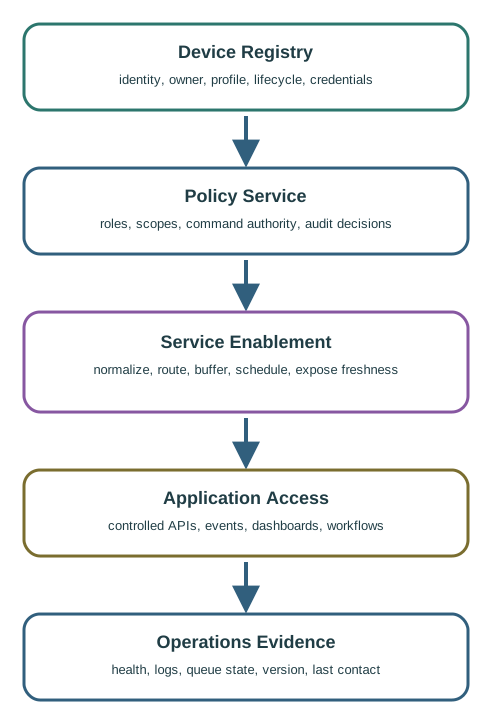
Make the Platform a Boundary Stack
“M2M platform” becomes testable when it is split into responsibility planes.
- The names below come from an early service-platform decomposition; modern products may package them differently, but the hand-offs still have to exist.
- The split uses two identity domains deliberately.
- A user credential proves who is asking.
Major section
Make the Platform a Boundary Stack (continued)
A manager registers gateway gw-17, so the device plane stores its profile, area network, credential reference, and current status.
- Their role permits reading one building and issuing no actuator commands, while an administrator retains control of that scope.
- The application plane converts the vendor payload into the common temperature contract, retains source quality, merges room and asset context, and records the processing path.
- A stale device status should block or qualify a command.
Major section
Make the Platform a Boundary Stack (continued)
A disabled user should lose access without bricking the device.
- If the app requests a threshold change, authorization is checked again, the application plane records the request, and the device plane delivers it only to the scoped device.
- Acceptance, rejection, timeout, and the device result remain in the control log.
- Removing an app mapping should stop discovery without deleting historical observations.
Major section
Make the Platform a Boundary Stack (continued)
$$ allow = policy(user,\ role,\ device,\ action,\ context). $$.
- Charging or quota accounting can then use the user/service entitlement record and measured service usage, but it does not redefine whether the device credential was valid.
- A schema merge failure should quarantine the record with its original payload and provenance rather than invent a value.
- Those independent failure behaviors are the reason to preserve the four planes even when one vendor service implements all of them.
Major section
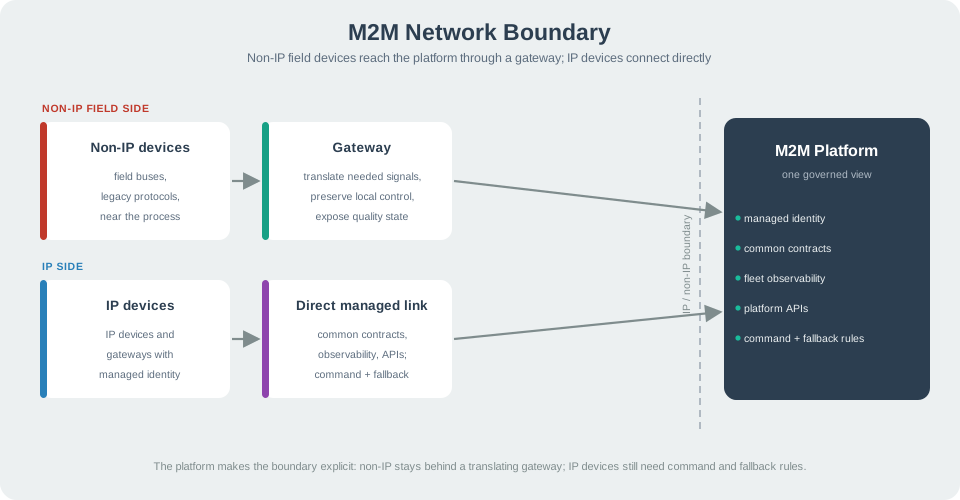
IP and Non-IP Network Boundaries
Non-IP field systems may still be correct for local equipment.
- IP-based devices may be correct for newer telemetry or cloud-facing services.
- The platform must make the boundary explicit.
- Field buses and legacy protocols can remain near the process.
- They still need explicit command and fallback rules.
Major section
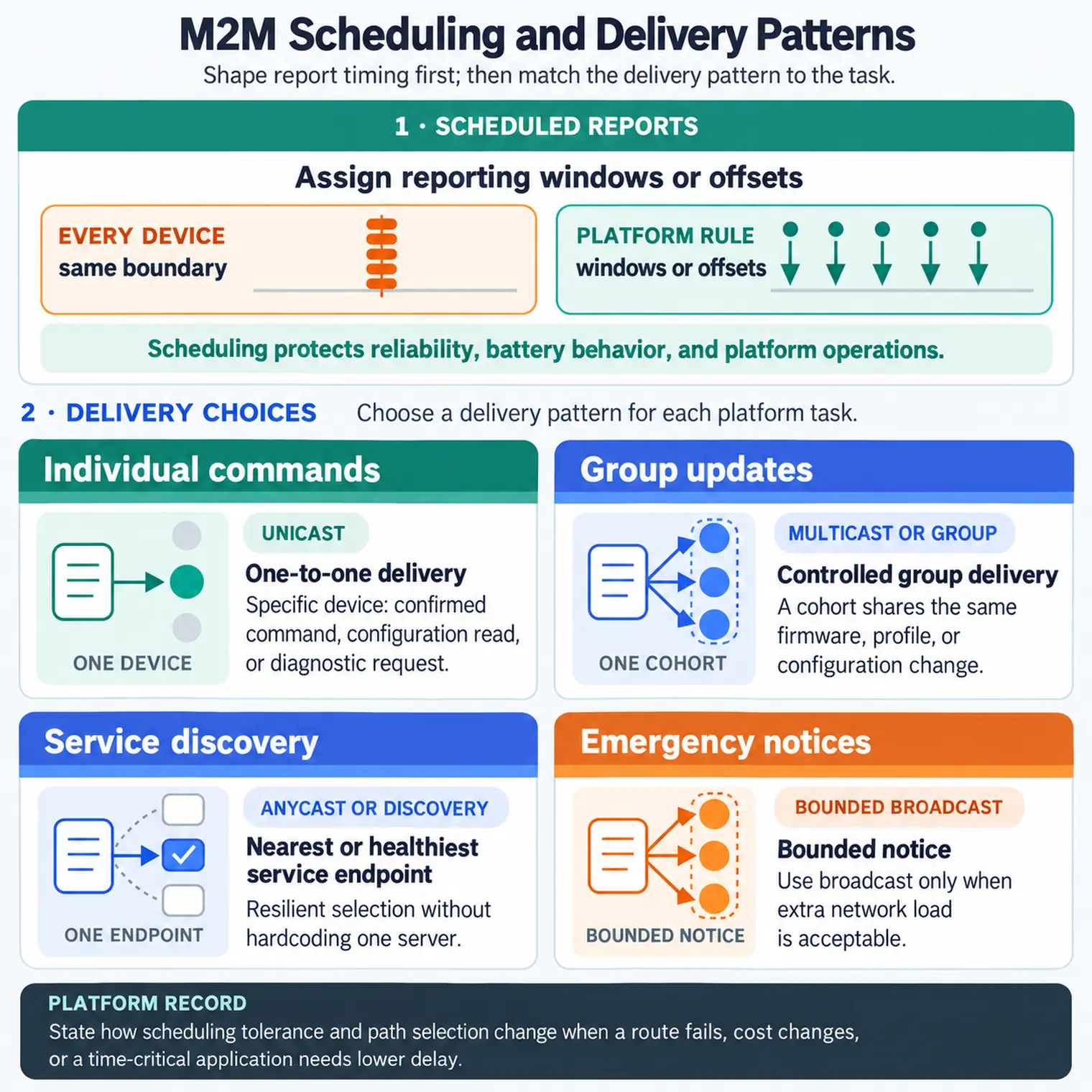
Scheduling and Delivery
Scheduling is not only a network optimization.
- It protects reliability, battery behavior, and platform operations.
- A platform should assign reporting windows or offsets rather than letting every device report at the same boundary.
- The record should also state how scheduling tolerance and path selection change when a route fails, cost changes, or a time-critical application needs lower delay.
Major section
Building Operations Platform
A campus has working local controllers for ventilation and lighting.
- The platform should not take over the physical loops; it should collect governed operational data and expose controlled actions.
- Device registry, gateway health, energy trend records, alert routing, maintenance tickets, and access policy move into the service platform.
- The platform design is acceptable only if it states which commands may cross the boundary, how stale data is marked, and how operators distinguish a local-control alarm from a platform analytics alert.
Major section
Common Mistakes
Device identity, user identity, application identity, and gateway identity should be related by policy, not collapsed into one identifier.
- Unscheduled reporting can create bursts that look like outages even when devices and links are healthy.
- Applications should use governed APIs or events.
- Gateway health, translation version, queue depth, and last contact are part of the platform state.
Deck summary
Key takeaways
The owner must decide which tasks stay local and which tasks the shared service will own.
- Local control must still work when the shared service is slow or down.
- A late result may be true about the past and still be unsafe now.
- A service platform should make M2M deployments repeatable.
- “M2M platform” becomes testable when it is split into responsibility planes.
Retrieval practice
Recall check 1 of 4

Blueprint Bina says: answer from memory, then check your reasoning.
Q1A campus platform will onboard ventilation controllers, lighting gateways, energy meters, and maintenance apps. Which first platform boundary record keeps the design traceable?
Show answer
Answer: A A traceable M2M platform decision separates identity domains, gateway contracts, reporting schedules, command scopes, application access, diagnostics, audit records, and retest triggers before the fleet depends on the platform.
Retrieval practice
Recall check 2 of 4

Blueprint Bina says: answer from memory, then check your reasoning.
Q2A gateway translates field-bus readings into platform events. Which records best show the platform boundary is well designed?
Show answer
Answer: B A platform boundary is well designed when field signals become governed records with identity, units, timestamps, quality, freshness, and clear rejected-message behavior.
Retrieval practice
Recall check 3 of 4

Blueprint Bina says: answer from memory, then check your reasoning.
Q3Place each M2M platform service where it lives so you can trace a machine message without bypassing identity or policy.
Show answer
Answer: A Separate enrolment and policy, machine-traffic mediation, and controlled application access so you can follow every message through an accountable service boundary.
Q4Complete the deterministic slot function so devices spread reports across a window instead of reporting together.
Show answer
Answer: A A deterministic slot spreads device reporting across the available window while keeping each device predictable.
Retrieval practice
Recall check 4 of 4

Blueprint Bina says: answer from memory, then check your reasoning.
Q5A campus platform onboards 900 meters and gateways. On Monday every meter reports at 00:00, gateways hide queue depth, a maintenance app reads the database directly, and a group lighting command has no expiry. What platform change is most defensible?
Show answer
Answer: A This turns platform features into reviewable identity, scheduling, gateway, application, and command boundaries; group commands should be gated by scope, expiry, audit, and local rejection rules.
Print reference
Answers 1 of 2
Answer key.
- A · A traceable M2M platform decision separates identity domains, gateway contracts, reporting schedules, command scopes, application access, diagnostics, audit records, and retest triggers before the fleet depends on the platform.
- B · A platform boundary is well designed when field signals become governed records with identity, units, timestamps, quality, freshness, and clear rejected-message behavior.
- A · Separate enrolment and policy, machine-traffic mediation, and controlled application access so you can follow every message through an accountable service boundary.
Print reference
Answers 2 of 2
Answer key.
- A · A deterministic slot spreads device reporting across the available window while keeping each device predictable.
- A · This turns platform features into reviewable identity, scheduling, gateway, application, and command boundaries; group commands should be gated by scope, expiry, audit, and local rejection rules.