Emerging Paradigms · Study deck
M2M Architectures and Standards
Picture a cold room with a temperature sensor and a cooling unit.
Blueprint Bina is your guide for this deck.

After studying this chapter
Learning objectives
You will be able to:
- Explain: The strongest designs separate device protocols from common services, model devices and data as resources, use gateways deliberately, spread traffic across time, and make degraded operation explicit.
- Explain: A gateway may translate protocols, normalize data, apply local alert rules, buffer during outages, and forward records to a cloud or site CSE.
- Explain: This connects the model to operation: the design record should make registration, current and historical readings, applicable policy, and notification ownership unambiguous.
- Explain: The platform needs a durable way to identify a device, its application role, credentials, owner, location or site, and lifecycle state.
Major section
Start Simple · In 60 Seconds · Minimum Viable Understanding
The sensor notices heat, and the cooling unit must respond.
- Machine-to-machine (M2M) design decides how those two machines share that event.
- A gateway is a local bridge between devices and a wider system.
- A protocol is a set of rules for exchanging messages.
- These checks show whether the design can fail safely.
Major section
Why Architecture Matters · Common Service Layer Pattern · Where Should Logic Live?
The architecture problem appears when the system becomes a fleet.
- Devices may come from different vendors, speak different protocols, operate without people nearby, and remain deployed for years.
- The platform needs a durable way to identify a device, its application role, credentials, owner, location or site, and lifecycle state.
- Registration, discovery, data storage, subscription, security, and management should be shared services rather than duplicated inside every application.
- The central pattern in oneM2M is a common service layer.
Major section
oneM2M Resource Tree · Network Architecture Choices
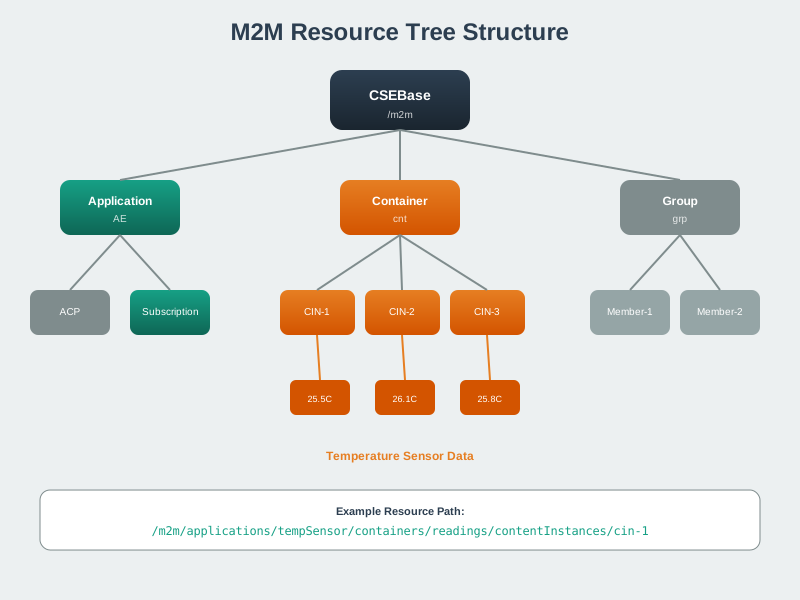
oneM2M represents applications, devices, data containers, content, policies, and subscriptions as resources.
- This connects the model to operation: the design record should make registration, current and historical readings, applicable policy, and notification ownership unambiguous.
- A tree made only from generic IDs can be technically valid but still hard to operate during an incident.
- A temperature container, command container, or alarm container can have different retention and subscription behavior.
- Retention policy matters because fleets can produce many records.
Major section
Gateway and Scheduling Pattern · Scheduling Rule of Thumb
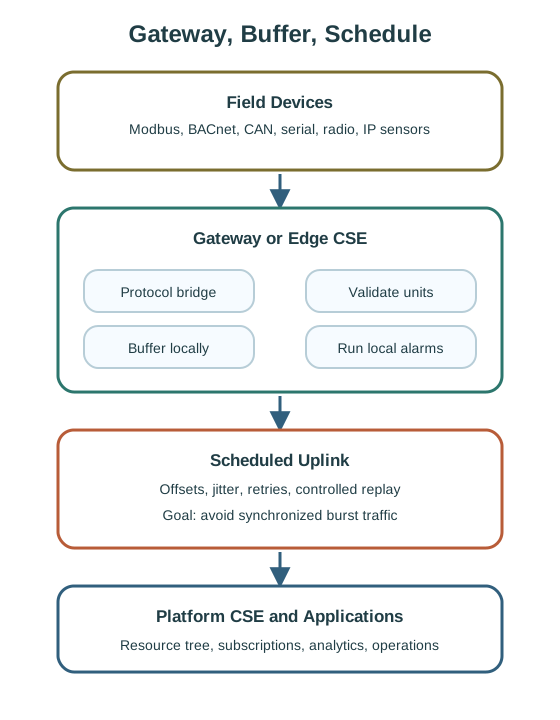
Gateways are often the practical bridge between legacy M2M and modern platform services.
- A gateway may translate protocols, normalize data, apply local alert rules, buffer during outages, and forward records to a cloud or site CSE.
- Scheduling is as important as translation.
- If every device reports at the top of the minute, the platform sees a burst.
- If devices are assigned offsets across a reporting interval, the same volume becomes smoother and easier to operate.
Major section
Standards and Requirements · Security and Operations
Architecture must make compromise containable.
- If one extracted key authenticates every device, one compromised endpoint can impersonate the fleet.
- Provision unique credentials, bind them to device records, and support revocation or quarantine.
- Registration, credential changes, configuration updates, failed authentication, and command execution need audit records.
- Reading telemetry is not the same as sending commands.
Major section
Cold-Chain Site Architecture · Practice Checks · Interactive Quiz: Match Concepts
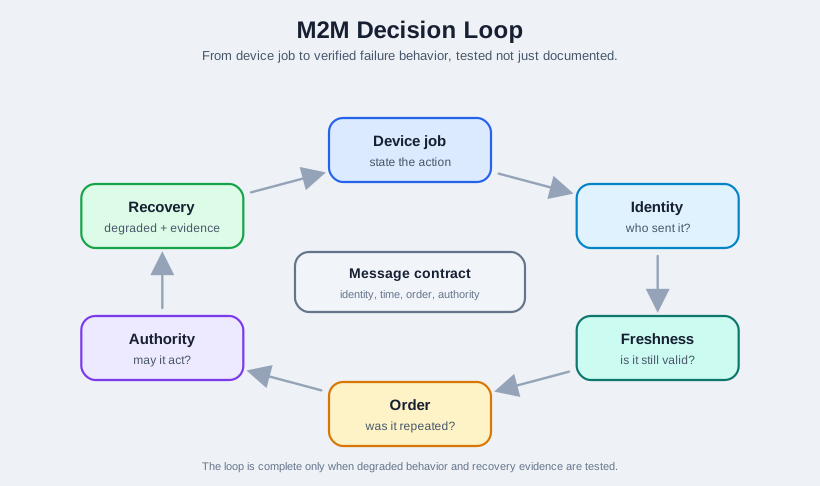
A cold-chain warehouse has refrigerated rooms, door sensors, compressor meters, and alarms.
- The business needs live alarms at the site, cloud dashboards for operations, and auditable temperature history.
- Device domain: BACnet controllers and IP temperature sensors remain in the site network.
- Applications: Facility operators receive alarms; compliance users retrieve historical records; maintenance users review compressor behavior.
Try it: Cold-Chain Site Architecture · Practice Checks · Interactive Quiz: Match Concepts in the chapter
Major section
Code Challenge: Assign Reporting Offsets · Common Mistakes
A gateway is a managed system.
- It needs ownership, patching, certificates, monitoring, local storage policy, and failure handling.
- A fleet list without resource structure, metadata, groups, and policies becomes hard to query, authorize, or operate.
- WAN outages should be designed, not discovered.
- Average traffic can look small while synchronized reporting overloads the network or broker.
Major section
Architecture Review Checklist · How Machines Talk to Machines
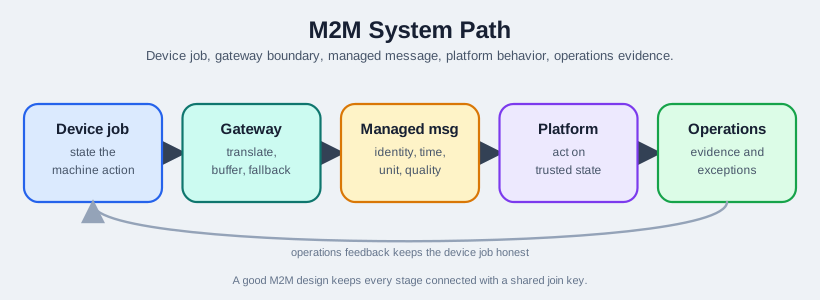
A gateway is the point that passes, stores, filters, or changes messages between parts of a system.
- Its rules and owner are part of the machine job.
- Its controller sends a warning to a gateway.
- No person has to copy the reading from one screen to another.
- The machine path may cross several teams.
Major section
Why Bursts and Replay Break Fleets · Summary
M2M architecture is about making machine fleets discoverable, manageable, secure, and resilient.
- The strongest designs separate device protocols from common services, model devices and data as resources, use gateways deliberately, spread traffic across time, and make degraded operation explicit.
Major section
Concept Relationships · Key Takeaway
M2M architecture defines how machines, gateways, common services, and applications are arranged.
- oneM2M provides a common service layer and resource model for interoperable M2M and IoT systems.
- M2M architecture connects devices, gateways, platforms, applications, and operations processes.
- Topology, protocol, identity, and management choices should follow scale, autonomy, reliability, and lifecycle needs.
Deck summary
Key takeaways
The sensor notices heat, and the cooling unit must respond.
- The architecture problem appears when the system becomes a fleet.
- oneM2M represents applications, devices, data containers, content, policies, and subscriptions as resources.
- Gateways are often the practical bridge between legacy M2M and modern platform services.
- Architecture must make compromise containable.
Retrieval practice
Recall check 1 of 5

Blueprint Bina says: answer from memory, then check your reasoning.
Q1A building operator wants one application to combine occupancy sensors, HVAC controllers, and lighting controllers from several vendors. Which architectural choice best prevents the application from becoming a bundle of vendor-specific protocol code?
Show answer
Answer: D The application should consume registered resources and subscriptions through a shared service layer rather than speaking every device protocol itself.
Retrieval practice
Recall check 2 of 5

Blueprint Bina says: answer from memory, then check your reasoning.
Q2Where should a new temperature reading sit in a oneM2M resource sketch for a cold-room controller?
Show answer
Answer: D As a content instance under its temperature container and application entity.
Q3What exposes device state as governed resources instead of raw M2M links?
Show answer
Answer: C The service layer exposes device state as governed resources instead of raw links.
Retrieval practice
Recall check 3 of 5

Blueprint Bina says: answer from memory, then check your reasoning.
Q4A remote site must report tank level and keep local pump protection working during backhaul outages. Which M2M design choice is strongest?
Show answer
Answer: C A practical M2M decision record should preserve identity, timing, sequence, local fallback, and operations evidence.
Retrieval practice
Recall check 4 of 5

Blueprint Bina says: answer from memory, then check your reasoning.
Q5Why is a payload such as just 64.2 not enough for a durable M2M tank-level reading?
Show answer
Answer: B Machine action requires context: identity, time, order, quality, freshness, and authority make a raw value usable.
Retrieval practice
Recall check 5 of 5

Blueprint Bina says: answer from memory, then check your reasoning.
Q6After a WAN outage, a cold-chain gateway has 40 minutes of buffered temperature records and live alarms are still active locally. Which recovery record best protects the M2M architecture?
Show answer
Answer: D This preserves audit history and limits burst pressure; the recovery record should also log gateway clock, buffer, policy, and replay state so gateway behavior stays visible while the common service layer catches up.
Print reference
Answers 1 of 2
Answer key.
- D · The application should consume registered resources and subscriptions through a shared service layer rather than speaking every device protocol itself.
- D · As a content instance under its temperature container and application entity.
- C · The service layer exposes device state as governed resources instead of raw links.
- C · A practical M2M decision record should preserve identity, timing, sequence, local fallback, and operations evidence.
- B · Machine action requires context: identity, time, order, quality, freshness, and authority make a raw value usable.
Print reference
Answers 2 of 2
Answer key.
- D · This preserves audit history and limits burst pressure; the recovery record should also log gateway clock, buffer, policy, and replay state so gateway behavior stays visible while the common service layer catches up.