LoRa & LoRaWAN · Study deck
LPWAN Fundamentals
LPWAN suits small, patient messages when field measurements support the radio, power, and operating assumptions.
Radio Remi is your guide for this deck.
After studying this chapter
Learning objectives
Workload fit comes before a technology family or a range claim.
- Compact, patient telemetry can be a good LPWAN candidate.The soil-sensor workload has long sleeps, delayed delivery, and tolerance for missed reports.
- Radio and power claims need deployment evidence.Reach, energy, downlink, and ownership must be checked against the installed antenna, actual workload, and operating plan.
- Some workloads need a separate network path.Streaming, tight control, frequent commands, and routine bulk transfers can exceed the compact, delay-tolerant message assumptions.
- A recommendation must state its limits and owners.The review record needs evidence, weak assumptions, mitigation, responsibility, and retest triggers before release.
Major section
Start Simple
A sleeping soil sensor is a candidate when the application can wait for its reading.
- The sensor can sleep between compact reports.The farm example sends a few numbers and tolerates waiting until a later report when a message is missed.
- Long reach and low power come with workload limits.LPWAN trades speed and message size for reach and low device power rather than supporting every kind of traffic.
- The workload record must define acceptable delay and loss.Payload size, reporting cadence, waiting time, and missed-reading tolerance determine whether the service is LPWAN-shaped.
- The energy model must include work around transmission.Joining, sending, waiting, receiving, and retrying all contribute to the sensor’s real power demand.
Major section
Site Evidence and Safe Retry Behavior
A promising workload still needs evidence from the installed device and its surroundings.
- Field trials must represent difficult installed conditions.Antenna positions, walls, ground, weather, and busy periods can change whether the remote reading arrives.
- Missed messages are part of the coverage evidence.A record containing only successful reports cannot establish how often the installed path loses observations.
- Retry behavior must respect power and shared airtime.A small sleeping device still needs a safe retry plan and fair use of the shared radio channel.
- Urgent control can require another communication path.Frequent updates and commands that cannot wait do not share the patient telemetry assumptions of the soil sensor.
Major section
The Workload Must Fit Every Constraint
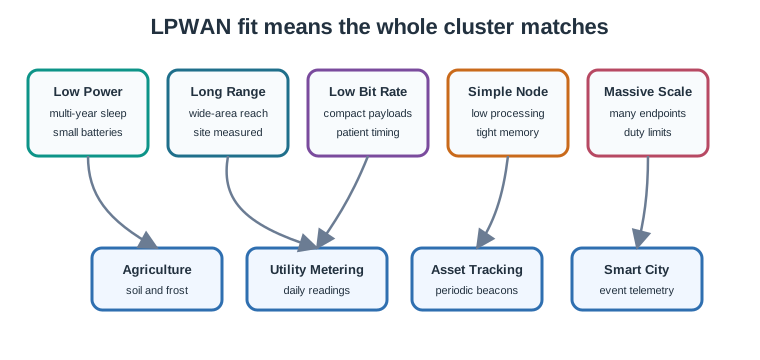
This characteristics diagram combines LPWAN constraints; start with Low Power and compare the other properties.
- Low power depends on the complete sleep-and-report cycle.The first characteristic needs evidence for sleep behavior and the work surrounding each compact transmission.
- Long range needs evidence from the actual installation.The antenna and local environment must support the claim rather than relying on a headline distance.
- Low bit rate is suited to small, infrequent messages.Continuous streams and bulky transfers do not share the compact-message assumptions shown in the characteristics diagram.
- The workload must satisfy the whole cluster of characteristics.Processing and scale belong beside power, reach, and rate when deciding whether the application fits LPWAN.
Major section
The Waste Fleet’s Four Daily Reports
The waste-sensor fleet illustrates why traffic requirements must stay attached to the fit decision.
- The waste-sensor workload has a defined message size and cadence.The chapter’s 8,000 fill-level sensors send a 16-byte report every six hours.
- Routine bin telemetry can wait for the next planning cycle.Four uplinks per bin per day allow a missed reading to wait until later route planning.
- Other city traffic has different payload and timing needs.CCTV clips, traffic-light actuation, and daily firmware images do not inherit the bins’ compact, patient workload assumptions.
- New requirements can require a separate network path.Hourly photos, live actuator supervision, or technician tablet sync must not silently expand the original LPWAN role.
Activity 1 · Match
✎ Match the traffic requirements

I want you to sort the traffic before choosing a radio family.
Match these five workloads: fill-level reports, soil telemetry, CCTV clips, traffic-light actuation, firmware images. Meanings: A, routine bulk downloads; B, small readings for later route planning; C, control that cannot wait; D, media-heavy uploads; E, measurements from a sleeping field sensor. Then mark which workloads remain LPWAN candidates.
3 minutes · Pen and paper · Answer: Activity 1
Major section
Vineyard Workload and Design Forces
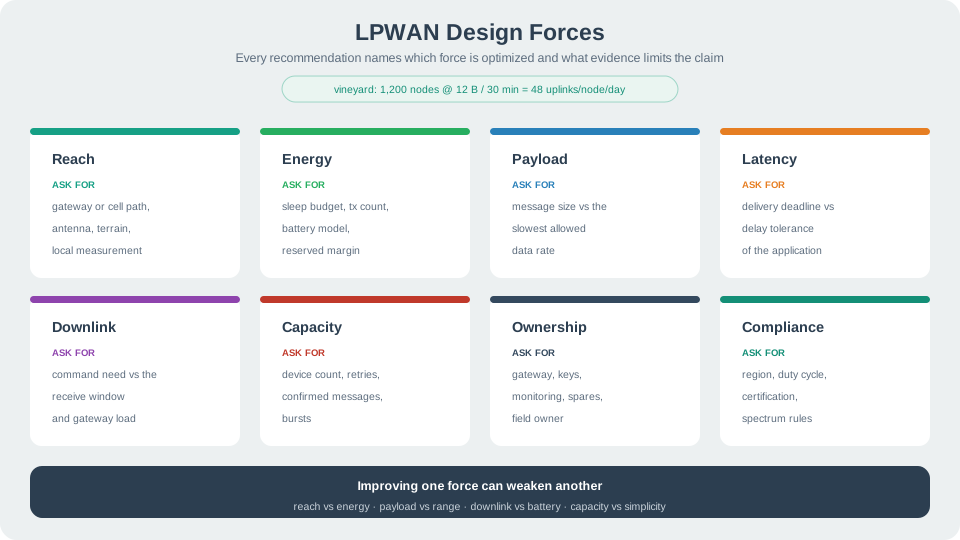
These design-force cards connect the vineyard workload with evidence; start at the example before comparing the cards.
- The vineyard example is the design-force comparison’s starting point.Its 1,200 soil nodes must each send a 12-byte moisture and temperature sample every 30 minutes during irrigation season.
- Reach requires a measured gateway or cell path.Installed antenna placement, terrain, and local observations must support the coverage claim for the actual vineyard.
- Energy and downlink must fit the application’s timing.Sleep, receive windows, retries, command frequency, and acknowledgments determine whether the workload can sustain the selected path.
- Ownership and compliance constrain the final recommendation.Operating duties belong beside payload, latency, and capacity because improving one design force can weaken another.
Major section
Private and Public Operating Duties
Private and public networks move operating duties to different owners.
- Private gateways require an infrastructure operating plan.Mast locations, backhaul, spares, keys, and monitoring must be provided for the vineyard’s privately managed path.
- Private infrastructure needs a field technician owner.The plan must assign responsibility for gateway maintenance and failures rather than leaving the installed equipment unsupported.
- A public service requires lifecycle and outage arrangements.Availability, accounts, regional roaming, escalation, and an exit path must be reviewed if service coverage changes.
- Radio performance alone cannot prove maintainability.Private and public paths move ownership and service dependencies to different places that need explicit evidence.
Major section
Vineyard Alarms and Installation Changes
The vineyard record must include traffic beyond the routine soil sample.
- The routine cadence is only the starting workload.Each node sends 48 routine uplinks per day before any additional retries or alarms are included.
- Frost alarms can require faster reporting.The operating record must distinguish urgent frost behavior from the regular moisture and temperature sampling cadence.
- Metal roofs can change antenna installation needs.Pump-shed coverage may require external antennas rather than relying on an unchanged node placement.
- Threshold changes and closed-loop control have different requirements.Rare configuration commands can be patient, while routine control may change the technology-family shortlist.
Major section
Workloads That Need Another Path
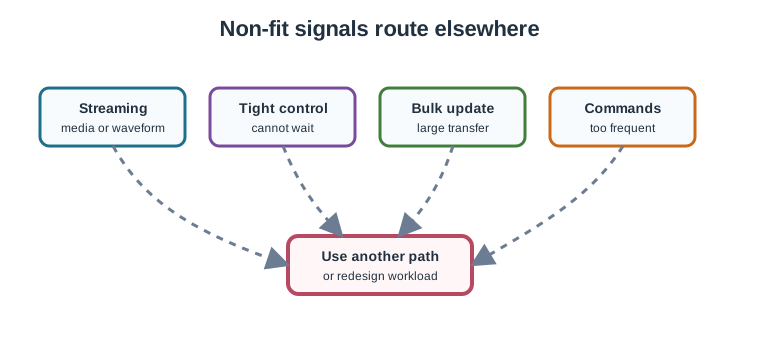
This non-fit filter identifies demands that need another path; begin with Streaming and Tight control.
- Streaming media is outside the compact-message assumption.The first non-fit signal covers media or waveforms that require a different volume of data from sparse telemetry.
- Tight control cannot depend on delayed wide-area delivery.A command that cannot wait does not share the timing tolerance expected of the chapter’s sleeping sensors.
- Bulk updates and frequent commands add transfer demands.Large downloads and repeated downlink increase receive time, battery use, and interrupted-transfer handling requirements.
- Unsupported operations also require a redesign.A working radio link is insufficient when gateway maintenance or service ownership has no responsible team.
Major section
Review Records and Retest Triggers
A review record pairs each claim with the conditions that require another review.
- The claim must name the workload and deployment scope.Region, candidate family, measured evidence, and weak assumptions belong in the review record before release.
- Each weakness needs mitigation and an owner.The record must connect a known risk to an action and a person responsible for following the evidence.
- Installation and service changes can invalidate the pilot.Enclosure revisions, antenna relocation, subscription changes, and moves between regions are explicit retest triggers.
- Increased sampling can reopen link and capacity evidence.A request for ten times more samples changes the workload behind the old pass and can require another access technology.
Major section
Antenna Gain Needs Correct Aim
Directional gain helps only while the vineyard node remains aimed toward the gateway.
- The patch’s gain depends on useful orientation.The chapter’s 6 dBi patch has 3.98× linear gain while its direction supports the gateway link.
- The beam screen covers only part of a full turn.The symmetric-beam screen is 101.8°, or 28.3% of a full turn, so antenna direction matters.
- The aimed case has a larger ideal range screen.Aimed 20 dBm EIRP gives the chapter’s 2.00× ideal range ratio under the stated assumptions.
- An off-axis penalty can reverse the directional advantage.The chapter’s 15 dB penalty leaves only 5 dBm toward the gateway when the node is mispointed.
Major section
When antenna aim becomes a penalty
The off-axis case turns the antenna choice into a placement and orientation requirement.
- The off-axis case has a 15 dB penalty.The aimed 20 dBm EIRP is reduced by the orientation penalty when the patch no longer points usefully.
- Only 5 dBm is directed toward the gateway.The reduced signal shows why the antenna’s advertised gain cannot establish the mispointed node’s link performance.
- The mispointed patch is below the omni reference.Its gateway-directed level is 9 dB below the chapter’s 0 dBi omni comparison.
- The range screen makes orientation an evidence requirement.The 0.355× range screen reverses the aimed advantage, so the vineyard record must retain placement and orientation assumptions.
Major section
Temperature Telemetry and Calibration Downloads
The cold-chain tag needs different paths for temperature reporting and calibration downloads.
- A compact temperature heartbeat can fit LPWAN.The cold-chain tag’s five-minute report is a candidate when its payload is small and delayed arrival is acceptable.
- The calibration package has a different transfer shape.A weekly 250 kB download requires thousands of small fragments and long receive time even before protocol overhead.
- Interrupted transfers need their own operating plan.The calibration path adds retry handling, battery use, and recovery responsibilities beyond the routine temperature report.
- Bulk calibration can use a separate maintenance connection.The chapter routes the package through depot Wi-Fi or a wired cradle while keeping temperature telemetry on LPWAN.
Activity 2 · Predict
✎ Add the calibration download
I want you to explain why one product can need separate communication paths.
The cold-chain tag adds a weekly 250 kB calibration package to its temperature heartbeat. Predict the effects on receive time, battery use, and interrupted-transfer handling. Sketch the revised path choice.
3 minutes · Pen and paper · Answer: Activity 2
Major section
summary (continued)
This comparison places different workloads inside radio envelopes; compare the tablet with the remote tank.
- The nearby tablet needs a high-rate traffic path.The Wi-Fi region fits its bulk transfer workload rather than the remote tank’s sparse observations.
- Local-link options have a distinct role in the comparison.Bluetooth LE and 802.15.4 have a different rate and range envelope from wide-area telemetry.
- LPWAN can fit the remote tank’s patient reports.The LoRa region matches tens-of-bytes telemetry over kilometres when the operating evidence supports the path.
- The plotted envelope is not a deployment guarantee.Payload, cadence, latency, link margin, regulation, terrain, gateways, and retry energy must support the selected radio role.
Deck summary
Key takeaways
An LPWAN recommendation is useful when its operating limits and evidence remain explicit.
- The message shape must justify the LPWAN role.Size, cadence, delay tolerance, and downlink requirements determine whether the workload remains small and patient.
- Installed measurements must bound range and battery claims.Site reach and a complete energy model need the actual antenna, sleep behavior, receive windows, and retries.
- The architecture must include service and failure ownership.Gateway duties, service dependencies, and recovery responsibility remain necessary even when compact telemetry works in a pilot.
- Unsuitable traffic must move to another path or design.Changed payload, region, antenna, service, or ownership requires renewed review rather than extending an old claim without evidence.
Retrieval practice
Recall check 1 of 3
Radio Remi says: answer from memory, then check your reasoning.
Q1Which workload is the strongest LPWAN fit before detailed design?
Show answer
Answer: C LPWAN fits compact, delay-tolerant, sleep-first workloads when regional, coverage, power, and operations evidence are available.
Retrieval practice
Recall check 2 of 3
Radio Remi says: answer from memory, then check your reasoning.
Q2A vineyard co-op wants LPWAN soil-moisture nodes across open rows, pump sheds, and a metal-roof packing shed. A public coverage map includes the valley. What evidence is still missing before the architecture is ready?
Show answer
Answer: D LPWAN readiness requires final-site link evidence, workload cadence, power behavior, downlink limits, service ownership, and retest triggers, not just public coverage visibility.
Retrieval practice
Recall check 3 of 3
Radio Remi says: answer from memory, then check your reasoning.
Q3Which LPWAN recommendation is evidence-safe?
Show answer
Answer: A An LPWAN decision is safe when it is bounded by workload fit, regional evidence, radio and power assumptions, downlink behavior, and operations ownership.
Print reference
Answers
Answer key.
- C · LPWAN fits compact, delay-tolerant, sleep-first workloads when regional, coverage, power, and operations evidence are available.
- D · LPWAN readiness requires final-site link evidence, workload cadence, power behavior, downlink limits, service ownership, and retest triggers, not just public coverage visibility.
- A · An LPWAN decision is safe when it is bounded by workload fit, regional evidence, radio and power assumptions, downlink behavior, and operations ownership.
Print reference
Activity 1 answer
Model answer.
Match: Fill-level reports match B; soil telemetry matches E; CCTV clips match D; traffic-light actuation matches C; firmware images match A. Compact, patient fill-level reports and soil telemetry remain LPWAN candidates, subject to field evidence. Media, tight control, and routine bulk downloads need another path or redesign.
Print reference
Activity 2 answer
Model answer.
Predict: Fragmentation increases receive time, energy use, and retry handling. Keep compact, delay-tolerant temperature telemetry on LPWAN, subject to evidence. Route calibration packages through depot Wi-Fi or a wired cradle and record responsibility for interrupted transfers.