LoRa & LoRaWAN · Study deck
LPWAN Technology Selection
A remote tank reports its level four times a day, but a falling-level alarm may lead staff to close an inlet valve.
Radio Remi is your guide for this deck.

After studying this chapter
Learning objectives
You will be able to:
- Explain: The useful question is not "Which LPWAN is best?" The useful question is "Which candidate can satisfy this requirement, in this region, under this operating model, with evidence that another reviewer can inspect later?".
- Explain: A 6 dBi antenna is 3.98× linear gain, producing a 20 dBm (100 mW) ideal EIRP screen while concentrating the favoured response into 3.16 sr, or 25.12% of a sphere.
- Explain: That schedule leaves at most about 30 s of waiting under normal operation, but the remaining deadline must cover transfer, queueing and application handling.
Major section
Start Simple
LoRaWAN is a low-power radio system for small messages over long paths.
- A payload is the useful data inside a message.
- These facts remove choices that cannot meet the job before a sales claim enters the discussion.
- Hills, walls, movement, local radio rules, weak return paths, and missing service can all defeat a good paper choice.
Major section
Start Simple (continued)
A low send rate may save energy, yet it can also delay an urgent update.
- This tank story cannot select a network for every site.
- Those claims need a field test and a named owner.
- The deeper work qualifies the first shortlist; it does not undo the need-first rule.
Major section
Eddie's Math Bridge: Antenna Gain As A Battery Lever
The mathematical gist.: The chapter's 14 dBm transmitter is 25.12 mW.
- A 6 dBi antenna is 3.98× linear gain, producing a 20 dBm (100 mW) ideal EIRP screen while concentrating the favoured response into 3.16 sr, or 25.12% of a sphere.
Major section
Overview: Selection Is an Evidence Record
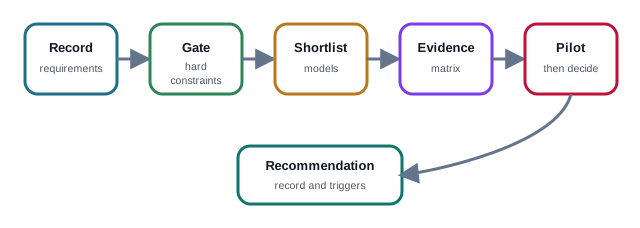
LPWAN technology selection should not start with a favorite network name.
- It should start with a short record of the device workload, placement, power target, mobility pattern, ownership model, security boundary, lifecycle need, and evidence available for the real deployment.
- The level sensors may tolerate delayed uplinks and no routine downlink.
Major section
Overview: Selection Is an Evidence Record (continued)
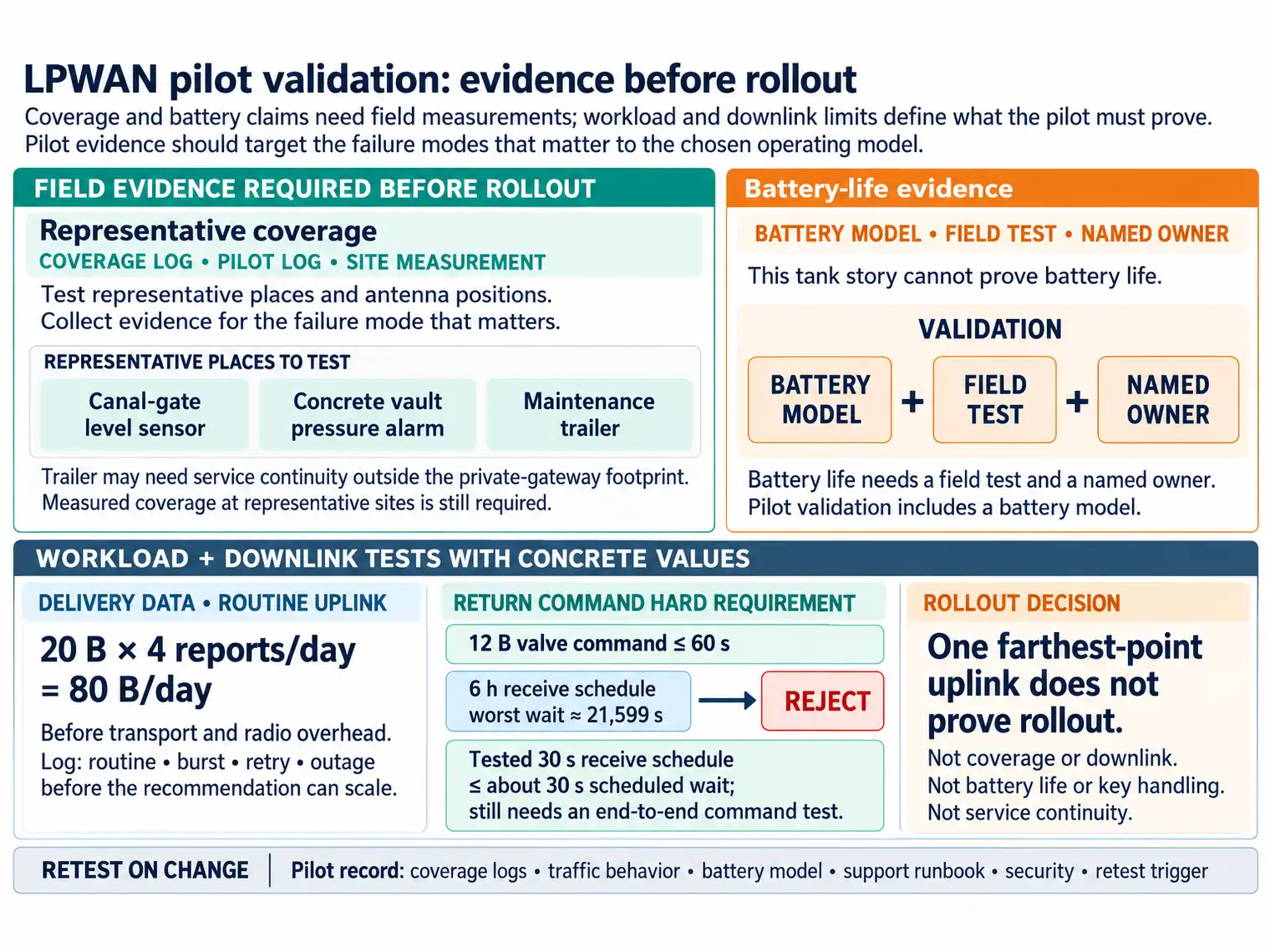
That evidence makes the later recommendation auditable rather than personal preference.
- The useful question is not "Which LPWAN is best?" The useful question is "Which candidate can satisfy this requirement, in this region, under this operating model, with evidence that another reviewer can inspect later?".
- The pressure alarms may need stronger indoor evidence and a support owner who can inspect missed reports.
- The overview record should also preserve the rejected paths.
Major section
Overview: Selection Is an Evidence Record (continued)
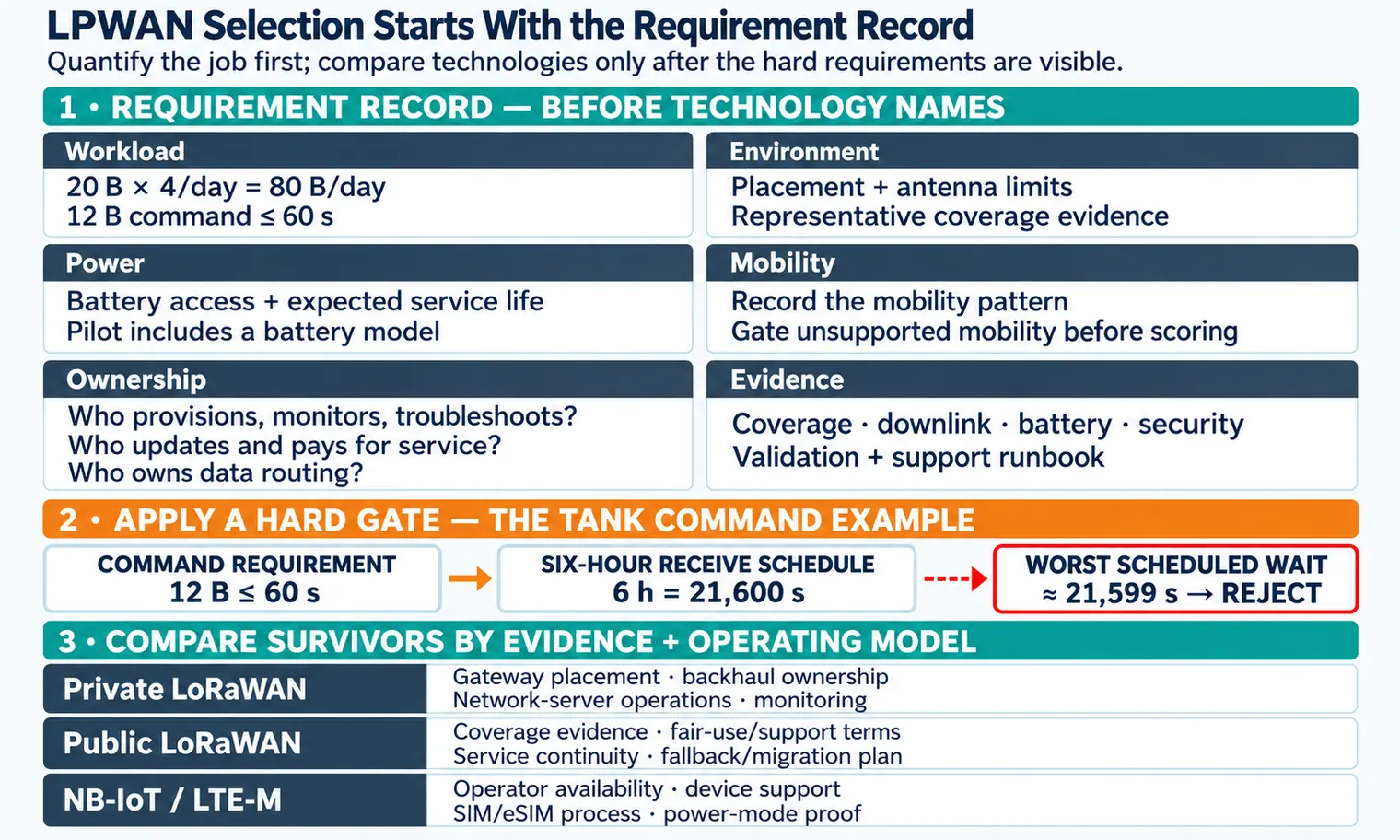
For example, an irrigation district may have three device groups that look similar at first glance: canal-gate level sensors, concrete-vault pressure alarms, and mobile maintenance trailers.
- The trailers may need mobility and service continuity outside the private-gateway footprint.
- If private LoRaWAN is kept, the record should say who owns gateways, backhaul, server operations, and field diagnostics.
- Constraint Remove candidates that cannot satisfy region, coverage, mobility, power, payload, duty, certification, or operations boundaries.
Major section
Overview: Selection Is an Evidence Record (continued)
If NB-IoT or LTE-M stays in the shortlist, it should name operator availability, identity management, power-mode proof, and subscription risk.
- If a non-LPWAN path is removed, the record should explain whether the blocker was power, cost, mobility, data volume, local infrastructure, or support burden.
- Requirement Record payload size, reporting cadence, burst behavior, downlink need, placement, antenna limits, battery access, and expected service life.
- Recommendation Name the chosen path, rejected paths, evidence, assumptions, risks, pilot checks, owner, and change triggers.
Major section
Practitioner: Gate the Shortlist Before Scoring
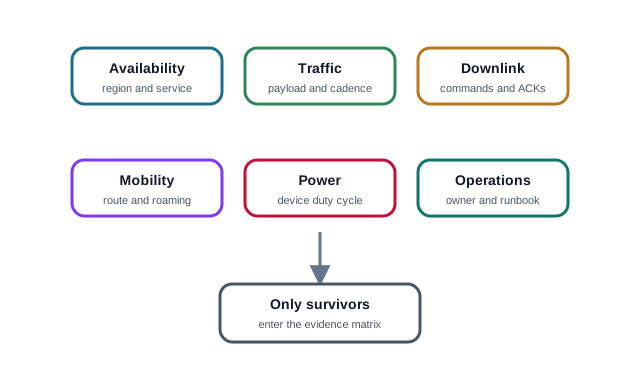
A practitioner should separate hard constraints from preferences.
- Public or community LoRaWAN depends on service terms and coverage evidence.
- NB-IoT and LTE-M depend on operator service, device support, subscription terms, and the behavior required by the workload.
- "We can install a gateway somewhere" without antenna, backhaul, monitoring, or maintenance evidence.
Major section
Practitioner: Gate the Shortlist Before Scoring (continued)
A selection record should name the region, the exact band, and the applicable airtime limit, not just "the coverage map includes this site.".
- Coverage evidence, fair-use and support terms, device behavior, service continuity, and fallback or migration plan.
- Operator availability, device support, SIM or eSIM process, payload and power evidence, roaming need, and service terms.
- "It is cellular" without route, indoor, power-mode, subscription, or lifecycle evidence.
Major section
Under the Hood: The Matrix Is a Trace, Not a Score
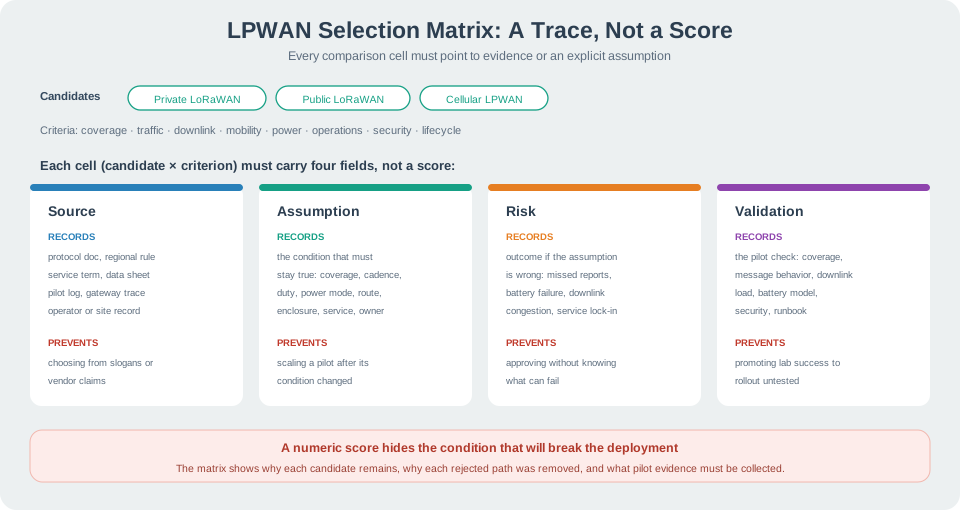
Under the hood, a selection matrix is useful only when each row has evidence, an assumption, a risk, and a validation check.
- A numeric score without those fields can make a weak decision look precise while hiding the condition that will break the deployment.
Major section
Under the Hood: The Matrix Is a Trace, Not a Score (continued)
Failure It Prevents.
- The matrix should show why each candidate remains, why each rejected path was removed, and what pilot evidence must be collected before the recommendation can scale.
- Choosing from slogans, stale assumptions, or vendor claims that cannot be reviewed later.
- Specification, service, device, region, site, or ownership changes.
Major section
Under the Hood: The Matrix Is a Trace, Not a Score (continued)
It should also name the trigger that reopens the decision when the region, operator, firmware, payload, enclosure, gateway plan, fleet size, or maintenance model changes.
- Scaling a pilot after the condition that made it work is no longer true.
- Payload, placement, enclosure, fleet size, firmware, route, or operator changes.
- Approving a candidate without knowing what can fail operationally.
- New incident, field exception, support burden, or capacity signal.
Major section
Reject the Tank Link That Cannot Return the Command
Four reports produce 80 bytes per day before transport and radio overhead.
- The selection record also requires a 12-byte valve command to arrive within 60 s.
- Selection must reject a six-hour receive schedule for that command, unless a separately tested mechanism supplies earlier opportunities.
Major section
Reject the Tank Link That Cannot Return the Command (continued)
For the worst scheduled wait, take a command arriving 1 s after the last receive opportunity.
- Six hours contain 21,600 s, so the next scheduled opportunity is about 21,599 s away.
- The selection should stop at a failed command requirement before assigning price scores.
- That schedule leaves at most about 30 s of waiting under normal operation, but the remaining deadline must cover transfer, queueing and application handling.
Major section
Reject the Tank Link That Cannot Return the Command (continued)
Selection therefore needs an end-to-end command test and a clear loss response, not merely a shorter timer in a table.
- Technology selection cannot trade a missed hard requirement for battery savings.
- Selection stays blocked for that candidate until the missing infrastructure and operating responsibility are resolved.
- A sound selection may separate sensing from control, add a local safe action or revise the product promise.
Major section
Summary
LPWAN technology selection starts with the deployment requirement, not a favorite network name.
- Hard gates remove candidates that fail availability, workload, field, power, downlink, mobility, security, or operations constraints.
- A matrix is useful only when every comparison is tied to evidence, assumptions, risks, mitigations, and validation checks.
- A recommendation should record the chosen path, rejected paths, pilot evidence, owner, rollout gate, and change triggers.
Deck summary
Key takeaways
LoRaWAN is a low-power radio system for small messages over long paths.
- A low send rate may save energy, yet it can also delay an urgent update.
- The mathematical gist.: The chapter's 14 dBm transmitter is 25.12 mW.
- LPWAN technology selection should not start with a favorite network name.
- That evidence makes the later recommendation auditable rather than personal preference.
Retrieval practice
Recall check 1 of 3

Radio Remi says: answer from memory, then check your reasoning.
Q1An irrigation district is choosing an LPWAN path for battery level sensors at canal gates, some inside concrete vaults, with rare downlink setpoint updates. Which starting point gives the strongest basis for technology selection?
Show answer
Answer: B A selection record starts with the deployment requirement and the evidence needed to compare candidate operating models against it.
Retrieval practice
Recall check 2 of 3

Radio Remi says: answer from memory, then check your reasoning.
Q2A private LoRaWAN option has good payload fit, but no gateway placement plan, backhaul owner, monitoring owner, or field coverage evidence. What should the practitioner do?
Show answer
Answer: C Practitioner review gates candidates on evidence and operating responsibility before comparing preferences.
Retrieval practice
Recall check 3 of 3

Radio Remi says: answer from memory, then check your reasoning.
Q3A recommendation says, 'Select private LoRaWAN because the farthest test point worked once.' What evidence is missing under the hood?
Show answer
Answer: D Under-the-hood review ties recommendation quality to source evidence, pilot validation, assumptions, risks, and retest triggers.
Print reference
Answers
Answer key.
- B · A selection record starts with the deployment requirement and the evidence needed to compare candidate operating models against it.
- C · Practitioner review gates candidates on evidence and operating responsibility before comparing preferences.
- D · Under-the-hood review ties recommendation quality to source evidence, pilot validation, assumptions, risks, and retest triggers.