LoRa & LoRaWAN · Study deck

LPWAN Architectures

A field sensor may reach several LoRaWAN gateways with one uplink, while only the network server decides how that frame enters the application.

Radio Remi is your guide for this deck.

lpwan
Radio Remi, the module guide, in a scene from this chapter.
iotclass.org

After studying this chapter

Learning objectives

You will be able to:

  • Explain: In a LoRaWAN design, that means logging the uplink that opened the receive window, the network-server scheduling decision, the gateway selected for the downlink, and the observed device response.
  • Explain: In a cellular LPWAN design, it means proving attach state, paging or power-saving behavior, operator reachability, application retry behavior, and the cost of waking the device more often.
  • Explain: The design also decides who owns the access network, where security and routing decisions happen, how downlinks reach sleepy devices, and what evidence proves coverage at the site.
  • Explain: They do not replace installed coverage proof.
iotclass.org

Major section

Track One Uplink Through the LoRaWAN Roles
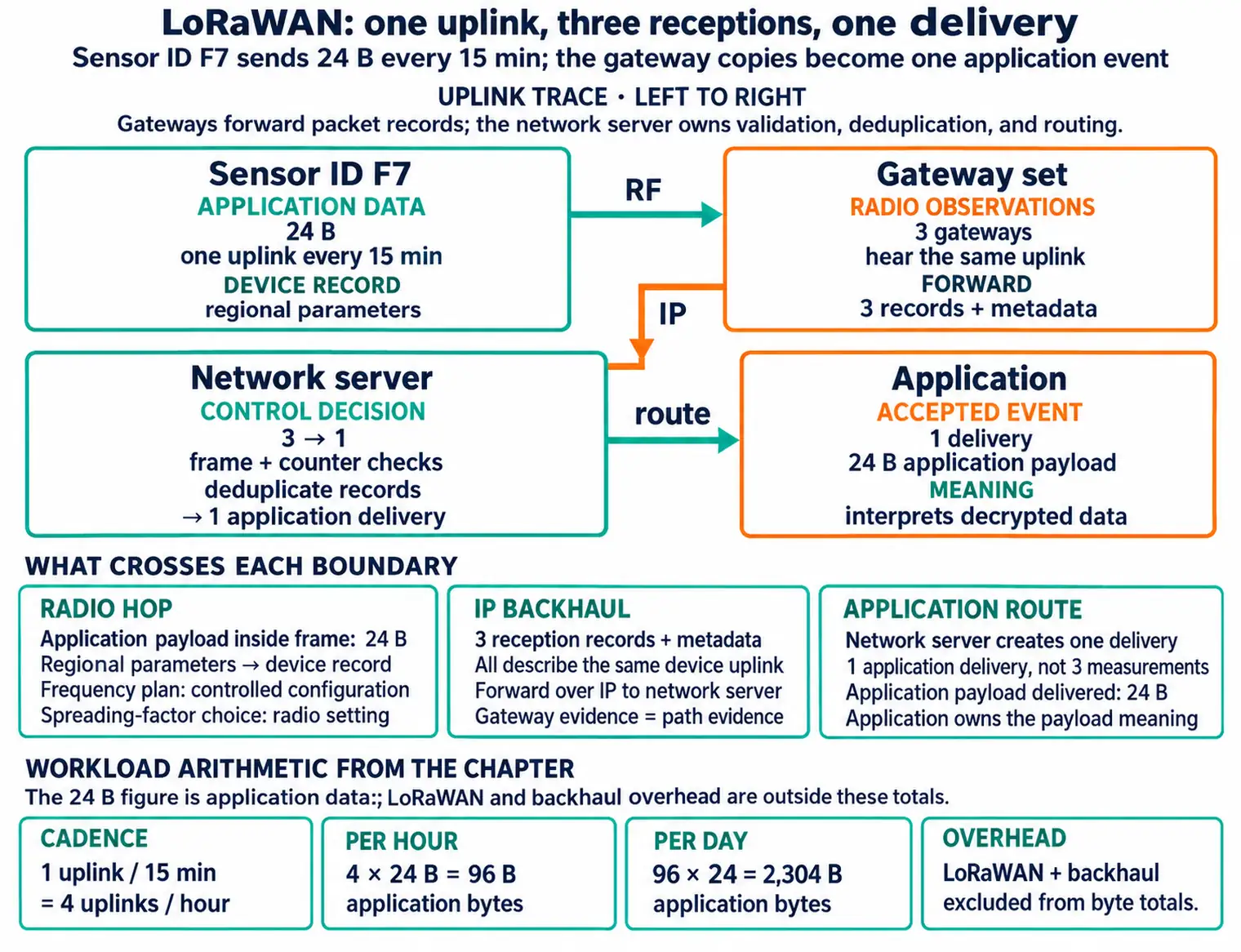
Multiple gateways may forward the same uplink; deduplication belongs above those receivers rather than in the battery device.

  • The gateway forwards radio packets and timing information.
  • The application side interprets decrypted domain fields and decides what a soil reading or alarm means.
  • Three gateways receive the same uplink and forward three reception records.
An LPWAN architecture record should track the path from device workload to radio access, network service, application boundary, and operations ownership.
iotclass.org

Major section

Track One Uplink Through the LoRaWAN Roles (continued)

That small payload does not make downlink free or immediate.

  • Receive windows, duty constraints, scheduling, coverage, and device class shape when a command can arrive.
  • A private gateway still needs network-server functions.
  • A public network still leaves the application owner responsible for payload schema, device mapping, authorization, and data handling.
iotclass.org

Major section

Start Simple

The field team can place its own network gear, buy a managed service, or use mobile service.

  • A gateway is a device or service that joins the field radio path to a wider network.
  • LoRaWAN is a low-power wide-area network in which gateways forward radio messages to a network service.
  • Those details may shift the owner.

Key terms

gateway
gateway is a device or service that joins the field radio path to a wider network.

Why it matters

This chapter starts by naming that boundary, because support, security, diagnostics, and release evidence all change when ownership changes.

iotclass.org

Major section

Start Simple (continued)

The radio path has an owner.

  • The radio with the longest paper range is not always the best design.
  • Under the Hood covers routing, downlink limits, shared air, identity, and service boundaries.
  • They do not replace installed coverage proof.
  • The field device has an owner.
iotclass.org

Major section

Overview: LPWAN Architecture Is an Ownership Decision

Low-power wide-area networks are chosen for small, infrequent messages over long distances, but the radio technology is only part of the architecture.

  • The design also decides who owns the access network, where security and routing decisions happen, how downlinks reach sleepy devices, and what evidence proves coverage at the site.
An LPWAN architecture record should track the path from device workload to radio access, network service, application boundary, and operations ownership.
iotclass.org

Major section

Overview: LPWAN Architecture Is an Ownership Decision (continued)

LoRaWAN commonly uses private, community, or operator gateways that forward radio packets to a network server.

  • Ultra-narrowband LPWAN services use operator-managed base stations and backend delivery.
  • Cellular LPWAN options such as NB-IoT and LTE-M use cellular access, subscriber identity, and mobile-network functions.
  • Local Evidence Coverage claims need site evidence.
iotclass.org

Major section

Overview: LPWAN Architecture Is an Ownership Decision (continued)

Operator LPWAN Devices use operator-managed radio access and backend services.

  • Each model changes the boundary you must review.
  • For example, a water utility might place level sensors on hilltop tanks, pressure alarms in concrete pump rooms, and valve controllers beside public roads.
  • The customer reviews integration, coverage, identity, payload limits, and continuity risk.
iotclass.org

Major section

Overview: LPWAN Architecture Is an Ownership Decision (continued)

A private LoRaWAN design can work well when the team can place gateways, secure backhaul, and operate the network-server boundary.

  • An operator LPWAN design shifts access responsibility outside the utility, so the review must focus on provider coverage, service continuity, and integration diagnostics.
  • A cellular LPWAN design changes the identity, plan, roaming, and power-mode questions.
  • Gateways forward packets to a network server that handles device state, duplicate suppression, routing, and downlink scheduling.
iotclass.org

Major section

Practitioner: Build the Boundary Record First
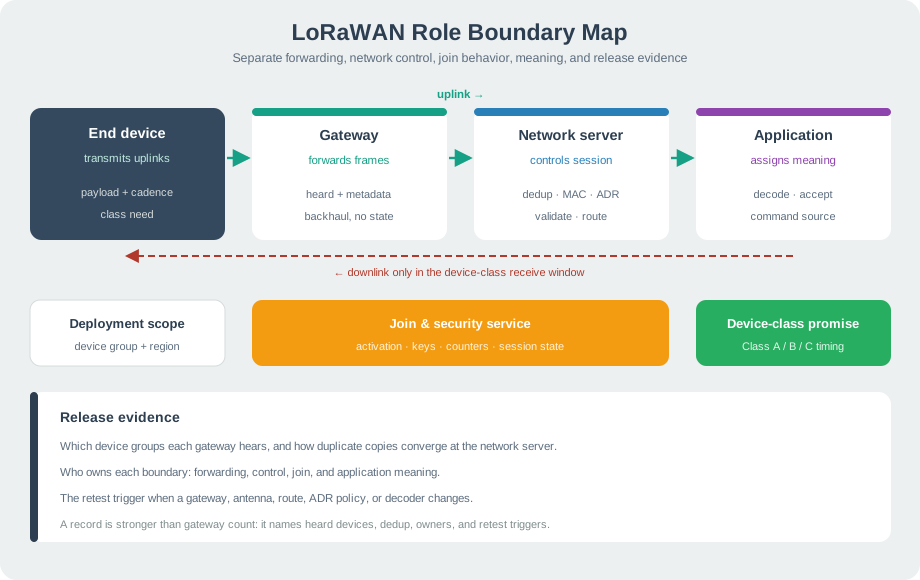
A practical LPWAN architecture record starts with roles.

  • In LoRaWAN, gateways normally forward packets and metadata; the network server owns device-session state, duplicate suppression, adaptive data-rate decisions, and downlink scheduling.
  • In operator-managed LPWAN and cellular LPWAN, more of the access and core-network behavior sits outside the project team.
Role ownership changes the evidence packet: private gateways, operator access, cellular identity, application integration, and operational handoff have different owners.
iotclass.org

Major section

Practitioner: Build the Boundary Record First (continued)

Coverage evidence, tenancy model, device activation process, data-routing policy, service limits, and support path.

  • SIM or eSIM ownership, radio coverage, power-mode tests, service plan, roaming limits, and application-path verification.
  • A small pilot should prove the path in the places where devices will actually live.
  • A gateway on a temporary mast, a hosted server trial account, and a lab SIM can all make a prototype look finished while leaving the production owner unclear.
iotclass.org

Major section

Under the Hood: Downlink Promises and Release Gates

Each family can be valid, but each family needs its own proof chain.

  • Class B and Class C can support different downlink timing, but they change power and operational assumptions.
  • Cellular LPWAN power-saving modes and operator paging behavior also need workload-specific evidence.
  • These tests turn architecture diagrams into release evidence.

Key terms

UI availability
UI availability is not delivery evidence." }, { "text": "Show gateway internet reachability but omit scheduling, class, and command result.", "correct": false, "feedback": "Not quite.
iotclass.org

Major section

Under the Hood: Downlink Promises and Release Gates (continued)

The release gate should test the exact timing path, not just the fact that a packet eventually arrives.

  • In a LoRaWAN design, that means logging the uplink that opened the receive window, the network-server scheduling decision, the gateway selected for the downlink, and the observed device response.
  • In a cellular LPWAN design, it means proving attach state, paging or power-saving behavior, operator reachability, application retry behavior, and the cost of waking the device more often.
  • In an operator-managed ultra-narrowband design, it means checking the provider callback, duplicate handling, delayed delivery, and support evidence.
iotclass.org

Deck summary

Key takeaways

Multiple gateways may forward the same uplink; deduplication belongs above those receivers rather than in the battery device.

  • That small payload does not make downlink free or immediate.
  • The field team can place its own network gear, buy a managed service, or use mobile service.
  • The radio path has an owner.
  • Low-power wide-area networks are chosen for small, infrequent messages over long distances, but the radio technology is only part of the architecture.
iotclass.org

Retrieval practice

Recall check 1 of 3

Radio Remi says: answer from memory, then check your reasoning.

Q1A reservoir-monitoring team chooses an LPWAN radio after reading a 15 km datasheet range. Devices will sit inside concrete pump rooms, on hilltop tanks, and in roadside valve cabinets that need rare downlinks. What architecture question still has to be answered before approval?

AWho owns the access path for each site class, where routing and security decisions happen
BWhether every pump-room, tank, and valve device can route through every other LPWAN device.
CWhether the application dashboard can hide duplicate or missing pump and valve messages after deployment.
DWhether the largest advertised outdoor range can be copied into the pump-room and valve-cabinet site plan.
Show answer

Answer: A LPWAN architecture review ties each installation class to ownership, gateway or operator boundary, application path, downlink limits, and site-specific evidence.

iotclass.org

Retrieval practice

Recall check 2 of 3

Radio Remi says: answer from memory, then check your reasoning.

Q2A private LoRaWAN site hears the same uplink through three gateways. Which architecture record is strongest?

AThe sensor selects one gateway before transmit, so duplicate uplinks should be excluded from the record.
BThe application dashboard receives every gateway copy and chooses the final uplink for storage.
CGateways forward copies with metadata; the network server handles session checks, duplicates, routing, and downlinks.
DThe gateway backhaul decides duplicate handling once packets reach the server over IP.
Show answer

Answer: C LoRaWAN architecture review separates stateless gateway forwarding from stateful network-server decisions.

iotclass.org

Retrieval practice

Recall check 3 of 3

Radio Remi says: answer from memory, then check your reasoning.

Q3A design promises near-real-time downlink commands to battery LoRaWAN devices but only shows successful uplink telemetry. What evidence is missing?

AUse the radio range claim plus uplink success as proof that downlink commands are ready.
BRecord device class, receive window, server scheduling, gateway path, command result, and failure behavior.
CShow the dashboard command button and skip the device receive-window evidence.
DShow gateway internet reachability but omit scheduling, class, and command result.
Show answer

Answer: B Downlink claims need evidence for the selected LPWAN architecture, device class or power mode, scheduling path, and observed result.

iotclass.org

Print reference

Answers

Answer key.

  1. A · LPWAN architecture review ties each installation class to ownership, gateway or operator boundary, application path, downlink limits, and site-specific evidence.
  2. C · LoRaWAN architecture review separates stateless gateway forwarding from stateful network-server decisions.
  3. B · Downlink claims need evidence for the selected LPWAN architecture, device class or power mode, scheduling path, and observed result.
iotclass.org