LoRa & LoRaWAN · Study deck
LoRaWAN vs LPWAN Alternatives
A farm's far field sits behind a ridge.
Radio Remi is your guide for this deck.

After studying this chapter
Learning objectives
You will be able to:
- Explain: A technology is ready only when the operations team can explain how it will detect missing data, diagnose the responsible boundary, and revisit the choice after site, device, payload, policy, or provider changes.
- Explain: It should be compared with cellular LPWAN options such as NB-IoT and LTE-M, and with ultra-narrowband managed-service models, by asking which path has evidence for the actual deployment.
- Explain: LoRaWAN might fit the fixed probes when the team can place gateways and collect link evidence, while a cellular LPWAN path may fit moving assets that leave the property.
Major section
Start Simple
A gateway is the unit that receives nearby device messages and passes them to the wider service.
- Its site and owner can decide whether the path works.
- A rare valve command must also get back to them.
- The sites are far apart, mains power is absent, and one field sits behind a hill.
Major section
Start Simple (continued)
LoRaWAN is one kind of low-power wide area network, not a name for every such network.
- Long range does not promise coverage, large messages, quick replies, movement support, or low operating cost in every place.
- For Practitioner work, use the evidence matrix and release record below.
- A path that cannot reach the worst field is out.
Major section
Start Simple (continued)
For Under the Hood work, follow the message, link, and network limits named by the technical chapters in See Also.
- A path that cannot send the needed reply in time is out.
- A path that breaks a local rule is out.
- Price, speed, or a good brand cannot score away a hard fail.
Major section
Start Simple (continued)
A private LoRaWAN path needs sites, gateways, backhaul, keys, updates, and support.
- It also adds a contract, plan, coverage map, and change risk.
- A small daily reading and an urgent valve command may need different proof.
- A tracker may cross gateway or provider areas.
- More paths can improve reach, but they also add keys, cost, state, and support work.
Major section
Start Simple (continued)
A fixed farm test does not prove a city asset tag, and a city drive does not prove a deep indoor meter.
- Reopen it after a new site, payload, reply need, network rule, provider, gateway, or battery.
- A fixed farm sensor, a city asset tag, and a rare valve command may point to different answers.
- This comparison starts by splitting the workload, then checks coverage, ownership, power, mobility, downlink, security, and support evidence for each candidate.
Major section
Overview: Compare Evidence, Not Labels
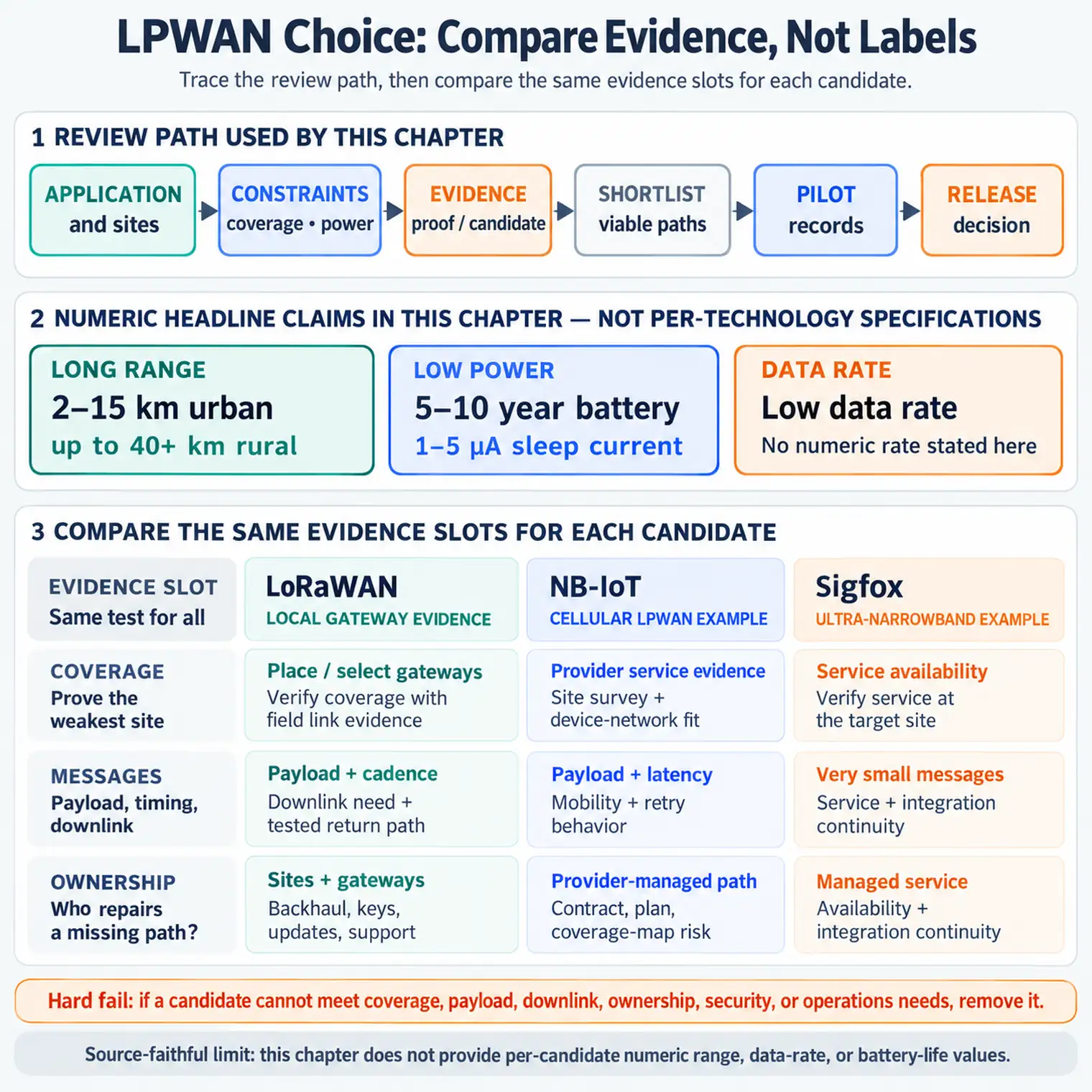
LoRaWAN is one LPWAN path, not the automatic answer.
- It should be compared with cellular LPWAN options such as NB-IoT and LTE-M, and with ultra-narrowband managed-service models, by asking which path has evidence for the actual deployment.
- The useful comparison is not a generic ranking.
- That split keeps the recommendation honest.
Major section
Overview: Compare Evidence, Not Labels (continued)
The comparison record should therefore split the device groups before it chooses a label.
- For example, one project may include fixed soil probes, mobile asset tags, and rare valve commands.
- The valve commands need their own downlink-timing proof.
- If the only evidence is a provider coverage map, it cannot prove a buried sensor.
Major section
Overview: Compare Evidence, Not Labels (continued)
LoRaWAN might fit the fixed probes when the team can place gateways and collect link evidence, while a cellular LPWAN path may fit moving assets that leave the property.
- If the only evidence is a private gateway test, it cannot prove roaming.
- If the only evidence is one uplink, it cannot prove downlink service or incident response.
- Cellular LPWAN Strongest when provider-managed connectivity, service evidence, mobility support, and contracted operations match the application.
Major section
Overview: Compare Evidence, Not Labels (continued)
LoRaWAN Strongest when the team can place or select gateways, verify coverage, manage network profiles, and own enough operational evidence.
- Ultra-narrowband service Strongest only when very small message behavior, service availability, and integration continuity are verified.
- Hybrid Valid when site classes, device classes, mobility, ownership, or message criticality differ enough that one LPWAN path is weaker than two bounded paths.
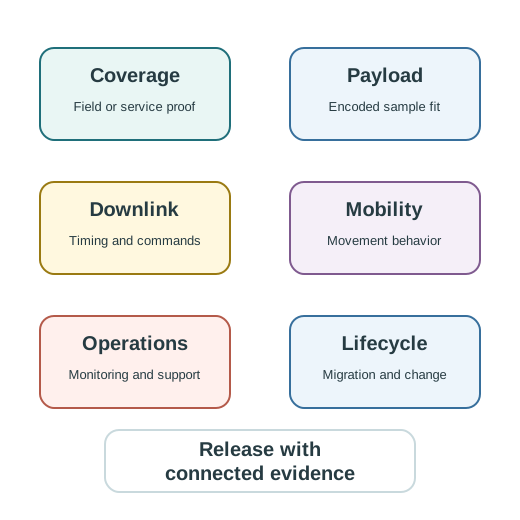
- If a candidate cannot satisfy coverage, payload, downlink, ownership, security, or operations requirements in the target environment, do not keep it just because the technology name is familiar.
Major section
Practitioner: Shortlist by Hard Constraints
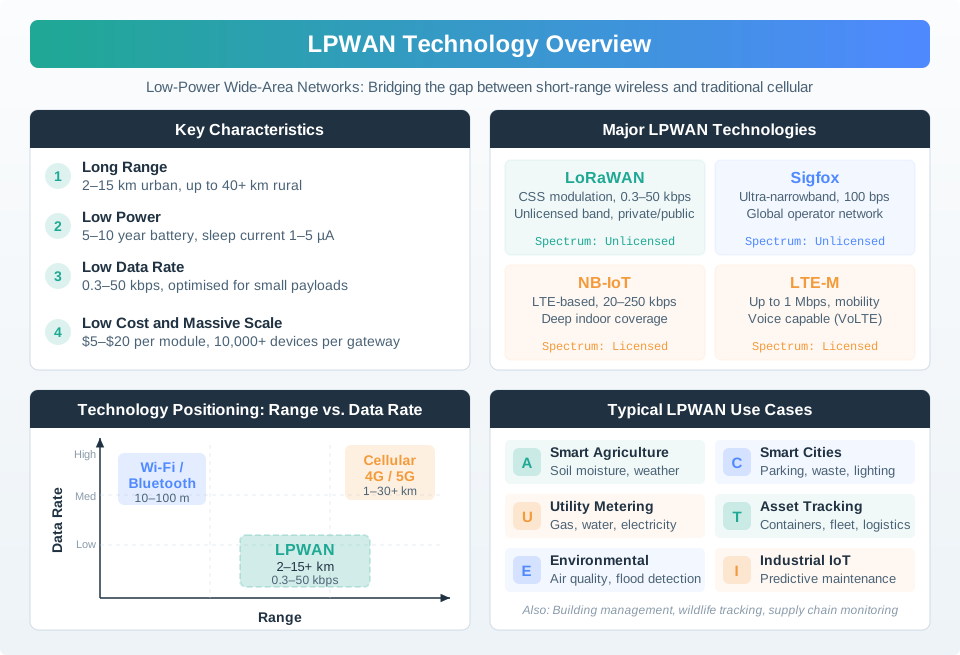
A defensible shortlist separates technology capability from service availability and operations.
- LoRaWAN can be a good candidate when gateway placement, network-server routing, device profiles, and application ownership are under review.
- Cellular LPWAN can be a good candidate when provider coverage, module support, mobility, roaming, and service operations are part of the evidence record.
Major section
Practitioner: Shortlist by Hard Constraints (continued)
A candidate without a row is not "still possible"; it is unproven for this decision.
- When two candidates survive, do not force a premature winner.
- Provider service evidence, site survey, module behavior, and operational support boundary.
- Uplink cadence, payload size, downlink need, device class, duty-cycle constraints, and ADR behavior.
Major section
Under the Hood: Release Records Beat Generic Rankings
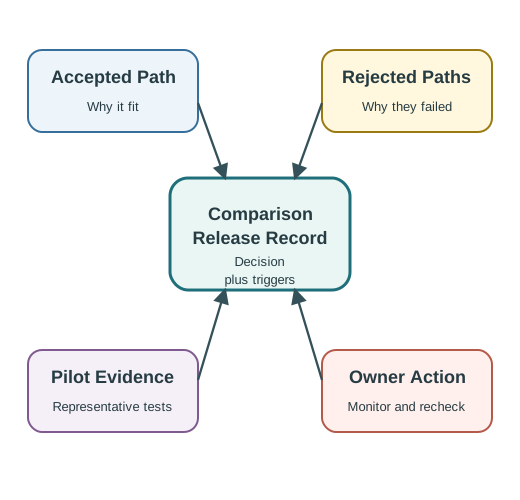
LPWAN comparison becomes risky when a team treats the candidate list as a scoreboard.
- The release record should state assumptions, exceptions, pilot limits, unresolved risks, rollback path, and recheck triggers.
- The hard part is that many failures look identical at the dashboard.
- A generic ranking cannot route that work.
Major section
Under the Hood: Release Records Beat Generic Rankings (continued)
The release record must say which boundary owns each symptom and which evidence proves that boundary is healthy.
- A technology is ready only when the operations team can explain how it will detect missing data, diagnose the responsible boundary, and revisit the choice after site, device, payload, policy, or provider changes.
- It also has to protect the future choice.
- Without that record, the same shortlist gets reused after its assumptions have expired.
Major section
Compare the Cost of Owning the Hilltop Receiver
That small count does not settle the choice: the gateway location may cost more to operate than the data service.
- The private gateway path has £600 of backhaul and power costs, plus two £150 maintenance visits, totalling £900.
- The £60 gap is too narrow to justify selection without coverage, lifecycle and service evidence.
Major section
Compare the Cost of Owning the Hilltop Receiver (continued)
A managed alternative priced at £12 per device per year would cost 80 × £12 = £960 before any installation or exception fees.
- The gateway and subscription costs here are classroom assumptions, not market prices.
- The LoRaWAN candidate needs an installed gateway and a tested return path.
- The alternatives need equally concrete service evidence; a coverage map cannot stand in for a message from the far field.
Major section
Compare the Cost of Owning the Hilltop Receiver (continued)
Its lower cost would not cure that hard failure.
- The alternatives should be rejected or assigned only to the delay-tolerant probes.
- Combining LoRaWAN with a backup path adds credentials, state and a rule for recognizing duplicate readings.
- A useful selection makes that work visible beside payload, energy and timing.
Deck summary
Key takeaways
A gateway is the unit that receives nearby device messages and passes them to the wider service.
- LoRaWAN is one kind of low-power wide area network, not a name for every such network.
- For Under the Hood work, follow the message, link, and network limits named by the technical chapters in See Also.
- A private LoRaWAN path needs sites, gateways, backhaul, keys, updates, and support.
- A fixed farm test does not prove a city asset tag, and a city drive does not prove a deep indoor meter.
Retrieval practice
Recall check 1 of 3

Radio Remi says: answer from memory, then check your reasoning.
Q1A farm operator wants battery soil probes in low fields, pallet trackers that leave the property, and rare valve downlinks. The team says LoRaWAN is best because it is low power and long range. What should the reviewer ask for first?
Show answer
Answer: B LPWAN comparison starts with the behavior of each device group, the ownership boundary, and observed evidence from the actual deployment.
Retrieval practice
Recall check 2 of 3

Radio Remi says: answer from memory, then check your reasoning.
Q2A campus can install gateways and wants local coverage logs, routing control, and application integration ownership. Which candidate deserves first review?
Show answer
Answer: C LoRaWAN is a strong first candidate when local gateway and network evidence are central, but it still needs a pilot record.
Retrieval practice
Recall check 3 of 3

Radio Remi says: answer from memory, then check your reasoning.
Q3When is a hybrid LPWAN design more defensible than forcing every device onto one technology?
Show answer
Answer: D Hybrid LPWAN designs need explicit boundaries, owner decisions, and release evidence for each path.
Print reference
Answers
Answer key.
- B · LPWAN comparison starts with the behavior of each device group, the ownership boundary, and observed evidence from the actual deployment.
- C · LoRaWAN is a strong first candidate when local gateway and network evidence are central, but it still needs a pilot record.
- D · Hybrid LPWAN designs need explicit boundaries, owner decisions, and release evidence for each path.