LoRa & LoRaWAN · Study deck

Practice: LoRaWAN Simulation

Picture a field meter that sends one reading during a desk test.

Radio Remi is your guide for this deck.

simulation
iotclass.org

After studying this chapter

Learning objectives

You will be able to:

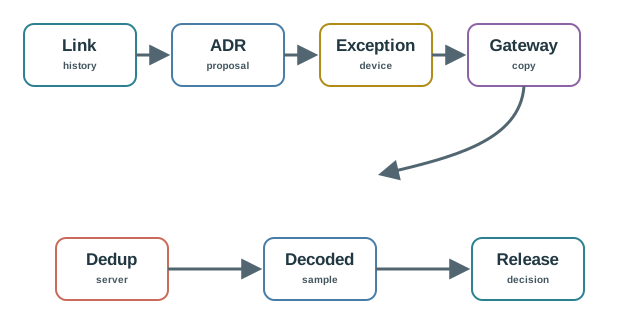
  • Explain: That path is evidence for LoRaWAN ADR and duplicate-copy simulation check showing link history, ADR proposal, exception device, gateway copy, deduplication, decoded sample, and release decision; retain it when revisiting the “history”–“adr” decision.
  • Explain: The record appears on screen, yet no one knows whether a second receiver heard it, whether the reply window opened, or whether the value still means the same thing after decoding.
  • Explain: Another reviewer should be able to see why the claim passed, why a broader claim did not pass, and which owner has to collect the next record.
iotclass.org

Major section

Start Simple

The record appears on screen, yet no one knows whether a second receiver heard it, whether the reply window opened, or whether the value still means the same thing after decoding.

  • A neat trace is only the start of the review.
  • LoRaWAN means Long Range Wide Area Network, a system for small messages over long radio links.
  • A gateway is a device that hears those radio messages and passes them onward.
iotclass.org

Major section

Start Simple (continued)

A payload is the useful data carried inside a message.

  • A simulation cannot prove range, interference, battery life, or local installation quality.
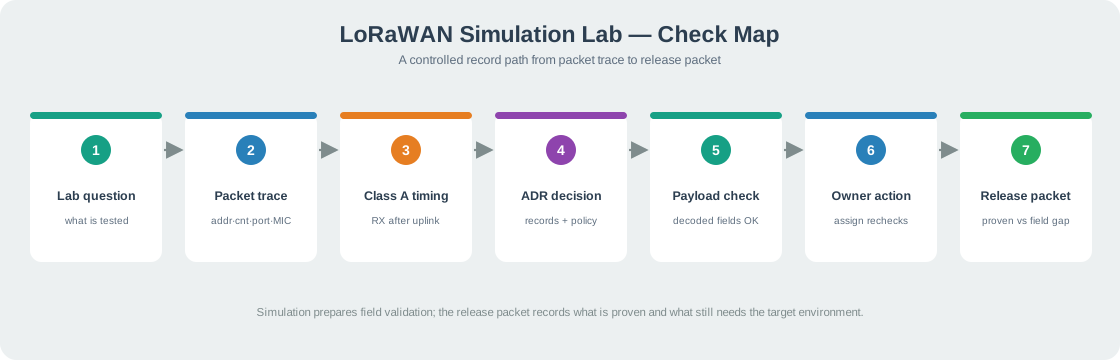
  • The deeper lab steps show how timing records, duplicate handling, decoded values, and release checks turn the rehearsal into a bounded evidence plan.
  • A simulated packet trace is not field proof, but it can teach the habit of asking what each record shows and what it leaves unproven.
iotclass.org

Major section

In 60 Seconds

This lab uses simulated LoRaWAN records instead of an external emulator.

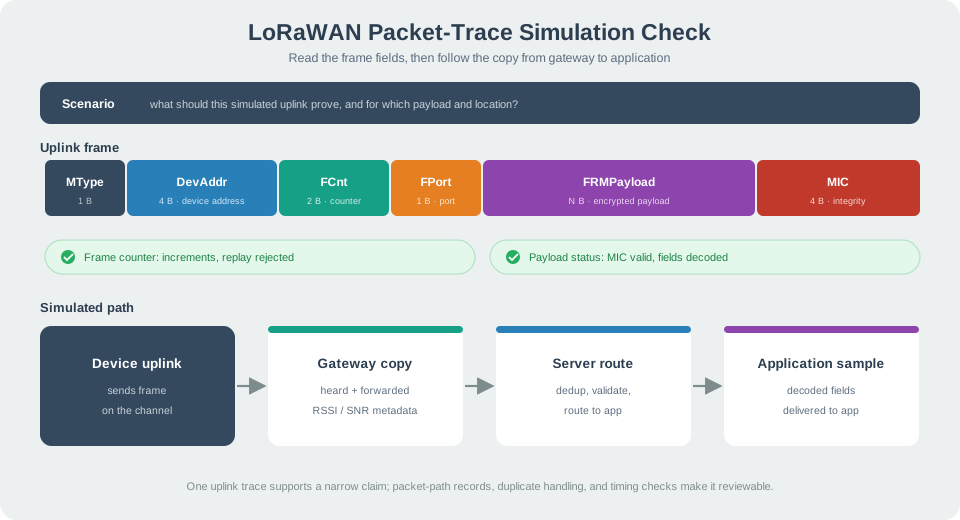
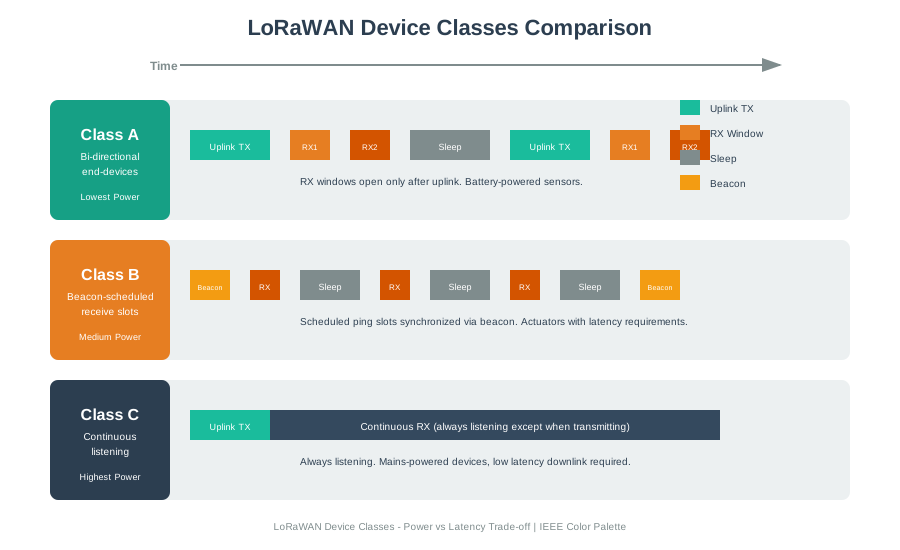
  • You will inspect packet traces, Class A receive timing, ADR decisions, duplicate gateway copies, decoded payload samples, and security symptoms.
  • The goal is not to build a radio stack.
  • The goal is to learn how an operator decides whether simulated records are meaningful enough to prepare for field validation.
iotclass.org

Major section

Lab 3: ADR And Duplicate-Copy Check

ADR and duplicate-copy handling are easier to understand in simulation, but the check still needs clear records and boundaries.

  • From “proposal”, it arrives at “Exception”.
  • That path is evidence for LoRaWAN ADR and duplicate-copy simulation check showing link history, ADR proposal, exception device, gateway copy, deduplication, decoded sample, and release decision; retain it when revisiting the “history”–“adr” decision.
LoRaWAN ADR and duplicate-copy simulation check showing link history, ADR proposal, exception device, gateway copy, deduplication, decoded sample, and release decision.

Try it: Lab 3: ADR And Duplicate-Copy Check in the chapter

iotclass.org

Major section

Overview: Simulation Is A Bounded Proof
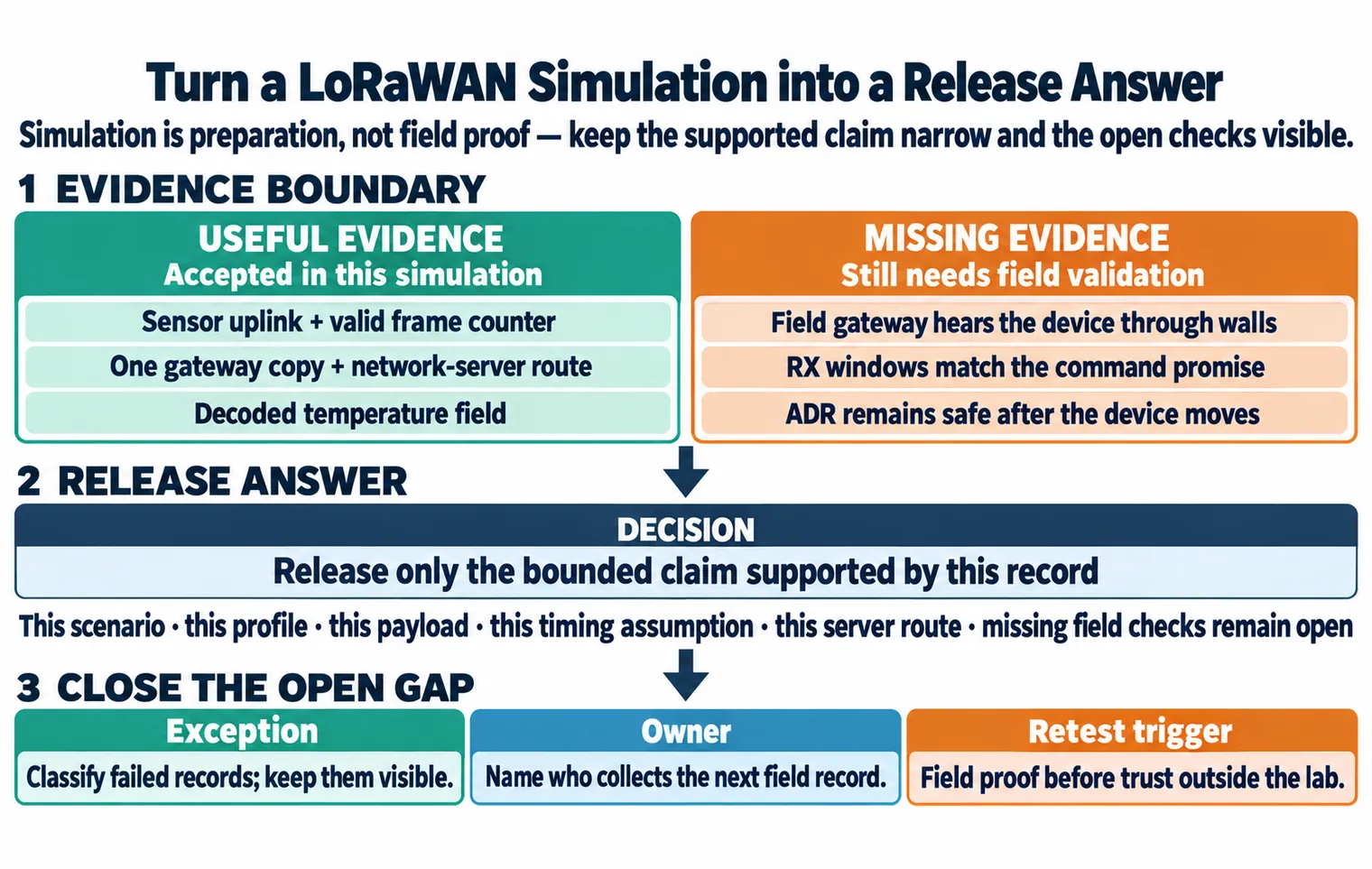
A LoRaWAN simulation lab is useful when it proves one narrow claim and records the boundary around that claim.

  • For example, a desk simulation may show a sensor uplink, a valid frame counter, one gateway copy, a network-server route, and a decoded temperature field.

Key terms

If those pieces
If those pieces are absent, the simulation may still be a good exercise, but it is not yet a release record.
Simulation evidence becomes usable when the release answer separates accepted proof from missing field checks, exceptions, owners, and retest triggers.

Try it: Overview: Simulation Is A Bounded Proof in the chapter

iotclass.org

Major section

Practitioner: Write The Replayable Lab Record

The lab record should let another reviewer replay the decision without rerunning the exercise.

  • Another reviewer should be able to see why the claim passed, why a broader claim did not pass, and which owner has to collect the next record.
  • When a record fails, preserve the failure instead of rewriting the scenario until it looks clean.
  • Tie ADR changes to link history, exception devices, and rollback rules.
  • Worked Record: Missed Downlink In A Good Uplink Test The device sends an uplink and the application decodes the payload, but a command is missed.

Try it: Practitioner: Write The Replayable Lab Record in the chapter

iotclass.org

Major section

Under The Hood: Simulation Can Hide Coupled Failures

A payload-size change can affect airtime, data-rate fit, ADR decisions, duty pressure, downlink capacity, decoder versioning, and field support.

  • A simulation that checks only one layer can miss the coupling that matters in production.
  • If ADR then lowers spreading factor for fixed devices, moving or obstructed devices can become exceptions.
  • If the product also promises operator commands, the extra uplinks can change when downlinks are queued and whether the device is listening.
  • Security and state can hide the same kind of coupling.

Try it: Under The Hood: Simulation Can Hide Coupled Failures in the chapter

iotclass.org

Deck summary

Key takeaways

The record appears on screen, yet no one knows whether a second receiver heard it, whether the reply window opened, or whether the value still means the same thing after decoding.

  • A payload is the useful data carried inside a message.
  • This lab uses simulated LoRaWAN records instead of an external emulator.
  • ADR and duplicate-copy handling are easier to understand in simulation, but the check still needs clear records and boundaries.
  • A LoRaWAN simulation lab is useful when it proves one narrow claim and records the boundary around that claim.
iotclass.org

Retrieval practice

Recall check 1 of 6

Radio Remi says: answer from memory, then check your reasoning.

Q1A simulation shows one LoRaWAN uplink reaching the application decoder. What record makes that result useful for a release decision?

AApprove once the decoder shows one expected payload field from the device.
BRecord scenario, profile, path, decode, timing, ADR basis, owner, and limits.
CUse one uplink or coverage point as proof for every payload, location, gateway path, class behavior, and downlink need.
DLeave regional settings, ADR, join custody, and owner response records until after deployment.
Show answer

Answer: B LoRaWAN simulation evidence should connect trace fields, gateway and server routing, join or activation context, Class A timing, ADR or link-budget assumptions, application decoding, and explicit field-validation limits.

iotclass.org

Retrieval practice

Recall check 2 of 6

Radio Remi says: answer from memory, then check your reasoning.

Q2A simulation shows uplinks arriving, then states commands will arrive whenever operators send them. What is missing?

ANothing, because uplinks and commands use the same radio record.
BOnly a cleaner timeline graphic for the operator dashboard.
CAn assertion that the gateway can wake sleeping Class A devices.
DClass A windows, queue status, fallback, owner, and recheck trigger.
Show answer

Answer: D Uplink success does not prove downlink command timing.

iotclass.org

Retrieval practice

Recall check 3 of 6

Radio Remi says: answer from memory, then check your reasoning.

Q3A simulation receives one uplink through two gateways. What should the network-server record show?

ABoth gateway copies become separate application records for the same event.
BRecognize duplicates, deliver one record, and select downlink path if needed.
CBoth copies are rejected because duplicate reception means failure.
DThe application chooses which gateway heard the packet after both copies arrive.
Show answer

Answer: B Duplicate gateway copies are expected in LoRaWAN and should be merged before application delivery.

iotclass.org

Retrieval practice

Recall check 4 of 6

Radio Remi says: answer from memory, then check your reasoning.

Q4Place each LoRaWAN simulation responsibility where it lives so you can separate the scenario and trace from Class A or ADR reasoning and an owned release packet.

ALab Question and Scenario
BPacket Trace Capture
CADR and Payload Decision
DOwner Release Packet
Show answer

Answer: A The simulation lab is reviewable when its question produces a versioned packet trace, timing and ADR decisions stay scoped to the model, and an owner records what still needs field proof.

iotclass.org

Retrieval practice

Recall check 5 of 6

Radio Remi says: answer from memory, then check your reasoning.

Q5A learner finishes a simulated LoRaWAN uplink test. What makes the result a bounded proof instead of a vague success claim?

AThe record states that LoRaWAN works because one simulated packet arrived.
BIt names scenario, trace fields, decoded result, missing records, and field boundary.
CThe record removes failure cases so the lab stays simple.
DThe record waits until deployment to name owners and limits.
Show answer

Answer: B A bounded simulation proof records exactly what was checked and what remains outside the simulation.

iotclass.org

Retrieval practice

Recall check 6 of 6

Radio Remi says: answer from memory, then check your reasoning.

Q6A simulated payload decode passes, but the product team later adds fields and changes reporting cadence. What hidden coupling should the release record force reviewers to recheck?

AOnly whether the old screenshot and previous dashboard labels still exist.
BNothing, because application fields cannot change airtime, retries, or release evidence.
CPayload fit, data rate, ADR, duty pressure, decoder version, and retest owner.
DOnly gateway color-coding and the dashboard legend after the payload change.
Show answer

Answer: C Simulation must preserve cross-layer couplings so later payload, cadence, activation, and ownership changes trigger retest.

iotclass.org

Print reference

Answers 1 of 2

Answer key.

  1. B · LoRaWAN simulation evidence should connect trace fields, gateway and server routing, join or activation context, Class A timing, ADR or link-budget assumptions, application decoding, and explicit field-validation limits.
  2. D · Uplink success does not prove downlink command timing.
  3. B · Duplicate gateway copies are expected in LoRaWAN and should be merged before application delivery.
iotclass.org

Print reference

Answers 2 of 2

Answer key.

  1. A · The simulation lab is reviewable when its question produces a versioned packet trace, timing and ADR decisions stay scoped to the model, and an owner records what still needs field proof.
  2. B · A bounded simulation proof records exactly what was checked and what remains outside the simulation.
  3. C · Simulation must preserve cross-layer couplings so later payload, cadence, activation, and ownership changes trigger retest.
iotclass.org