LoRa & LoRaWAN · Study deck
LoRaWAN Field Deployment
A soil-sensor trial covers an open orchard row and a low corner behind a metal shed.
Radio Remi is your guide for this deck.
After studying this chapter
Learning objectives
You will be able to:
- Explain: Missing uplinks after a firmware update, for example, should be checked through profile and channel records, gateway hearing, activation state, network-server routing, and application ingestion in that order.
- Explain: A citywide public testbed's coverage gradient does not prove a private single-building deployment's field strength, and a three-gateway campus plan does not prove citywide capacity.
- Explain: A LoRaWAN field deployment is ready only when the radio plan, regional profile, gateway path, activation path, application integration, monitoring plan, and fallback owner have been checked together.
- align LoRaWAN regional profiles with gateway and server plans
Major section
Start Simple
One unit sends a message beside the office.
- That proves a narrow bench path, not the final fields, power life, warning delay, or support plan.
- This low-power wide-area radio system carries small messages.
- When an antenna, site receiver, region setting, or device version changes, reopen only the affected checks.
- The field map should show both proof and limits.
Major section
Start Simple (continued)
Under the Hood explains airtime, channel rules, adaptive rates, joins, and delayed downlinks.
- The release owner should name the exact device group, software version, radio region, site receivers, message rate, join method, application route, and person who responds to failure.
- Hand the record to the support owner before release.
- Or keep the group in trial.
Major section
Start Simple (continued)
Leave a clear list of open places and conditions so the pilot result is not sold as a wider promise.
- Fix any step that depends on the original designer being present.
- This simple release rule cannot promise radio coverage everywhere.
- A deployment is ready when the tested path matches the real place and promise.
Major section
Overview: Deployment Is a Release Decision
A good deployment record keeps those promises narrow.
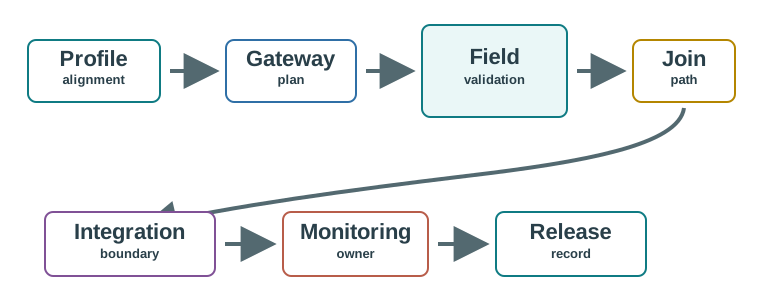
- A LoRaWAN field deployment is ready only when the radio plan, regional profile, gateway path, activation path, application integration, monitoring plan, and fallback owner have been checked together.
- It also records what was not proven.
- That narrowness protects the next maintainer.
Major section
Overview: Deployment Is a Release Decision (continued)
A coverage sketch or a single successful uplink can support a narrow observation, but neither one proves a release-ready deployment.
- The deployment record should say what was tested, where it was tested, which assumptions remain open, and what change reopens the decision.
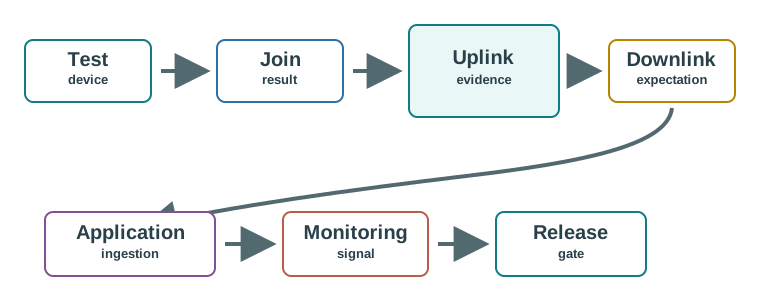
- The deployment question is not "did one packet arrive?" It is "does the tested path match the actual place, firmware, region, gateway, server, application, and support promise?".
- It names the device group, installation condition, firmware build, gateway set, join method, payload cadence, expected downlink behavior, application route, monitoring signal, and support owner.
Major section
Practitioner: Build the Field Evidence Chain
When a record is missing, avoid jumping to a later layer.
- For example, application debugging is premature if the gateway has not shown that it hears the device.
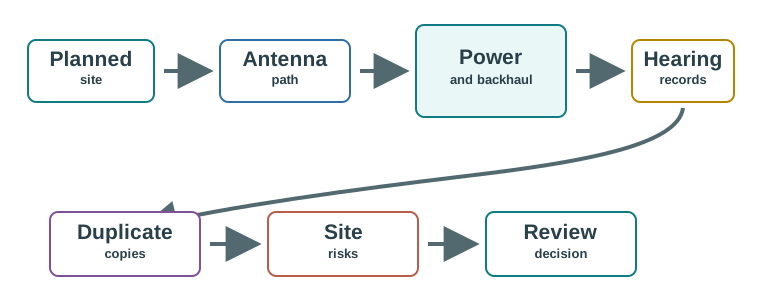
- A practical review can use one representative installation as a trace.
- If any field is blank, the release statement should be scoped down or held.
Major section
Practitioner: Build the Field Evidence Chain (continued)
Firmware, profile, gateway, or operator-policy change.
- Site, antenna path, power, backhaul, hearing records, and duplicate-copy behavior.
- Gateway move, antenna change, new obstruction, backhaul change, or coverage complaint.
- Firmware, payload cadence, device class, ADR, or installation change.
- Payload version, decoder, endpoint, storage, or owner change.
Major section
Practitioner: Build the Field Evidence Chain (continued)
Gateway Map CheckA gateway map is planning context.
- A university campus deployment shows the same discipline at a smaller, private-network scale.
- Neither example is release evidence for a different site.
- A citywide public testbed's coverage gradient does not prove a private single-building deployment's field strength, and a three-gateway campus plan does not prove citywide capacity.
Major section
Under the Hood: Troubleshoot by Surface, Then Recheck
This surface-first habit also protects escalation.
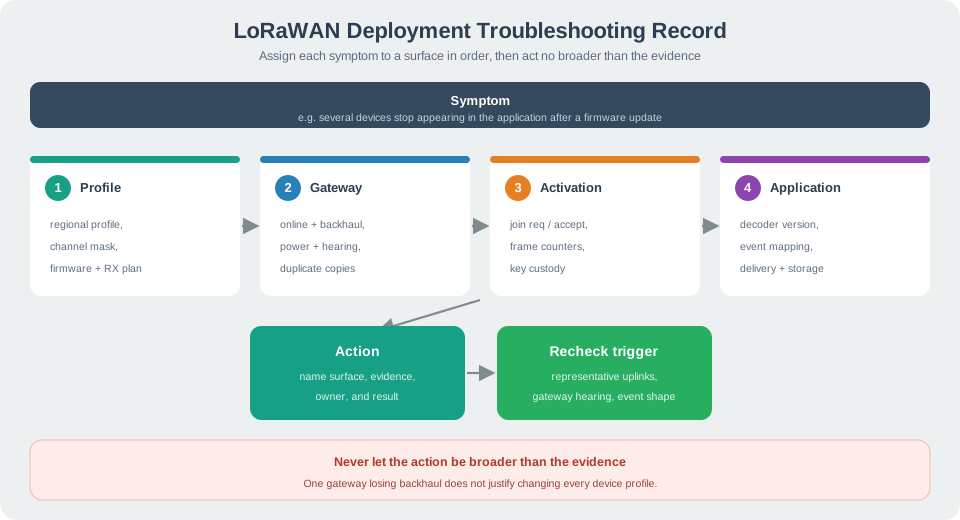
- LoRaWAN deployment failures are easier to diagnose when each symptom is assigned to an evidence surface before action is taken.
- Acting on the last visible layer first can waste time and hide the real release risk.
- A profile repair in one region does not prove another region.
Major section
Under the Hood: Troubleshoot by Surface, Then Recheck (continued)
Missing uplinks after a firmware update, for example, should be checked through profile and channel records, gateway hearing, activation state, network-server routing, and application ingestion in that order.
- Each action should name the surface, evidence, owner, result, and recheck trigger.
- If the team changes a channel mask, the recheck is representative uplinks through the intended gateway set.
- If it moves an antenna, the recheck is gateway hearing and duplicate-copy behavior.
Major section
Under the Hood: Troubleshoot by Surface, Then Recheck (continued)
If it changes a decoder, the recheck is application event shape, storage result, and owner acceptance.
- The record prevents "fixed" from meaning only "not currently visible.".
- It also prevents one local repair from becoming an unreviewed fleet-wide policy.
- A restored integration endpoint does not prove downlink timing.
Major section
Under the Hood: Troubleshoot by Surface, Then Recheck (continued)
The order matters because the same symptom can be produced by several layers.
- Replacing devices or rewriting the application is not justified until the earlier surfaces are checked.
- A successful retest on one bench device does not prove the field fleet.
- If only one gateway lost backhaul, do not change every device profile.
Major section
Under the Hood: Troubleshoot by Surface, Then Recheck (continued)
The troubleshooting outcome should update the release record with the evidence that changed, the cases still outside proof, and the next condition that forces a new review.
- A useful rule is to never let the action be broader than the evidence.
- If only a decoder rejected a new payload field, do not weaken activation checks.
- If only a region profile was wrong, do not call the radio plan failed.
Major section
Release the Orchard Rows One Coverage Class at a Time
Nine deliver all 20; the low-corner unit delivers 10.
- The fleet total is 9 × 20 + 10 = 190 accepted readings out of 200, or 95%.
- For the weak location, delivery is only 10 divided by 20 = 50%.
- The release cannot substitute the fleet average for that unit's result.
Major section
Release the Orchard Rows One Coverage Class at a Time (continued)
The open-row group has one evidence set; the obstructed corner has another.
- A revised antenna position or an additional receiving site should be tested with the final enclosure and the same reporting workload.
- The early configuration check confirms that the trial uses the intended regional profile.
- Field hearing records then establish the radio path, and application records establish that accepted readings reach the right soil plot.
Major section
Release the Orchard Rows One Coverage Class at a Time (continued)
Neither record can replace the other.
- Late field readings repair history, but cannot retroactively provide timely irrigation control.
- The release record needs the oldest useful reading age as well as the eventual delivery count.
- It must not label the whole orchard covered while quietly omitting the failed location.
Deck summary
Key takeaways
One unit sends a message beside the office.
- Under the Hood explains airtime, channel rules, adaptive rates, joins, and delayed downlinks.
- Leave a clear list of open places and conditions so the pilot result is not sold as a wider promise.
- A good deployment record keeps those promises narrow.
- A coverage sketch or a single successful uplink can support a narrow observation, but neither one proves a release-ready deployment.
Retrieval practice
Recall check 1 of 3

Radio Remi says: answer from memory, then check your reasoning.
Q1A LoRaWAN installation has one successful uplink from one test device. What conclusion is safest?
Show answer
Answer: A LoRaWAN release readiness requires evidence across profile, gateway, field, integration, and operations boundaries.
Retrieval practice
Recall check 2 of 3
Radio Remi says: answer from memory, then check your reasoning.
Q2A gateway plan shows ideal locations on a map but no field measurements. What evidence should block release until it exists?
Show answer
Answer: B Gateway plans need field records for hearing, backhaul, power, duplicate paths, and fallback behavior.
Retrieval practice
Recall check 3 of 3
Radio Remi says: answer from memory, then check your reasoning.
Q3After a firmware update, several devices stop appearing in the application. Which troubleshooting order is strongest?
Show answer
Answer: B Deployment troubleshooting should follow the evidence path from profile and gateway records through activation, server routing, and application ingestion.
Print reference
Answers
Answer key.
- A · LoRaWAN release readiness requires evidence across profile, gateway, field, integration, and operations boundaries.
- B · Gateway plans need field records for hearing, backhaul, power, duplicate paths, and fallback behavior.
- B · Deployment troubleshooting should follow the evidence path from profile and gateway records through activation, server routing, and application ingestion.