LoRa & LoRaWAN · Study deck
LoRa Modulation and Spreading Factors
Picture a field sensor whose short message barely reaches the receiver.
Radio Remi is your guide for this deck.

After studying this chapter
Learning objectives
You will be able to:
- "Explain LoRa chirp spread spectrum, spreading factor, and symbol-time tradeoffs"
- "Connect bandwidth, coding rate, payload, and retries to airtime evidence"
- "Write bounded modulation review records with link evidence and retest triggers"
- "Evaluate when ADR can own data-rate changes and when manual boundaries are safer"
Major section
Start Simple
Making the radio easier to hear may keep it on air much longer, which costs energy and shared channel time.
- The first comparison changes one setting and measures both effects.
- Bandwidth means the range of radio frequencies used to carry a signal.
- Modulation means changing a radio signal over time to carry information.
Major section
Start Simple (continued)
A payload means the useful reading or command inside a message.
- Weaken the path, repeat the packet, change one setting, and restart the receiver.
- This runway does not prove coverage, legal compliance, or fleet capacity from one bench link.
- The deeper sections explain chirps, spreading, coding, data rate, airtime, sensitivity, regional limits, and measured trade-offs.
Major section
Overview: LoRa Modulation Turns Radio Settings Into Airtime Evidence
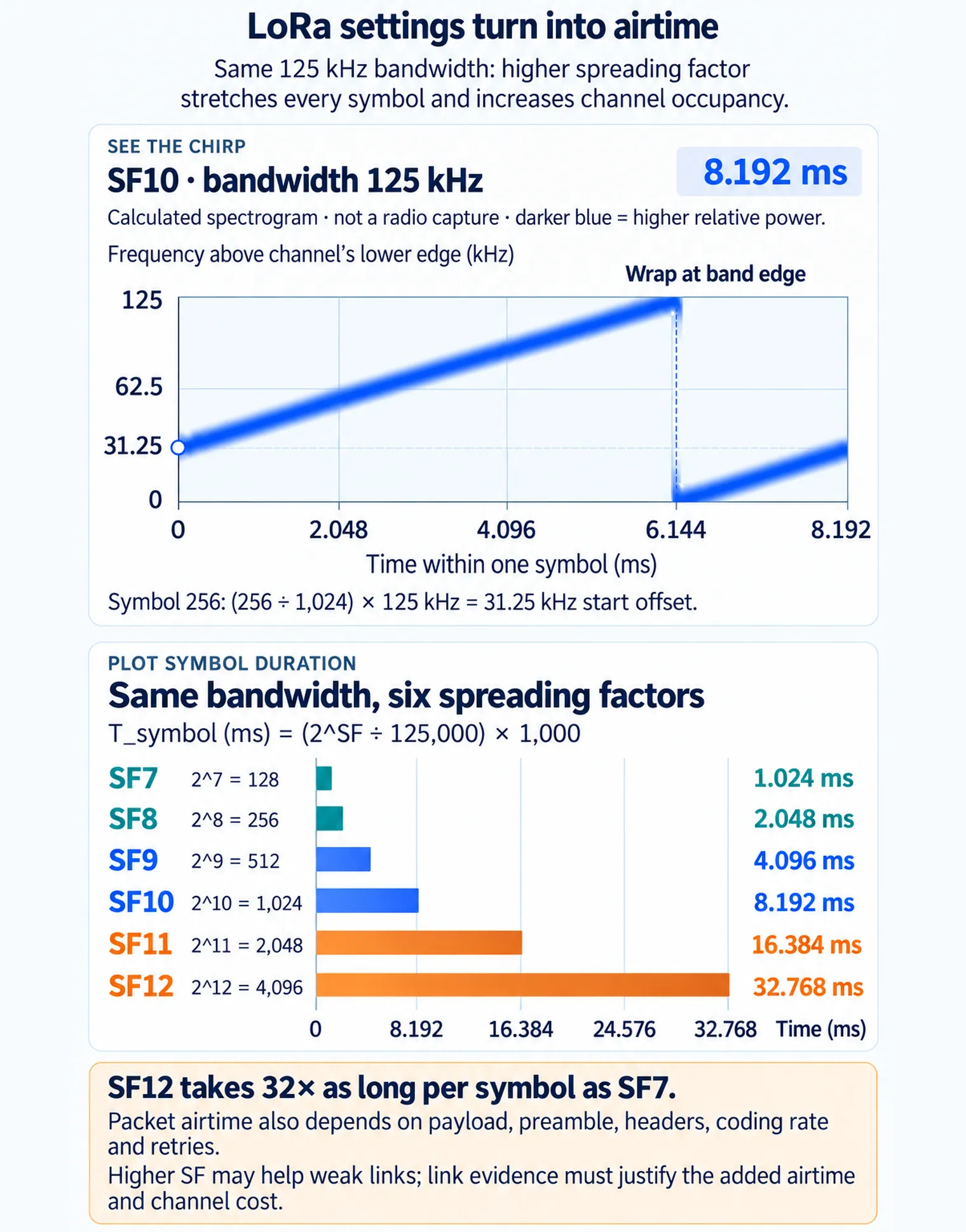
LoRa is the physical radio modulation used by LoRaWAN.
- LoRaWAN adds the network behavior around that radio, but modulation review starts with radio settings, payload size, observed link evidence, and time on air.
- The beginner mistake is choosing the highest spreading factor by habit.
- A simple scale check keeps the tradeoff concrete.
Major section
Overview: LoRa Modulation Turns Radio Settings Into Airtime Evidence (continued)
At SF12 it is about 32.768 ms, or 32 times longer before payload, preamble, header, coding-rate, and retry details are counted.
- Higher spreading factors can help weak links, but they also keep the channel occupied longer.
- Spreading Factor Controls symbol duration.
- Bandwidth Defines the channel span used by the chirp.
Major section
Overview: LoRa Modulation Turns Radio Settings Into Airtime Evidence (continued)
A defensible choice records why the setting fits the device group, message schedule, gateway evidence, regional profile, and ADR handoff.
- If you only need the intuition, this layer is enough: spreading factor is not a quality slider.
- Lower settings reduce airtime; higher settings can support weaker links when the evidence justifies the cost.
- Coding Rate Adds redundancy for error tolerance.
- More redundancy can help robustness, but it also adds transmitted symbols.
Major section
Practitioner: Write the Modulation Review Record
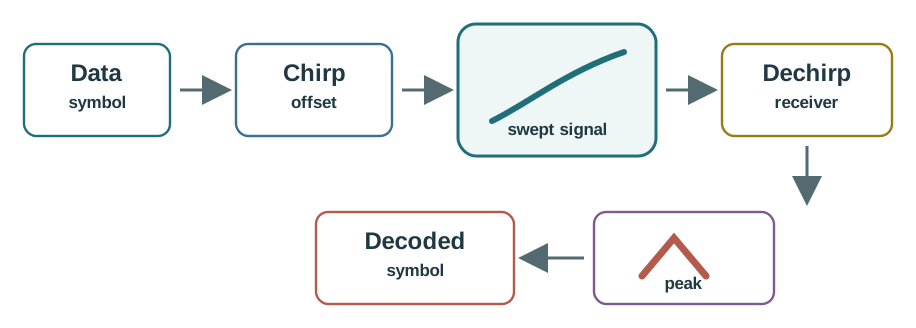
The reviewer should not approve "LoRa works" as a broad claim.
- The record should say which payload, which message schedule, which regional profile, which gateway evidence, which data-rate or ADR policy, and which retest trigger are in scope.
- The review tests one small message but approves every message pattern.
Major section
Practitioner: Write the Modulation Review Record (continued)
The chosen data rate is not tied to observed link evidence.
- One lab point is treated as field coverage evidence.
- Whether ADR owns the final data-rate adjustment, what history it can trust, and when manual override is allowed.
- ADR is enabled without a device profile that makes historical evidence useful.
Major section
Practitioner: Write the Modulation Review Record (continued)
Payload, firmware, placement, antenna, gateway, regional profile, ADR policy, or message-schedule change.
- The release record has no condition that reopens the review.
- Revise The setting may be plausible, but the record lacks payload, airtime, field, or ADR evidence for the reviewed scope.
- Defer The reviewer cannot tie the radio setting to a real device group, regional profile, gateway path, or release owner.
Major section
Under the Hood: Symbol Time Drives the Tradeoff
LoRa symbols are represented by chirps.
- Spreading factor changes how many possible symbol states are represented and how long each symbol occupies the channel.
- A higher spreading factor can make weak-link decoding more practical, but it also extends the time on air for the same payload family.
Major section
Under the Hood: Symbol Time Drives the Tradeoff (continued)
Airtime affects channel occupancy, retries, downlink opportunities, regional profile fit, battery behavior, and gateway capacity.
- ADR can help only when the device pattern gives it useful, recent evidence.
- The useful under-the-hood shortcut is T symbol = 2 SF / bandwidth.
- The same shortcut can be written as a rate check.
Major section
Under the Hood: Symbol Time Drives the Tradeoff (continued)
If a tracker moves between basements, loading docks, and outdoor yards, old uplinks can overstate the current margin.
- At 125 kHz, SF10 gives 1024 / 125,000 = 8.192 ms per symbol, while SF12 gives 4096 / 125,000 = 32.768 ms.
- Symbol rate is R s = bandwidth / 2 SF, and an uncoded bit-rate intuition is R b = SF x bandwidth / 2 SF.
- Mobile or bursty devices may need narrower review boundaries.
Major section
Under the Hood: Symbol Time Drives the Tradeoff (continued)
A field record that says "SF12 worked once" therefore proves only a narrow reception event unless it also shows the payload family, traffic count, retry rate, gateway diversity, and regional airtime headroom.
- With 125 kHz bandwidth that puts SF7 near 5.5 kbit/s before the full LoRaWAN packet and coding details, while SF12 is only a few hundred bit/s.
- Coding rate, commonly 4/5 in introductory examples, adds redundancy; whitening, interleaving, headers, preamble, MAC commands, acknowledgements, and retries then decide the delivered application throughput.
- ADR Limits ADR is strongest for relatively stable devices with useful history.
Major section
Under the Hood: Symbol Time Drives the Tradeoff (continued)
If a fixed meter has weeks of stable uplinks, ADR may be able to move it toward a lower spreading factor and return channel capacity.
- The review should name when ADR owns the decision, when a manual boundary is safer, and which movement or gateway change reopens the calculation.
- Symbol Duration Longer symbols can support weaker links, but every longer frame also consumes more shared channel time.
- Payload Coupling Headers, MAC commands, joins, retries, acknowledgements, and encoded payload size all change the airtime record.
Major section
Summary
Two quantitative views keep the spreading-factor choice connected to both radio physics and network behaviour.
- The second view, Figure: SF7 through SF12 are compared by chirps per, makes every doubling of chirps per symbol line up with the coded rate learners should use in an airtime record.
- LoRa modulation review connects radio settings to evidence.
Major section
Summary (continued)
Across Figure: SF7 through SF12 are compared by chirps per, SF7 begins at 128 chirps/symbol and 5.469 kb/s, whereas: SF12 reaches 4,096 chirps/symbol and 293 b/s.
- The: Coding-rate overhead card explains why the coded rows—not the higher uncoded shortcut—belong in a release budget before preamble, MAC commands, ACKs, and retries are added.
- Spreading factor, bandwidth, coding rate, payload size, regional profile, gateway evidence, and ADR policy all affect whether a LoRaWAN message pattern is fit for release.
- The safest review habit is to avoid broad claims.
Deck summary
Key takeaways
Making the radio easier to hear may keep it on air much longer, which costs energy and shared channel time.
- A payload means the useful reading or command inside a message.
- LoRa is the physical radio modulation used by LoRaWAN.
- At SF12 it is about 32.768 ms, or 32 times longer before payload, preamble, header, coding-rate, and retry details are counted.
- A defensible choice records why the setting fits the device group, message schedule, gateway evidence, regional profile, and ADR handoff.
Retrieval practice
Recall check 1 of 3

Radio Remi says: answer from memory, then check your reasoning.
Q1A team chooses the highest spreading factor for every LoRaWAN sensor because it sounds safest. What should the review require first?
Show answer
Answer: C Higher spreading factors can help weak links, but the device group, airtime cost, and message schedule must justify the choice.
Retrieval practice
Recall check 2 of 3

Radio Remi says: answer from memory, then check your reasoning.
Q2A field pilot proves one small uplink at one gateway and then the team approves a larger alarm payload at the same spreading factor. What is the review gap?
Show answer
Answer: A Evidence for one message class does not automatically approve another payload and schedule.
Retrieval practice
Recall check 3 of 3

Radio Remi says: answer from memory, then check your reasoning.
Q3A device moves between locations, and ADR keeps adjusting data rate from old uplink history. What should the deeper review question be?
Show answer
Answer: B ADR depends on useful device-profile history; movement or changing link conditions can make the evidence boundary stale.
Print reference
Answers
Answer key.
- C · Higher spreading factors can help weak links, but the device group, airtime cost, and message schedule must justify the choice.
- A · Evidence for one message class does not automatically approve another payload and schedule.
- B · ADR depends on useful device-profile history; movement or changing link conditions can make the evidence boundary stale.