LoRa & LoRaWAN · Study deck
LoRaWAN Introduction
A water tank stands beyond the farm buildings.
Radio Remi is your guide for this deck.

After studying this chapter
Learning objectives
Trace a tank reading from radio to application; distinguish LoRa from LoRaWAN; check workload fit, class timing, joining, and evidence limits.
- Trace one tank reading from radio to application.Follow the message through each handoff before using its value for a refill decision.
- Distinguish LoRa from LoRaWAN.Separate the radio method from the network rules that handle device traffic.
- Check workload fit, class timing, joining, and evidence limits.Use the actual message pattern and test record to bound the service claim.
Major section
Start Simple
Its battery device sends only a level and a time.
- The farm manager does not need a claim about impressive range.
- She needs a fresh reading that belongs to the right tank, reaches the service, and still makes sense after rain, a weak battery, or a brief break in coverage.
- This opening does not promise continuous reach or instant control.
Major section
Start Simple (continued)
LoRa is the radio technique that can help that message travel.
- A receiver hearing a signal does not by itself prove that the final record is usable.
- It frames a long-range, low-power message path that must be measured at the real site.
- Keeping that split clear makes every later design choice easier to review.
Major section
Spreading Factor, Rate, And Processing Gain
The mathematical gist: On the chapter's idealized 125 kHz, rate-4/5 screen, SF7 lasts 1.024 ms, gives about 5,469 bit/s, and has 21.07 dB ideal spreading gain.
SF12 lasts 32.768 ms, gives about 293 bit/s before low-data-rate optimization, and has 36.12 dB ideal spreading gain: 15.05 dB more than SF7, but an 18.67× lower nominal rate.
The EU863-870 SF12/125 kHz data rate is 250 bit/s, so use that regional value for a LoRaWAN budget.
At −20 dB SNR, the 1,794 bit/s Shannon ceiling bounds either rate in this idealized comparison.
Major section
Overview: LoRaWAN Is a Network Fit, Not Just a Radio Choice
LoRaWAN is a wide-area networking protocol for IoT devices that send small messages, sleep for long periods, and can tolerate delayed or class-limited downlinks.
- The first beginner boundary is the difference between LoRa and LoRaWAN.
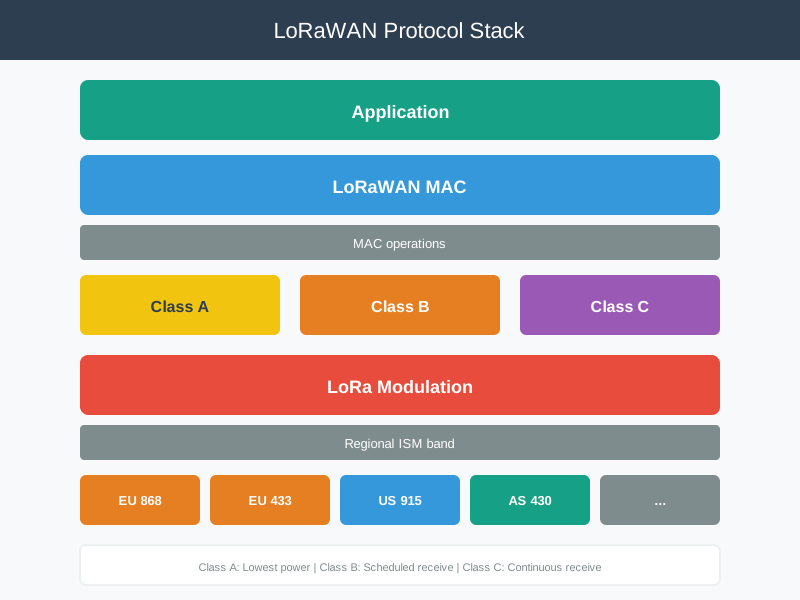
- LoRa is the physical radio modulation.
- LoRa modulation carries symbols over the air.
Major section
Overview: LoRaWAN Is a Network Fit, Not Just a Radio Choice (continued)
Separate the layersLoRa explains the radio signal.
- The LoRaWAN MAC then adds frame structure, counters, device-class receive behavior, MAC commands, ADR decisions, and server-controlled scheduling.
- Application data sits above that stack, so a product claim usually needs both radio evidence and application acceptance evidence.
- LoRaWAN explains the network behavior, server control, joining, counters, class timing, and routing.
Major section
Overview: LoRaWAN Is a Network Fit, Not Just a Radio Choice (continued)
A gateway-heard uplink can support a narrow radio-path observation, but it does not prove the join path, replay handling, ADR policy, downlink timing, or business action.
- A dashboard event can prove the application saw something, but it does not prove the installed device will keep enough link margin after antenna, region, payload, or class changes.
- The One-Minute ViewFit the workload Good first fits send compact telemetry or events, sleep most of the time, and can accept the downlink timing promised by their device class.
- That separation prevents two common beginner mistakes.
Major section
Overview: LoRaWAN Is a Network Fit, Not Just a Radio Choice (continued)
Where LoRaWAN FitsStrong fit: small status readings, event reports, meter updates, and sparse telemetry where delayed delivery can be acceptable.
- Evidence needed: payload size, message cadence, regional profile, gateway hearing, server ownership, activation records, class timing, link evidence, and operations owner.
- A camera, a bulk firmware channel, or a cloud-dependent emergency stop is not a beginner LoRaWAN fit unless another design layer changes the requirement.
- If you can separate LoRa from LoRaWAN and explain when the workload is a fit, you can stop here.
Major section
Practitioner: Build the First LoRaWAN Evidence Record
Worked Review: Soil-Moisture SensorClaim: a field sensor sends compact soil-moisture readings and can wait for ordinary maintenance commands.
- The practitioner job is to turn a broad technology statement into a reviewable record.
- Packet records, gateway metadata, server routing logs, join evidence, and application receipt.
- Those changes require a new review.
Major section
Practitioner: Build the First LoRaWAN Evidence Record (continued)
The record should show what the device sends, what the network is responsible for, what the application expects, and which evidence would make the claim stale.
- Choosing Class C for convenience without proving energy and operations fit.
- Limit: this record does not prove bulk updates, immediate control, or a different field location.
- Worked Review: Remote Valve CommandClaim: the cloud can close a valve immediately over LoRaWAN.
Major section
Under the Hood: Roles, Classes, Activation, and ADR
The deeper layer explains why LoRaWAN evidence is split across several owners.
- A single uplink can involve a radio setting, more than one gateway, a network server, an activation boundary, application payload handling, device-class timing, and a future ADR decision.
- Each layer can be correct while another layer still needs review.

Major section
Under the Hood: Roles, Classes, Activation, and ADR (continued)
A LoRa signal trace supports a radio claim; it does not by itself prove joining, security, routing, or application acceptance.
- LoRa Versus LoRaWANLoRa describes how symbols are carried over the radio.
- Gateway Forwarding and Server ControlLoRaWAN uses a star-of-stars pattern.
- Mechanics and Evidence LimitsMechanic.
Major section
Under the Hood: Roles, Classes, Activation, and ADR (continued)
LoRaWAN describes how end devices use that radio inside a network: uplinks, receive windows, frame counters, MAC commands, joins, server routing, and application payload delivery.
- End devices transmit, and any gateway that hears an uplink can forward a packet record and reception metadata over an IP backhaul.
- Class B adds scheduled receive opportunities when the network and device support the timing discipline.
- A device can transmit a LoRa signal under chosen radio settings.
Major section
Under the Hood: Roles, Classes, Activation, and ADR (continued)
Class C keeps the receiver open most of the time except while transmitting, so it is normally reserved for devices with an energy source and a real need for faster downlinks.
- The class is chosen from the application timing promise, not from a ranking of better or worse classes.
- Activation, Counters, and OwnershipActivation determines how the device gets session state.
- Payload fit, installed uplink evidence, gateway metadata, and regional profile.
Major section
Under the Hood: Roles, Classes, Activation, and ADR (continued)
Key custody matters because network behavior and application payload meaning should remain separated.
- OTAA uses a join procedure; ABP uses pre-provisioned session state and therefore needs extra care around counters, reset behavior, and operational exceptions.
- Frame counters help detect replay, but they must be reviewed with reset and recovery behavior.
- The network policy and receive behavior match this device profile.
Deck summary
Key takeaways
Its battery device sends only a level and a time.
- LoRa is the radio technique that can help that message travel.
- The mathematical gist: On the chapter's idealized 125 kHz, rate-4/5 screen, SF7 lasts 1.024 ms, gives about 5,469 bit/s, and has 21.07 dB ideal spreading gain.
- LoRaWAN is a wide-area networking protocol for IoT devices that send small messages, sleep for long periods, and can tolerate delayed or class-limited downlinks.
- Separate the layersLoRa explains the radio signal.
Retrieval practice
Recall check 1 of 3
Radio Remi says: answer from memory, then check your reasoning.
Q1A utility team wants LoRaWAN for basement water meters that send compact readings twice per day and only need rare maintenance downlinks. What should the introductory review ask for next?
Show answer
Answer: B The review needs the workload, field path, activation, class timing, and application evidence before accepting the LoRaWAN choice.
Retrieval practice
Recall check 2 of 3
Radio Remi says: answer from memory, then check your reasoning.
Q2A product owner wants cloud commands to reach a battery sensor immediately, but the design only proves ordinary Class A uplinks. What is the best review action?
Show answer
Answer: C Class A downlinks follow uplinks.
Retrieval practice
Recall check 3 of 3
Radio Remi says: answer from memory, then check your reasoning.
Q3A field test shows one gateway heard one uplink from a LoRaWAN device. Which conclusion is too broad without more evidence?
Show answer
Answer: D One gateway-heard uplink can support a narrow radio or gateway observation, but it does not prove application acceptance, activation safety, ADR suitability, or downlink timing.
Print reference
Answers
Answer key.
- B · The review needs the workload, field path, activation, class timing, and application evidence before accepting the LoRaWAN choice.
- C · Class A downlinks follow uplinks.
- D · One gateway-heard uplink can support a narrow radio or gateway observation, but it does not prove application acceptance, activation safety, ADR suitability, or downlink timing.