LoRa & LoRaWAN · Study deck
LoRaWAN Release Readiness
Picture a water meter that sends a leak warning from a basement.
Radio Remi is your guide for this deck.

After studying this chapter
Learning objectives
You will be able to:
- Assemble a complete LoRaWAN review packet from focused chapter evidence.
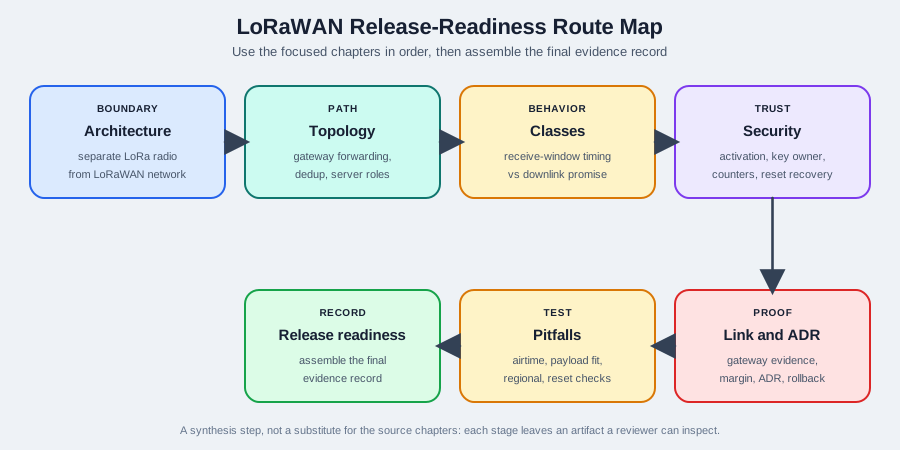
- Explain how topology, class behavior, security, link evidence, and ADR depend on each other.
- Diagnose deployment scenarios without relying on broad claims or unsupported numbers.
- Identify which evidence is missing from an incomplete release packet.
Major section
Start Simple
One receiver hears it during a test, yet the service may still miss it after a reset, a site change, or a busy hour.
- The release question is whether the whole path supports the promised warning.
- LoRaWAN is a low-power wide-area network system for carrying small device messages.
- A payload means the useful content inside a message.
Major section
Start Simple (continued)
A gateway is a receiver that forwards nearby radio messages to the network service.
- Each accepted or rejected step needs an owner and a reason.
- This walk-through does not prove every region, radio setting, device class, or fleet size.
- If a claim is plausible but not provable, the review should keep it open rather than call it ready.
Major section
Minimum Viable Understanding
Readiness is a chain.: A release is only as strong as its weakest missing proof point.
- Architecture explains responsibility.: It separates LoRa radio behavior, LoRaWAN network behavior, gateway forwarding, server control, joining, and application ownership.
- Settings need evidence.: Class choice, activation method, ADR policy, payload size, and channel plan should be backed by observations or records.
- Pitfalls are symptoms of missing review.: Failed uplinks, rejected frames, missed downlinks, and unstable settings should lead to narrow evidence requests.
Major section
Release Proof Chain
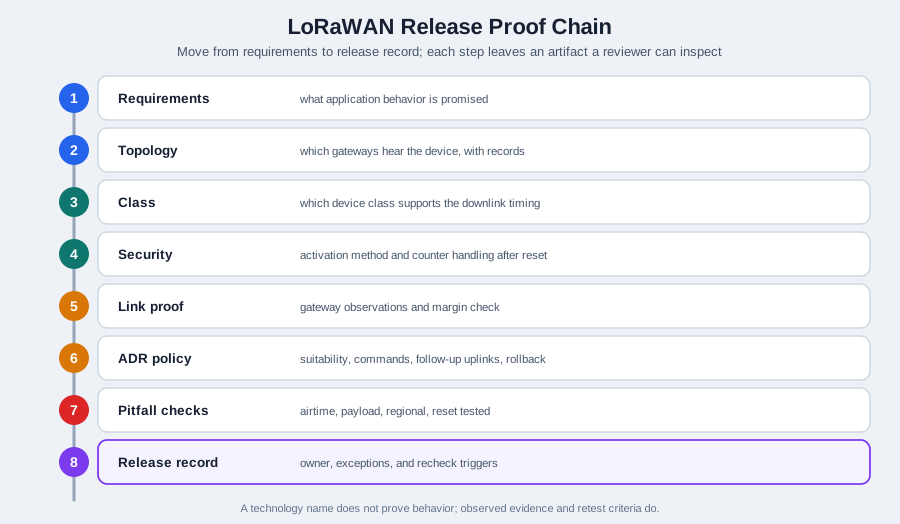
The capstone check should move from requirements to release record.
- Each step should leave an artifact that another reviewer can inspect.
- Relate it to “what application behavior is promised”, then carry “Topology” toward “which gateways hear the device, with records”.
Major section
Field, Dense-Site, And Control Scenarios
The first scenario diagnosis chapter is folded here.
- Field monitoring scenario: For sparse field monitoring, approve only the exact behavior proven by gateway records, profile settings, payload schedule, activation evidence, and application acceptance.
- A single successful uplink does not prove seasonal placement, enclosure, or downlink behavior.
- If the product needs immediate action, LoRaWAN Class A telemetry may be the wrong path; Class B/C or another network must be justified with energy and field evidence.
Major section
Regional, Airtime, And Roaming Scenarios
The second scenario diagnosis chapter is folded here.
- Regional profile scenario: If a device or gateway profile is copied from another region, hold release until channel plan, dwell-time or duty-cycle assumptions, payload size, and server profile match the target region.
- Request the smallest evidence set that separates those causes.
Major section
Regional, Airtime, And Roaming Scenarios (continued)
Airtime exception scenario: If exception devices require robust settings, show how the airtime budget remains acceptable and what owner rechecks the exception before scale.
- Roaming or shared-network scenario: If the deployment depends on a shared or roaming network path, record who owns gateway evidence, join/application routing, downlink limits, and incident response.
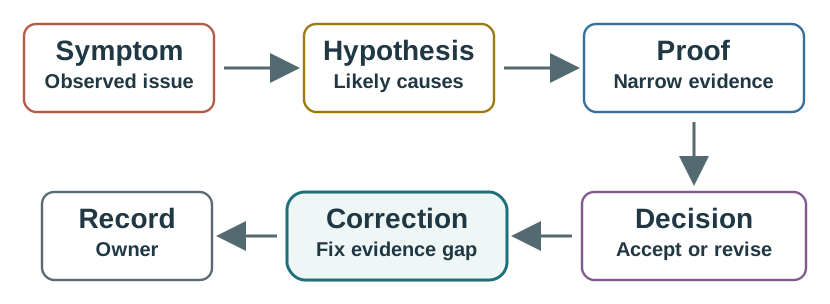
- The claim that LoRaWAN scenario diagnosis method showing symptom, hypothesis, requested proof, decision, correction, and record needs “Observed issue” as a concrete check beside “Hypothesis”.
- They also keep “Observed issue” in the running decision about the “observed issue”–“hypothesis” decision, tied to labelled evidence.
Major section
Release Packet
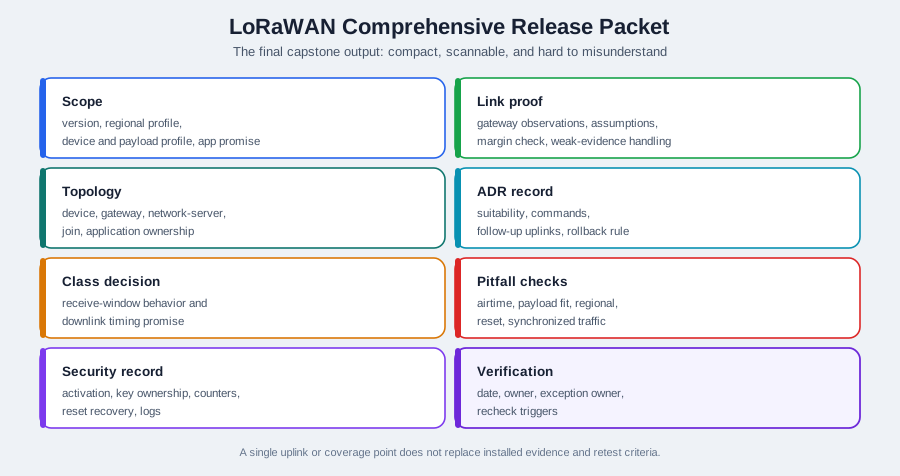
The final capstone output is a compact release packet.
- It should be easy to scan and hard to misunderstand.
- A release decision about the “the final capstone output: compact, scannable, and hard to misunderstand”–“scope” decision needs “version, regional profile”, not a slogan.
- Relate it to “Scope”, then carry “version, regional profile” toward “device and payload profile, app promise”.
Deck summary
Key takeaways
One receiver hears it during a test, yet the service may still miss it after a reset, a site change, or a busy hour.
- A gateway is a receiver that forwards nearby radio messages to the network service.
- Readiness is a chain.: A release is only as strong as its weakest missing proof point.
- The capstone check should move from requirements to release record.
- The first scenario diagnosis chapter is folded here.
Retrieval practice
Recall check 1 of 5

Radio Remi says: answer from memory, then check your reasoning.
Q1A team is preparing a LoRaWAN release packet. What should they prove before treating the design as ready?
Show answer
Answer: C LoRaWAN release review should connect the radio path, regional parameters, gateways, server roles, join/security custody, device class, payload pattern, ADR or link-budget evidence, owner response, and retest trigger.
Retrieval practice
Recall check 2 of 5

Radio Remi says: answer from memory, then check your reasoning.
Q2Place each LoRaWAN release item where it lives so you can connect network shape, device behavior, and accountable trust before approval.
Show answer
Answer: A Separate deployment shape, radio and class behavior, and trust ownership so you can review a LoRaWAN release as one evidence chain rather than a checklist of names.
Retrieval practice
Recall check 3 of 5

Radio Remi says: answer from memory, then check your reasoning.
Q3A LoRaWAN release packet includes a topology diagram and application dashboard screenshot, but no device-class decision, activation record, link evidence, or ADR follow-up. What is the best review decision?
Show answer
Answer: B A topology diagram and dashboard screenshot are not enough to prove LoRaWAN release readiness.
Retrieval practice
Recall check 4 of 5

Radio Remi says: answer from memory, then check your reasoning.
Q4After final placement, a device is heard by gateways but the network server rejects its frames after a reset. Which diagnosis path is strongest?
Show answer
Answer: D Gateway hearing proves the radio path, while network rejection after reset points toward session and counter behavior.
Retrieval practice
Recall check 5 of 5

Radio Remi says: answer from memory, then check your reasoning.
Q5A release packet says several weak devices will use slower data rates, receive frequent downlinks, and keep ADR enabled because the dashboard showed one successful uplink. What is the strongest review response?
Show answer
Answer: B LoRaWAN release readiness depends on coupled evidence.
Print reference
Answers 1 of 2
Answer key.
- C · LoRaWAN release review should connect the radio path, regional parameters, gateways, server roles, join/security custody, device class, payload pattern, ADR or link-budget evidence, owner response, and retest trigger.
- A · Separate deployment shape, radio and class behavior, and trust ownership so you can review a LoRaWAN release as one evidence chain rather than a checklist of names.
- B · A topology diagram and dashboard screenshot are not enough to prove LoRaWAN release readiness.
Print reference
Answers 2 of 2
Answer key.
- D · Gateway hearing proves the radio path, while network rejection after reset points toward session and counter behavior.
- B · LoRaWAN release readiness depends on coupled evidence.