LoRa & LoRaWAN · Study deck
LoRaWAN Link Budget and ADR
A meter in a courtyard reaches the gateway comfortably until it is placed inside its final cabinet.
Radio Remi is your guide for this deck.

After studying this chapter
Learning objectives
Calculate received level and reserved margin; test whether uplinks represent the installed path; verify ADR changes with reception, retries, and rollback.
- The received level and reserve determine available margin.Separate receiver need from the additional headroom reserved for path variation.
- Decide whether recent uplinks represent the operating path.A courtyard sample may not describe a meter inside its final cabinet.
- Check an ADR change with follow-up reception, retries, and rollback.Confirm the changed setting under representative conditions and define when to reverse it.
Major section
Start Simple
The weakest expected path matters more than a single successful radio packet.
- Transmit behavior, antenna losses, and path loss determine received-level estimates.The review keeps configured power, antenna path, gateway evidence, and receiver requirement together with the units and test point used in the calculation.
- Spare margin allows for placement and environmental variation.A meter that reaches the gateway in the courtyard can lose needed headroom when installed inside its final cabinet or moved behind an obstruction.
- Slower settings can extend reach while consuming more airtime.The selected setting must balance receiver need against the shared channel time required to send the meter’s actual message profile.
- Faster settings can leave the weak edge with less protection.A shorter attempt may require a stronger received signal, so its benefit depends on the remaining margin and the retries observed after the change.
Major section
Stable history and moving devices
ADR decisions need representative history rather than an isolated strong signal.
- Repeated uplinks from a fixed sensor can describe a stable path.Gateway records from a consistent location can support ADR when the remaining margin is acceptable and later uplinks verify the new setting.
- Movement or sudden obstruction can make recent history unrepresentative.A moving asset’s uplinks from one stop may not describe the next, so the chapter calls for bounded, disabled, or manually reviewed ADR.
- A setting change needs follow-up samples and a usable fallback.Command acceptance alone leaves performance unproven; current received signal, margin, and retry behavior must still support the meter’s operating workload.
- One successful meter path cannot prove every site’s margin.A basement meter, moving asset, and fixed courtyard sensor need representative evidence windows before they can share the same adaptive-setting conclusion.
Major section
ADR Retry Energy At The Margin Boundary
A failed faster transmission can consume more energy than one safer transmission.
- The 0.386 mJ and 0.772 mJ values are idealized RF energies.They use a 15-symbol radio interval at 14 dBm RF output and 125 kHz; they are not LoRaWAN packet airtimes or battery energies.
- Sending both SF7 and SF8 intervals gives 1.158 mJ of RF energy.This sums the idealized transmitted RF energy for the failed SF7 interval and the later SF8 interval, before real frame and receive costs.
- The two-interval case uses 50% more RF energy than SF8 alone.That is 1.158 mJ versus 0.772 mJ for SF8 alone; actual battery energy requires measured supply power.
- The margin buffer can protect energy as well as reception.The chapter’s 10 dB ADR buffer helps prevent energy-wasting retries, but measured packet delivery and current traces still decide the final setting’s service fit.
Major section
Overview: Link Budget Is Evidence, Not a Guarantee
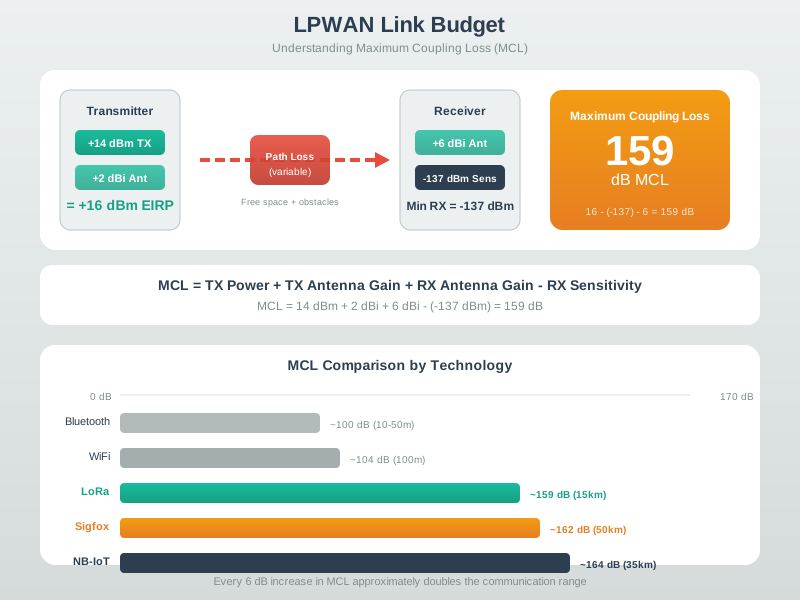
This link-budget diagram connects the transmit path with the receiver's required signal level.
- The transmitter starts the budget with power and its antenna path.The figure’s transmit-side entries establish the configured signal contribution that must remain tied to the installation and selected radio setting.
- Losses reduce signal before the receive antenna contributes gain.Enclosure and path-loss assumptions connect the transmit side to the gateway, producing an illustrative received level of −111 dBm in the chapter.
- The receiver threshold defines the need for the selected setting.The −123 dBm requirement is the comparison point for the expected received signal, rather than a universal threshold for every data rate.
- The remaining margin must cover expected variation before an ADR change.The illustrative 12 dB total leaves only 2 dB above the 10 dB reserve, so a strong-looking received packet still needs a bounded review.
Major section
The assumptions behind −111 dBm
A numerical budget exposes which assumptions need a new field check.
- The illustrative received-level estimate is about −111 dBm.The chapter uses 14 dBm EIRP, 1 dB enclosure loss, 126 dB path loss, and 2 dBi receive antenna gain.
- The receiver requirement determines the margin left by that estimate.Against −123 dBm, the predicted signal leaves 12 dB in total, with only 2 dB remaining above the project’s 10 dB reserve.
- Enclosure, antenna height, and gateway diversity can change the path.Moving the courtyard meter inside its cabinet can invalidate the earlier installation assumptions even when its configured transmit power has not changed.
- ADR approval needs an evidence window covering the operating assumptions.Representative gateway samples must support the setting under expected weather, enclosure, and payload conditions before the earlier budget can justify a reduction.
Major section
Practitioner: Review Margin Before Changing Settings
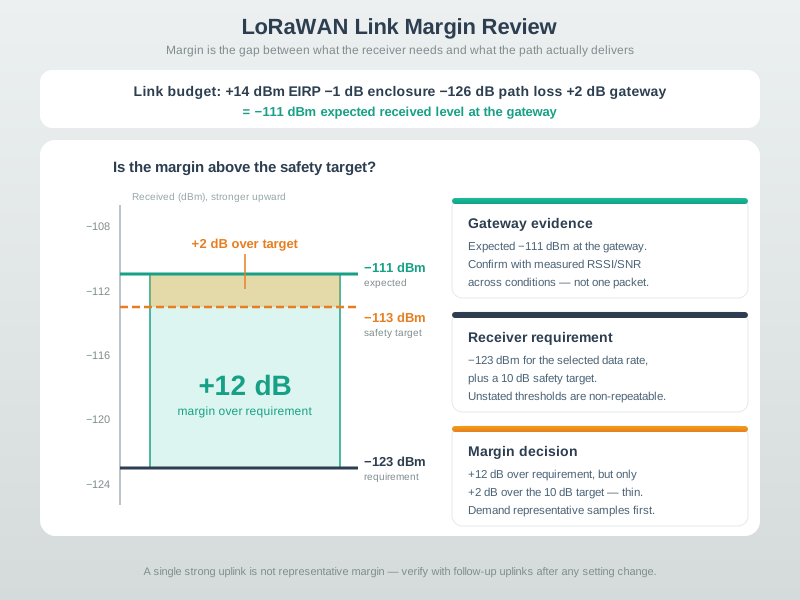
This ladder separates the receiver requirement, safety target, and expected received signal.
- The receiver requirement is the lowest reference on the ladder.The selected setting needs −123 dBm in the illustrative review, establishing the reference from which available signal margin is measured.
- The safety target is above the receiver requirement.The 10 dB reserve places that target at −113 dBm, retaining room for variation instead of approving every signal above sensitivity.
- The expected signal must retain enough separation from both levels.At −111 dBm, the path has 12 dB above the receiver requirement but only 2 dB above the reserved safety target.
- A LinkADR response confirms acceptance rather than resulting performance.Follow-up uplinks must show margin and retry behavior after the change before the device’s accepted setting can support the workload claim.
Activity 1 · Work it out
✎ Spend the spare margin

I want you to protect the weak edge before you turn the transmit power down.
On paper, use −111 dBm expected signal and −123 dBm receiver requirement. Calculate the margin and subtract the 10 dB reserve. Then reduce transmit power by 6 dB. Does the revised margin meet the reserve?
On paper, use −111 dBm expected signal and −123 dBm receiver requirement. Calculate the margin and subtract the 10 dB reserve. Then reduce transmit power by 6 dB. Does the revised margin meet the reserve?
4 minutes · Pen and paper · Answer: Activity 1
Pause for 8 seconds
Major section
The proposed adjustment and rollback rule
An ADR record must connect the proposed adjustment with its evidence window.
- The record must state whether ADR is automatic, reviewed, or disabled.A route with unrepresentative history needs a bounded decision instead of automatically inheriting the approval given to a stable courtyard sensor.
- The proposed power or data-rate change must fit observed margin.Before-and-after settings belong with the receiver requirement, measured RSSI/SNR range, margin target, and expected airtime effect for the meter’s traffic.
- An unsuitable setting can waste airtime or hide a weak path.Faster transmissions may trigger enough extra retries to erase the initial channel-time saving, so per-attempt airtime cannot establish delivery efficiency.
- The release decision needs a rollback trigger for degraded evidence.The review can accept a faster rate only while margin stays above its target and confirmed retries remain below the recorded release limit.
Major section
Twenty courtyard uplinks and the weak edge
Strong recent uplinks can still miss the conditions that matter at the weak edge.
- The proposed reduction is 6 dB after 20 strong courtyard uplinks.That courtyard history defines the decision window, but its strength alone does not establish the margin available at the final installed location.
- Those uplinks must represent gateways, weather, enclosures, and payload conditions.Moving behind a metal cabinet or using a larger confirmed payload can break the earlier evidence window’s claim about the future operating path.
- Fixed sensors can support ADR when margin and verification remain acceptable.Repeated gateway records from a stable location justify an adjustment only when later uplinks demonstrate the changed setting under the required conditions.
- Moving devices need caution because their recent path may differ.Uplinks from one stop may not describe the next gateway area, so route evidence and an explicit fallback must bound the adaptive decision.
Major section
Under the Hood: Airtime, Exceptions, and Release Records
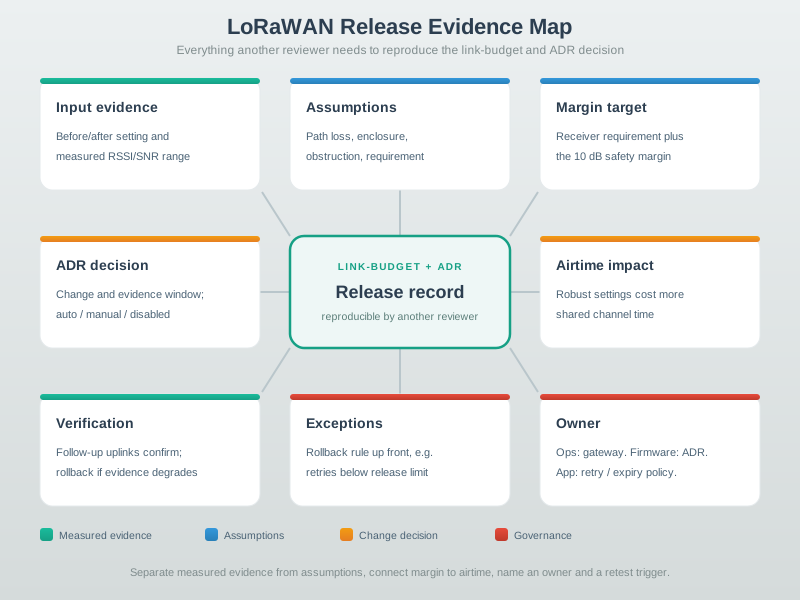
This release record connects radio margin with airtime, verification, and operational responsibility.
- The radio setting defines the receiver requirement and airtime estimate.The release record starts with transmit power, data rate, antenna path, channel-plan context, and message profile so another reviewer can reproduce the calculation.
- Margin and measured samples show whether the path supports that setting.Gateway evidence remains separate from path-loss and enclosure assumptions, allowing the reviewer to identify what was measured and what still requires confirmation.
- Verification records establish behavior after the settings change.Follow-up uplinks, RSSI/SNR ranges, and retry observations are needed beyond a command response that merely accepts the proposed ADR parameters.
- Owner and rollback fields connect degraded evidence with a response.Gateway outages, firmware handling, and application retry limits have different owners who need to act when the accepted setting no longer fits the workload.
Major section
Changes that reopen the radio review
A radio optimization stays valid only while its recorded assumptions remain current.
- Environment, antenna, enclosure, and gateway changes can invalidate path evidence.A courtyard result may no longer describe the signal after installation behind a cabinet, a changed antenna height, or a different gateway route.
- Payload and regional channel changes can alter the airtime tradeoff.The receiver requirement and channel-plan context belong to the selected setting, so the review must revisit them when the traffic or regional configuration changes.
- Firmware and network-service policy can change ADR response behavior.The device’s handling of a request and the service’s adaptive policy need current evidence instead of approval inherited from an earlier software combination.
- The release record must name retest triggers and responsible owners.Route, gateway, enclosure, firmware, network-service, application, and ownership changes are reasons to check whether the original margin and verification claims still hold.
Major section
Retries can erase the airtime saving
Less airtime per attempt does not guarantee less airtime per delivered message.
- A faster setting can shrink the margin at a weak receiver.Its required signal level may rise, so the budget needs the new receiver requirement instead of retaining the sensitivity used for the slower setting.
- Extra retries can consume the initial airtime or energy saving.Idealized SF7-then-SF8 RF intervals use 1.158 mJ versus 0.772 mJ for SF8 alone; real costs need measurement.
- Recorded RSSI and SNR provide reception evidence before and after changes.Those samples need the associated data rate, transmit setting, and gateway identity so the review follows the radio path actually used by the meter.
- The release limit must include retries and a rollback trigger.An acceptable median margin is insufficient if confirmed retries exceed the limit recorded for the changed setting and its shared-airtime budget.
Major section
Exception signals and the people who act
Different exception signals need owners who can act on their causes.
- Operations may own gateway outages while firmware owns ADR response handling.The release record connects each exception signal with the team able to investigate its cause instead of leaving the radio optimization unowned.
- The application team may own retry limits and command expiry.Those policies affect whether later traffic still meets the workload’s needs, even when the network service and device successfully exchange an ADR command.
- Subsequent uplinks must establish whether the new setting supports service.Command acknowledgement cannot show the current margin, retry count, or received-signal range needed to approve the meter’s changed operating behavior.
- Approval can change when current evidence no longer supports the decision.A moving route, failed gateway, or changed installation can require renewed measurements and rollback rather than continued use of yesterday’s strong courtyard history.
Activity 2 · Predict
✎ Move the meter
I want you to challenge the history that made yesterday’s radio setting look safe.
A previously fixed meter starts moving between gateway coverage areas. Predict why the old ADR evidence window may fail. Write two observations to collect before keeping the faster setting.
A previously fixed meter starts moving between gateway coverage areas. Predict why the old ADR evidence window may fail. Write two observations to collect before keeping the faster setting.
3 minutes · Pen and paper · Answer: Activity 2
Pause for 8 seconds
Major section
Spend Only the Margin above the Safety Target
This ladder shows why receiver sensitivity and reserved safety margin are different limits.
- The ladder separates −123 dBm receiver need from −111 dBm expected signal.These are distinct reference levels in the chapter’s illustrative path, so a received packet cannot by itself establish the reserved margin.
- The difference gives a total available margin of 12 dB.Subtracting the receiver requirement from the expected signal exposes how much signal headroom the paper budget has before reserving space for variation.
- The 10 dB reserve leaves only 2 dB for adjustment.The safety target sits at −113 dBm, making the separation from that target much smaller than the full gap above receiver sensitivity.
- A signal above sensitivity can still miss the required reserve.A proposed 6 dB power reduction would exceed the available 2 dB above target, even though the predicted packet might remain receivable.
Major section
Check the Proposed Power Reduction
Packet reception alone cannot establish that the reserved safety margin remains intact.
- The proposed 6 dB cut lowers expected signal to −117 dBm.With the rest of the illustrative path unchanged, subtracting the transmit-power reduction from −111 dBm gives the revised received-level estimate.
- The new signal remains 6 dB above the −123 dBm requirement.The packet may still be receivable on paper, but the gap above sensitivity is now smaller than the margin recorded for the original setting.
- The remaining margin is 4 dB below the 10 dB reserve.A 6 dB total margin cannot satisfy the chapter’s safety target, so command acceptance or one received packet cannot justify the proposed reduction.
- Later uplinks must confirm margin and retries after an accepted change.Measured packet delivery and current traces determine service fit, keeping the screening arithmetic separate from evidence of the meter’s final operating behavior.
Major section
Acceptance, verification, and changed paths
An accepted ADR command begins verification rather than completing the performance claim.
- Uplink history supports the decision before the setting request.The 20 courtyard samples need to represent the gateway, weather, enclosure, and payload conditions expected after the proposed adaptive change.
- The command response establishes whether requested settings were accepted.LinkADRAns belongs to the apply-and-verify sequence, but acceptance alone leaves the meter’s resulting margin, airtime, and delivery behavior unmeasured.
- Later uplinks must establish margin, retries, and service behavior.Current samples connect received signal and quality with the changed data rate, transmit setting, and gateway identity used by the device.
- A changed gateway or path needs renewed evidence.Moving the courtyard meter indoors means the budget describes a different installation, so its historical adjustment cannot automatically retain the same approval.
Deck summary
Key takeaways
Radio approval must connect the budget, representative observations, and response to change.
- Signal above sensitivity does not establish the reserved margin.The illustrative −117 dBm result after a 6 dB reduction is receivable on paper but falls 4 dB short of the 10 dB reserve.
- ADR needs current history representing the device’s actual path.A fixed courtyard sensor and a moving asset cannot share one conclusion unless their evidence windows describe the same future operating conditions.
- Extra retries can erase a faster transmission’s apparent benefit.In the idealized RF interval example, SF7 then SF8 uses 1.158 mJ versus 0.772 mJ for SF8 alone; frame and battery costs require measurement.
- Verification and rollback ownership keep settings tied to measured service.Follow-up uplinks, current traces, retry limits, and named exception owners keep the approved radio behavior connected to the workload after the initial change.
Retrieval practice
Recall check 1 of 4
Radio Remi says: answer from memory, then check your reasoning.
Q1Before enabling ADR for a planned LoRaWAN sensor route, which evidence belongs in the link-budget record?
Show answer
Answer: B A LoRaWAN link-budget review should connect device transmit settings, spreading factor or data rate, antenna path, measured gateway RSSI/SNR, receiver threshold, margin target, and ADR verification.
Retrieval practice
Recall check 2 of 4
Radio Remi says: answer from memory, then check your reasoning.
Q2A device has one excellent uplink and several weak uplinks from the same installation. What should the reviewer do before approving a less robust setting?
Show answer
Answer: C Margin approval needs representative evidence, not only a successful or best-case uplink.
Retrieval practice
Recall check 3 of 4
Radio Remi says: answer from memory, then check your reasoning.
Q3A moving asset changes gateway paths frequently. Recent uplinks from one stop may not represent the next stop. What ADR review decision is most appropriate?
Show answer
Answer: D ADR suitability depends on whether recent uplink evidence represents the next transmissions.
Retrieval practice
Recall check 4 of 4
Radio Remi says: answer from memory, then check your reasoning.
Q4An ADR setting lowers airtime in a pilot. What else should its release record name?
Show answer
Answer: A Airtime benefit is useful only with bounded evidence and a way to recover.
Print reference
Answers
Answer key.
- B · A LoRaWAN link-budget review should connect device transmit settings, spreading factor or data rate, antenna path, measured gateway RSSI/SNR, receiver threshold, margin target, and ADR verification.
- C · Margin approval needs representative evidence, not only a successful or best-case uplink.
- D · ADR suitability depends on whether recent uplink evidence represents the next transmissions.
- A · Airtime benefit is useful only with bounded evidence and a way to recover.
Print reference
Activity 1 answer
Model answer.
Work it out: Initial margin is 12 dB, leaving 2 dB above the 10 dB reserve. After a 6 dB reduction, received level is −117 dBm and margin is 6 dB. That misses the reserve by 4 dB.
Print reference
Activity 2 answer
Model answer.
Predict: Movement can make old uplinks describe a different path from the current one. Collect representative gateway and RSSI/SNR evidence, then check margin and retry behavior after the setting change. Keep a fallback when the evidence degrades.