LoRa & LoRaWAN · Study deck

LoRaWAN Device Classes

A battery valve sends a reading every ten minutes.

Radio Remi is your guide for this deck.

archdeviceclasses
Radio Remi, the module guide, in a scene from this chapter.
iotclass.org

After studying this chapter

Learning objectives

You will be able to:

  • Explain: If the application needs scheduled or low-latency downlinks, the review must prove the energy source, network support, and failure behavior needed by Class B or Class C.
  • Explain: If the same product also sends daily telemetry, that telemetry flow may still remain Class A while the command flow uses Class B or Class C.
  • Explain: A class claim becomes releasable only when the record names the application promise, selected class, downlink timing evidence, energy assumption, network support, exception rule, and owner.
  • Explain: The evidence should connect logs across the end device, network server, and application action.
iotclass.org

Major section

Start Simple

A class name is useful only when its listening pattern can meet that delay without exhausting the power source.

  • Latency means the delay between a request and its result.
  • LoRaWAN means a low-power wide-area network system for small device messages.
  • Its device class sets when an end device listens for a downlink.
  • Class B adds scheduled listening opportunities.

Key terms

Device class
Device class is simply the promise about when a device will listen.
iotclass.org

Major section

Overview: Device Class Is A Downlink Timing Promise

Class B adds scheduled ping slots synchronized by beacons.

  • Class C keeps its receiver open most of the time except while transmitting.
  • The class choice should follow the application promise.
  • If a command can wait until the device next reports, Class A may be enough.

Key terms

Class A
Class A is usually defensible because the server can queue the change and deliver it after the next uplink-opened receive window.
Class A, Class B, and Class C trade receive-window availability, latency, and energy draw rather than application importance.
iotclass.org

Major section

Overview: Device Class Is A Downlink Timing Promise (continued)

If the application needs scheduled or low-latency downlinks, the review must prove the energy source, network support, and failure behavior needed by Class B or Class C.

  • For example, consider a water meter that reports once every six hours and receives a new sampling interval only a few times per year.
  • A door controller that must unlock within a few seconds has a different promise: waiting for the next routine uplink would break the product behavior.
  • That comparison keeps the class label tied to user-visible delay, not to a generic sense that one class is newer or stronger.
iotclass.org

Major section

Overview: Device Class Is A Downlink Timing Promise (continued)

Class A is usually defensible because the server can queue the change and deliver it after the next uplink-opened receive window.

  • If you only need the intuition, this layer is enough: do not choose the most advanced sounding class.
  • Class B Scheduled ping slots can reduce waiting time, but require beacon synchronization and network support.
  • Class C Mostly open receive behavior can support faster downlinks, usually for devices with enough external power.
iotclass.org

Major section

Practitioner Pattern: Select The Class With Gates, Not Slogans
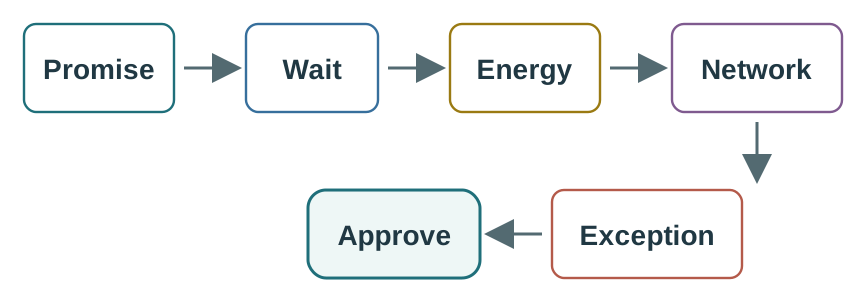
A useful class decision is a set of gates.

  • The reviewer checks the message promise, acceptable wait, energy source, network-server and gateway support, exception behavior, and release owner before accepting a class.
  • The decision can split by flow.
  • The important point is that each promise gets its own evidence record.

Why it matters

Splitting the flows prevents a single class decision from hiding two different timing promises.

Selection gates keep class choice tied to application timing, energy, network support, exception handling, and release approval.
iotclass.org

Major section

Practitioner Pattern: Select The Class With Gates, Not Slogans (continued)

A periodic meter may use Class A for normal reporting while a mains-powered controller uses Class C for faster command response.

  • A practical review table should be specific enough to falsify.
  • Command wait tolerance, queued-downlink behavior, receive opportunity, and verification trace.
  • Firmware, operations workflow, owner, or field-support model changes.
iotclass.org

Major section

Practitioner Pattern: Select The Class With Gates, Not Slogans (continued)

If the same product also sends daily telemetry, that telemetry flow may still remain Class A while the command flow uses Class B or Class C.

  • Command meaning, alarm path, service promise, or receiver rule changes.
  • Network-server support, beacon or ping-slot behavior, gateway path, and queue behavior.
  • Network provider, server configuration, gateway coverage, or regional plan changes.
iotclass.org

Major section

Under The Hood: Release Evidence Separates Class Choice From Class Claim
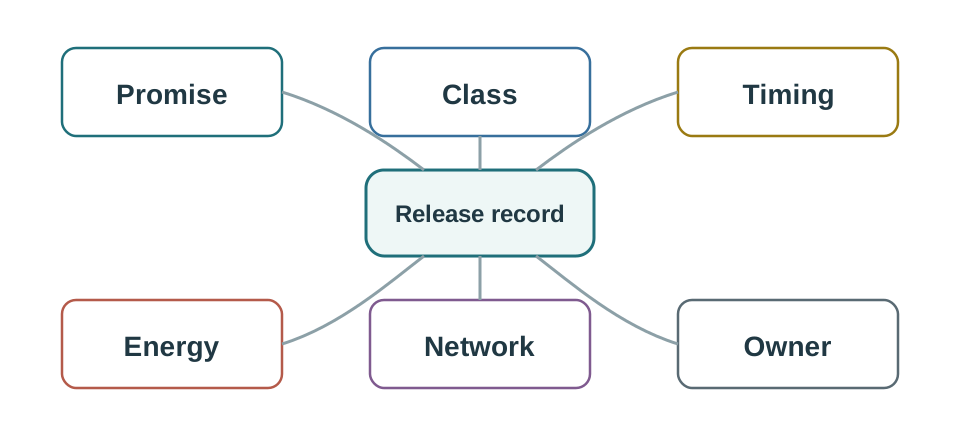
A class claim becomes releasable only when the record names the application promise, selected class, downlink timing evidence, energy assumption, network support, exception rule, and owner.

  • Class B and Class C especially need boundary checks.
  • Class B depends on scheduled receive opportunities.
  • A LoRaWAN class is not a complete deployment design.

Key terms

UP
UP is the event that creates RX1 and RX2; no independent ping schedule exists.
Class A
Class A is easiest to remember when it shares a clock with the alternatives.
The release record turns the class choice into a bounded claim with owner, verification, exception, and retest evidence.
iotclass.org

Major section

Under The Hood: Release Evidence Separates Class Choice From Class Claim (continued)

A Class C record should additionally show that the receiver policy and power source can sustain the open-listen behavior during normal operation.

  • Class C depends on a receiver that can stay open enough to meet the application promise.
  • The evidence should connect logs across the end device, network server, and application action.
  • Exception Boundary Record what happens when an uplink, beacon, ping slot, queue, or command acknowledgement is missed.
iotclass.org

Major section

Put the Valve Command on the Receive Clock

A command queued at 3 s has no new post-uplink opportunity until the next cycle.

  • Those windows depend on the uplink.
  • A command arriving just after a slot waits nearly 32 s for the next one, before transmission and application handling.
  • Losing beacons requires an explicit recovery policy, not an unchanged latency claim.
Common-axis LoRaWAN class timeline with Class A highlighted: one uplink followed by RX1 and RX2.
iotclass.org

Deck summary

Key takeaways

A class name is useful only when its listening pattern can meet that delay without exhausting the power source.

  • Class B adds scheduled ping slots synchronized by beacons.
  • If the application needs scheduled or low-latency downlinks, the review must prove the energy source, network support, and failure behavior needed by Class B or Class C.
  • Class A is usually defensible because the server can queue the change and deliver it after the next uplink-opened receive window.
  • A useful class decision is a set of gates.
iotclass.org

Retrieval practice

Recall check 1 of 3

Radio Remi says: answer from memory, then check your reasoning.

Q1What is the safest first question when selecting a LoRaWAN device class?

ARequired downlink wait, plus energy and network evidence for that timing.
BWhich class sounds most advanced to the product team and sales story.
CWhether Class C can be enabled for every battery-powered sensor in the fleet.
DWhether one demo uplink reached a gateway without checking receive windows.
Show answer

Answer: A Device class review should begin with the required downlink behavior and the evidence needed to support it.

iotclass.org

Retrieval practice

Recall check 2 of 3

Radio Remi says: answer from memory, then check your reasoning.

Q2A battery-powered field sensor reports once per day, and its configuration changes can wait until the next report. Which class decision is most defensible?

AUse Class C because it is always safer for remote configuration work.
BUse Class A; record queued commands, next-uplink receive behavior, and exceptions.
CUse Class B without checking beacon or ping-slot support first.
DAvoid recording exception behavior because the command is not urgent now.
Show answer

Answer: B Class A can be the right answer when downlinks can wait for an uplink-opened receive window and the queue behavior is reviewed.

iotclass.org

Retrieval practice

Recall check 3 of 3

Radio Remi says: answer from memory, then check your reasoning.

Q3Which release note best preserves a LoRaWAN Class B decision?

AClass B is accepted because scheduled downlinks are always better than Class A.
BClass B is accepted because the device once joined the network during setup.
CClass B is accepted without a retest trigger because class behavior is fixed.
DAccept Class B for this flow with timing, ping-slot support, exceptions, owner, and retest recorded.
Show answer

Answer: D Release evidence must preserve class support, timing, exceptions, ownership, and retest conditions.

iotclass.org

Print reference

Answers

Answer key.

  1. A · Device class review should begin with the required downlink behavior and the evidence needed to support it.
  2. B · Class A can be the right answer when downlinks can wait for an uplink-opened receive window and the queue behavior is reviewed.
  3. D · Release evidence must preserve class support, timing, exceptions, ownership, and retest conditions.
iotclass.org