UX Design · Study deck

Indoor Positioning: Wi-Fi, UWB, and Sensor Fusion

A BLE deployment can estimate position, but multipath and layout changes may leave the result too uncertain.

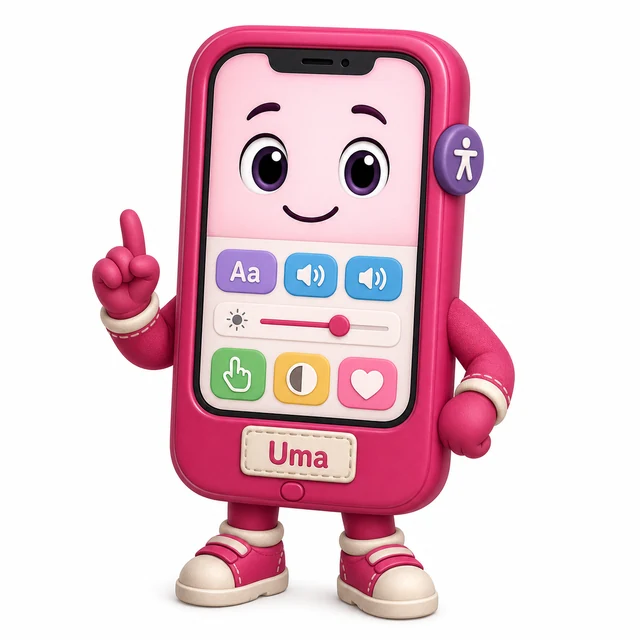
UX Uma is your guide for this deck.

locationawarenessindoor
UX Uma, the module guide, in a scene from this chapter.
iotclass.org

After studying this chapter

Learning objectives

You will be able to:

  • Explain: Each one continuously shouted: "I'm at the food court!" or "I'm at the shoe store!" When Lila's phone heard a beacon, it knew she was nearby.
  • Explain: Traditional one-way ToF problem:: If transmitter and receiver clocks are not synchronized, measuring $t_{\text{receive}} - t_{\text{transmit}}$ gives nonsense (clocks may differ by milliseconds).
  • Explain: The choice between BLE beacons (cheap, 1-3m), Wi-Fi (free infrastructure, 3-5m), and UWB (expensive, 10-30cm) depends on accuracy requirements, budget, and existing infrastructure.
  • design and maintain a Wi-Fi fingerprint map
iotclass.org

Major section

Wi-Fi Fingerprinting
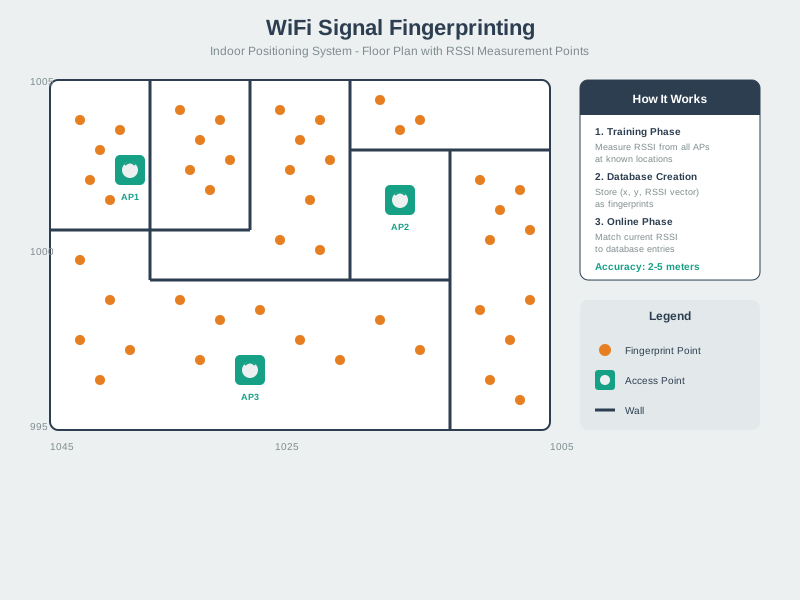
Device scans visible APs and measures RSSI.

  • Temporal variations: Different occupancy (empty vs. Crowded) affects propagation.
  • Device variations: Different phones have different RSSI calibration.
  • Machine learning (automatically detect and adapt to environmental changes).
  • Fingerprinting reuses infrastructure, while UWB changes the infrastructure to measure time more directly.
Wi-Fi Signal Fingerprinting
iotclass.org

Major section

UWB Time-of-Flight Precision

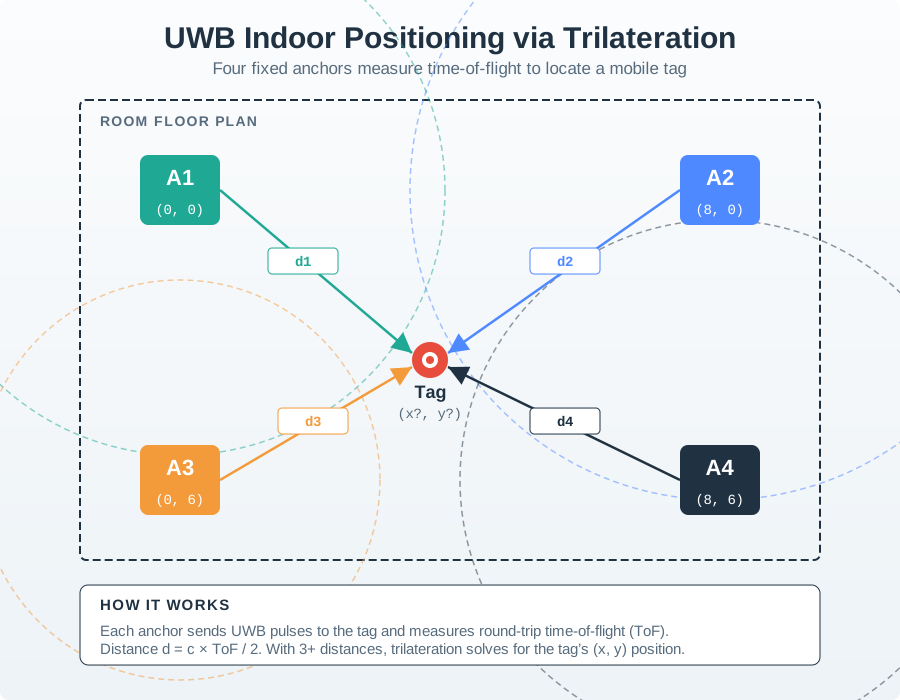
Traditional one-way ToF problem:: If transmitter and receiver clocks are not synchronized, measuring $t_{\text{receive}} - t_{\text{transmit}}$ gives nonsense (clocks may differ by milliseconds).

  • Tag → Anchor: Tag sends pulse at $t_1$ (tag clock).
  • Example with numbers:: Tag sends pulse at $t_1 = 0$.
  • Anchor waits $T_{\text{reply}} = 500$ µs, then replies.
Diagram showing UWB positioning with anchors at known positions and tag at unknown position.
iotclass.org

Major section

UWB Time-of-Flight Precision (continued)

Signal travels to anchor (distance $d = 5$ m): arrives at $\frac{5}{3 \times 10^8} = 16.67$ ns.

  • Tag receives at $t_4 = 500 \text{ µs} + 33.34 \text{ ns} = 500.03334$ µs.
  • The timing calculation becomes a position only when several measured distances meet in a known geometry.
  • Three distances can solve the two-dimensional position; the fourth adds redundancy for checking noise and obstructed paths.
iotclass.org

Major section

Indoor-Outdoor Sensor Fusion

Scenario: A delivery driver app must track location seamlessly as the driver moves from outdoor parking (GPS) to indoor warehouse (Wi-Fi/BLE) for package pickup.

  • Building floor plan constraint: Driver must be in accessible walkway.
  • HDOP increases from 1.2 to 6.5 (poor geometry).
  • Position (8.8, 9.9) is in valid walkway - no correction needed.

Numbers to remember

1-3%IMU provides relative movement but drifts over time (1-3% of distance traveled).
2–5 m: Wi-Fi Fingerprint offers a surveyed 2–5 m match
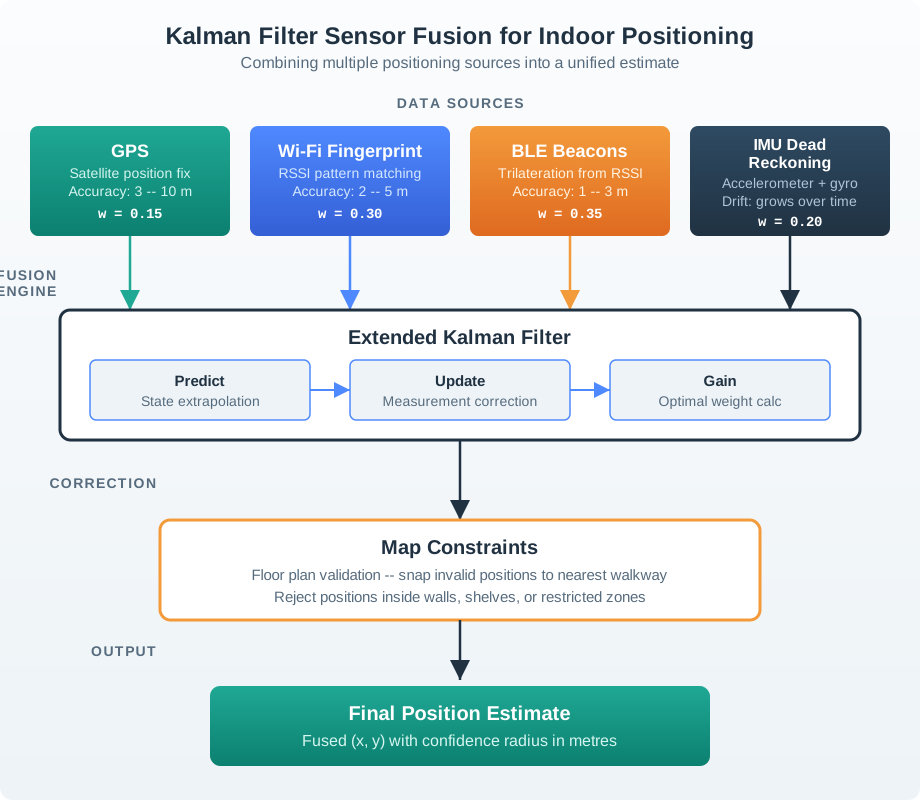
Indoor positioning combines GPS handoff, Wi-Fi fingerprints, BLE beacons, and IMU motion in a fusion filter, then applies map constraints before exposing a usable place estimate.
iotclass.org

Major section

Indoor-Outdoor Sensor Fusion (continued)

If position were in wall/shelf, snap to nearest valid location.

  • Key Insight: Sensor fusion requires careful weighting based on each source's reliability.
  • GPS provides absolute position outdoors but fails indoors.
  • IMU provides relative movement but drifts over time (1-3% of distance traveled).
  • Wi-Fi fingerprinting gives zone-level position but requires pre-surveyed database.
iotclass.org

Major section

Indoor-Outdoor Sensor Fusion (continued)

BLE beacons provide proximity anchoring.

  • The Kalman filter dynamically adjusts weights as sensor reliability changes, enabling sub-3-meter positioning across the indoor-outdoor transition.
  • The worked examples have named the evidence sources.
  • The next step is turning those measurements into a repeatable implementation path.
iotclass.org

Major section

Hospital Asset Tracking Design

Room-level accuracy (identify which room equipment is in).

  • Key Insight: UWB provides 10x better accuracy than BLE, but costs 4x more and offers only 3-year battery life.
  • For hospital asset tracking, room-level accuracy is sufficient—knowing equipment is in "Room 305" is adequate.
  • Sub-30cm precision is unnecessary and wastes resources.

Why it matters

Scenario: A 500-bed hospital needs real-time location tracking for 2,000 medical devices (wheelchairs, IV pumps, portable monitors) to reduce search time and improve utilization.

iotclass.org

Major section

RSSI Calibration Neglect

Customers' apps showed them as being 8 meters from a beacon that was actually 3 meters away (2.7x error).

  • The store blamed "faulty beacons" when the issue was uncalibrated path loss.
  • The Cost: Using default n=2.0 in a concrete building (actual n=3.2) causes trilateration to estimate positions 12 meters off target.
  • This makes zone detection useless—users reported as being in the "Electronics" zone are actually in "Apparel.".

Key terms

Datasheet values
Datasheet values are laboratory measurements in free space—real buildings have walls, metal, people, and furniture that change RF propagation.
iotclass.org

Major section

Key Takeaway

The choice between BLE beacons (cheap, 1-3m), Wi-Fi (free infrastructure, 3-5m), and UWB (expensive, 10-30cm) depends on accuracy requirements, budget, and existing infrastructure.

  • The most robust real-world systems use sensor fusion, combining multiple technologies through Kalman filters to smooth transitions and handle individual sensor failures.
  • The key insight: no single positioning technology works everywhere -- seamless location awareness requires intelligent fusion of multiple sources.
  • Indoor positioning requires fundamentally different technologies from outdoor GPS because satellite signals cannot penetrate buildings.
iotclass.org

Major section

For Kids: Meet the Sensor Squad!

Indoor positioning is like finding your way in a building without any windows to see the sky!

  • The Sensor Squad was running a treasure hunt inside a huge shopping mall.
  • But there was a problem -- GPS didn't work indoors!
  • "Don't worry!" said Temperature Terry. "We have INDOOR tools!".
iotclass.org

Major section

For Kids: Meet the Sensor Squad! (continued)

"My GPS says I'm OUTSIDE!" cried the LED, standing right in the middle of the food court. "The satellite signals can't get through the roof!".

  • Each one continuously shouted: "I'm at the food court!" or "I'm at the shoe store!" When Lila's phone heard a beacon, it knew she was nearby.
  • If I measure the signal strength from THREE beacons, I can figure out exactly where I am -- just like GPS uses three satellites!" said Sammy.
  • This PATTERN is unique to the pet store!".
iotclass.org

Deck summary

Key takeaways

Device scans visible APs and measures RSSI.

  • Traditional one-way ToF problem:: If transmitter and receiver clocks are not synchronized, measuring $t_{\text{receive}} - t_{\text{transmit}}$ gives nonsense (clocks may differ by milliseconds).
  • Signal travels to anchor (distance $d = 5$ m): arrives at $\frac{5}{3 \times 10^8} = 16.67$ ns.
  • Scenario: A delivery driver app must track location seamlessly as the driver moves from outdoor parking (GPS) to indoor warehouse (Wi-Fi/BLE) for package pickup.
  • If position were in wall/shelf, snap to nearest valid location.
iotclass.org

Retrieval practice

Recall check 1 of 5

UX Uma says: answer from memory, then check your reasoning.

Q1A warehouse needs to track 500 pallets with zone-level accuracy (knowing which aisle a pallet is in). The budget is $30,000. Which indoor positioning technology is most appropriate?

AUWB with 10-30cm accuracy for precise pallet location
BBLE beacons for low-cost zone detection with 1-3m accuracy
CGPS receivers on each pallet for global tracking
DCamera-based tracking with computer vision
Show answer

Answer: B BLE beacons provide the best balance of accuracy (1-3m), cost ($15-25/tag), and battery life for zone-level warehouse asset tracking within a limited budget.

iotclass.org

Retrieval practice

Recall check 2 of 5

UX Uma says: answer from memory, then check your reasoning.

Q2You're deploying BLE beacons in a museum for indoor wayfinding. You place beacons 30 meters apart, but visitors' apps show their location jumping erratically between distant exhibits. What is the most likely cause?

ABeacon identifiers duplicated across several exhibits, confusing the map lookup
BPhone Bluetooth permission denied, so no beacon packets are scanned
CMultipath and sparse beacon geometry making RSSI distances unstable
DBLE transmit power is too high, preventing nearby phones from hearing it
Show answer

Answer: C Indoor RF propagation suffers from multipath effects—signals bounce off walls, floors, ceilings, metal objects, and people.

iotclass.org

Retrieval practice

Recall check 3 of 5

UX Uma says: answer from memory, then check your reasoning.

Q3A hospital deploys a real-time location system (RTLS) to track medical equipment. They need room-level accuracy (know which specific room equipment is in). Which technology provides the best accuracy for this application?

AUltra-Wideband (UWB) with 10-30cm accuracy
BGPS with 5-10m accuracy
CWi-Fi fingerprinting with 3-5m accuracy
DCell tower triangulation with 100-1000m accuracy
Show answer

Answer: A Ultra-Wideband (UWB) provides 10-30cm accuracy, far exceeding other indoor positioning technologies.

iotclass.org

Retrieval practice

Recall check 4 of 5

UX Uma says: answer from memory, then check your reasoning.

Q4You're implementing Wi-Fi fingerprinting for indoor positioning in an office building. After initial deployment, accuracy degrades significantly. What is the most likely cause?

AA floor-plan or access-point change invalidated the RSSI fingerprint map
BThe office moved from 2.4 GHz to 5 GHz, which always blocks fingerprinting
CAccess points slowly lost transmit power through normal hardware aging
DPhone Wi-Fi receivers wore out after repeated scans by the app
Show answer

Answer: A Wi-Fi fingerprinting maps RSSI patterns to physical locations during a calibration phase.

iotclass.org

Retrieval practice

Recall check 5 of 5

UX Uma says: answer from memory, then check your reasoning.

Q5Place each indoor-positioning responsibility where it lives so you can distinguish observations from a confidence-scored location and a usable wayfinding decision.

ARadio and Sensor Observations
BPosition Fusion and Confidence
CWayfinding and Fallback
DUnqualified Shortcut
Show answer

Answer: A Indoor positioning becomes useful only when radio and motion observations are fused into a qualified estimate before they drive wayfinding or fallback behavior.

Q6Complete the IoT dashboard widget creator with DOM manipulation:

Aconst widget = document.createElement('div');
Bconst widget = document.newElement('div');
Cconst widget = document.querySelector('div');
Dconst widget = new Element('div');
Show answer

Answer: A document.createElement() creates DOM elements. innerHTML with template literals allows dynamic HTML content.

iotclass.org

Print reference

Answers 1 of 2

Answer key.

  1. B · BLE beacons provide the best balance of accuracy (1-3m), cost ($15-25/tag), and battery life for zone-level warehouse asset tracking within a limited budget.
  2. C · Indoor RF propagation suffers from multipath effects—signals bounce off walls, floors, ceilings, metal objects, and people.
  3. A · Ultra-Wideband (UWB) provides 10-30cm accuracy, far exceeding other indoor positioning technologies.
  4. A · Wi-Fi fingerprinting maps RSSI patterns to physical locations during a calibration phase.
iotclass.org

Print reference

Answers 2 of 2

Answer key.

  1. A · Indoor positioning becomes useful only when radio and motion observations are fused into a qualified estimate before they drive wayfinding or fallback behavior.
  2. A · document.createElement() creates DOM elements. innerHTML with template literals allows dynamic HTML content.
iotclass.org