Wireless and Optical Sensing for IoT · Study deck
Lidar and Optical Ranging for IoT
Radio Remi is helping a warehouse door slow down before a trolley reaches it.
Radio Remi is your guide for this deck.
After studying this chapter
Learning objectives
You will be able to:
- Explain direct optical time of flight and structured-light depth.
- Compare 2D and 3D lidar with low-cost single-zone ToF modules.
- Choose among lidar, radar, and ultrasonic sensing using environment, privacy, cost, and power evidence.
- Explain: A direct time-of-flight range follows R = ct/2, where c is the speed of light and t is round-trip delay.
Major section
Light travel time and return strength
A direct time-of-flight range follows R = ct/2, where c is the speed of light and t is round-trip delay.
- A range without a status or quality value is incomplete evidence.
- An integration must keep the sensor's field of view separate from the object's physical width.
- A wide field can mix foreground and background returns, while a narrow field can miss a moving target.
Major section
From one zone to a point cloud
A single-zone module reports one range over its field of view.
- A multi-zone sensor reports a small depth grid.
- Motion during a scan can bend the apparent scene unless timestamps and pose are used.
- Structured light is strong at short range but can struggle in bright sun or on difficult surfaces.
Major section
Choose the modality
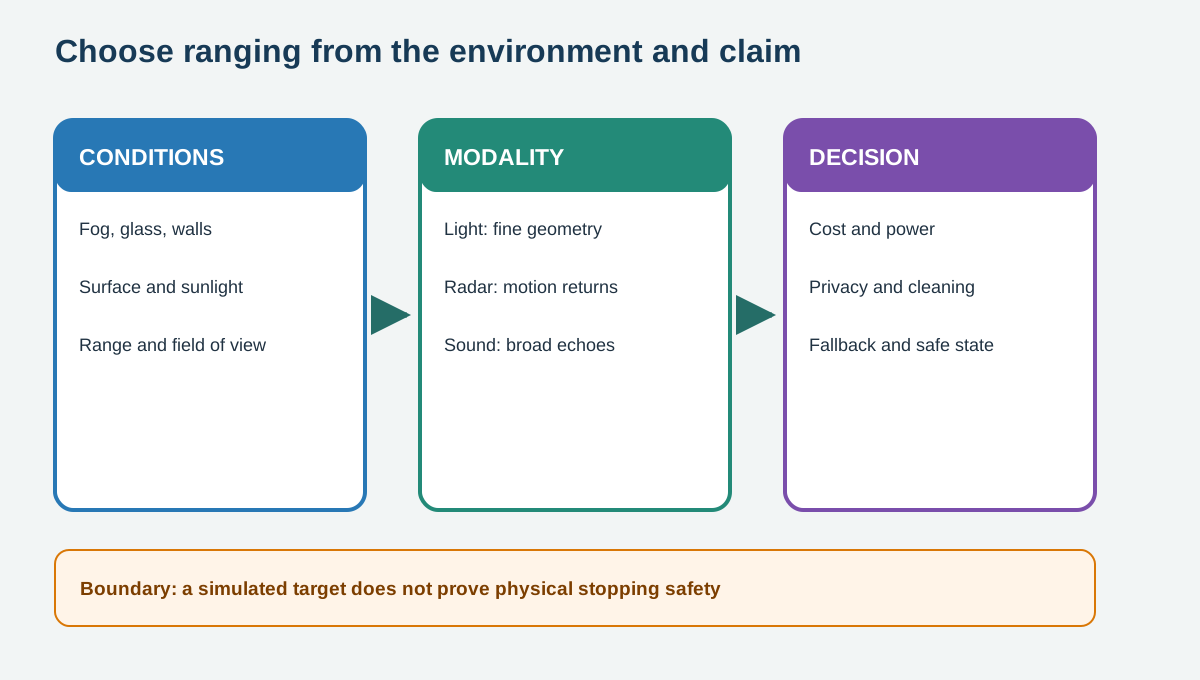
The comparison begins with the decision that the system must support, not with a preferred component.
- A fallback can slow a machine, ask for another reading, or transfer authority to a separate protective device.
- The arrows show processing order, not proof that the final output is correct in every setting.
Major section
VL53-class integration boundaries
A VL53L0X-style module uses I2C for configuration and distance results.
- Firmware should check initialization, timeout, status, units, and plausible bounds before acting.
- The Wokwi lab changes an explicitly labelled range-input surrogate and prints millimetres beside one HC-SR04 comparison line.
- Real hardware acceptance still needs known targets, difficult surfaces, ambient-light trials, and recorded status codes.
Major section
Summary
The useful choice connects a spatial question to a modality, a fallback, and named environmental limits.
- Those conditions explain why a sound bench result may not transfer to glass, fog, sunlight, or a moving platform.
- Optical ranging estimates light travel or pattern displacement under return-quality limits.
- A simulator checks code paths but cannot validate sunlight, fog, glass, stopping safety, or sensor calibration.
Deck summary
Key takeaways
A direct time-of-flight range follows R = ct/2, where c is the speed of light and t is round-trip delay.
- A single-zone module reports one range over its field of view.
- The comparison begins with the decision that the system must support, not with a preferred component.
- A VL53L0X-style module uses I2C for configuration and distance results.
- The useful choice connects a spatial question to a modality, a fallback, and named environmental limits.
Retrieval practice
Recall check

Radio Remi says: answer from memory, then check your reasoning.
Q1Why should a ToF reading carry a status or confidence value?
Show answer
Answer: A Weak or contaminated returns can make the numeric range unreliable.
Q2Which choice best fits one controlled, nearby optical zone?
Show answer
Answer: A A low-cost single-zone ToF module.
Print reference
Answers
Answer key.
- A · Weak or contaminated returns can make the numeric range unreliable.
- A · A low-cost single-zone ToF module.