Core Networking · Study deck
OSI and TCP/IP Models
Networks do several jobs in sequence.
Packet Pete is your guide for this deck.

After studying this chapter
Learning objectives
Follow this chapter path with evidence at each boundary.
- Name the system boundary.
- Record the evidence needed there.
- Keep the next decision tied to the source.
Major section
Start With the Layer That Owns the Failure
Networks do several jobs in sequence.
- They send a signal, deliver it across one local link, choose a route, deliver data, and give that data meaning.
- A fault in any one job may look like the same complaint: "it cannot connect.".
- A protocol is a set of rules that two systems agree to follow: Internet Protocol is the set of rules used to address and route packets across networks.
Major section
Overview: OSI and TCP/IP Models Are Troubleshooting Maps
The two models are not competing memory tests.
- A temperature reading, alarm, or actuator command is easier to debug when the team can name the job that failed.
- The job may be the physical signal, local delivery, routing, data delivery, or application meaning.
- OSI is the more detailed reference model.
Major section
Overview: OSI and TCP/IP Models Are Troubleshooting Maps (continued)
Its seven layers are Physical, Data Link, Network, Transport, Session, Presentation, and Application.
- TCP/IP is the practical model used for Internet systems.
- Its usual four groups are Network Access, Internet, Transport, and Application.
- Engineers use OSI when they need precise fault language.
- They use TCP/IP when discussing working Internet systems.
Major section
Overview: OSI and TCP/IP Models Are Troubleshooting Maps (continued)
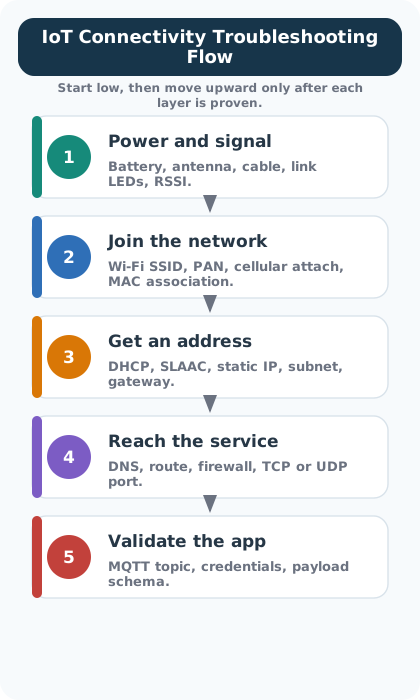
If you only need the intuition, this layer is enough: start at the bottom when a device cannot communicate, and move upward only when each lower layer has evidence.
- For example, suppose a greenhouse sensor stops updating a dashboard.
- A gateway is a device that links that local network to another network.
- This order stops a weak radio link from being mistaken for an MQTT or database fault.
Major section
Overview: OSI and TCP/IP Models Are Troubleshooting Maps (continued)
The sequence shows how each observation narrows the investigation without claiming that later boundaries have passed.
- For example, DHCP and SLAAC are two ways to obtain an address.
- If power and network joining work but both address methods fail, test addressing next.
- If this gives you the map, you can stop here.
Major section
Practitioner: Build a Layer Trace Record
A greenhouse sensor sends a periodic temperature reading through a gateway to a cloud dashboard.
- The dashboard shows stale data.
- The sensor is alive and the first hop is receiving frames.
- The gateway can reach the broker network path.
- The path exists, but delivery behavior is unstable.
Major section
Under the Hood: Encapsulation, Handoffs, and Failure Boundaries
Encapsulation is the main mechanical idea behind both models.
- As an application message moves down the sender's stack, each layer adds information for its own job.
- The receiver reverses the process and removes those wrappers as the message moves upward.
- The first hop cannot carry a usable frame.
Major section
Under the Hood: Encapsulation, Handoffs, and Failure Boundaries (continued)
The packet cannot be addressed or routed to the intended endpoint.
- The endpoint is reachable, but delivery behavior does not match the requirement.
- The message arrives but the application cannot interpret, authorize, or act on the right meaning.
- At this depth, the models are evidence contracts.
- OSI gives precise names for the contracts.
Major section
Implementation Ownership Across the Stack
The server reverses the process until its application receives the request.
- Layering is also an implementation contract.
- TLS protects the request bytes; TCP segments the resulting stream and maintains ordered delivery.
- A wired Linux gateway and a cellular phone do not share a layer-2 frame or PHY.
- The boundary is not absolute in every product.
Major section
Summary
OSI is a detailed seven-layer reference model; TCP/IP is the practical Internet architecture with fewer grouped layers.
- Layered thinking is most valuable when it turns a vague connectivity problem into specific evidence questions.
- A useful IoT trace starts at the physical and link layers, then moves through routed reachability, transport behavior, and application meaning.
- Encapsulation adds useful control information but also adds overhead, airtime, and failure boundaries.
Deck summary
Key takeaways
Networks do several jobs in sequence.
- The two models are not competing memory tests.
- Its seven layers are Physical, Data Link, Network, Transport, Session, Presentation, and Application.
- If you only need the intuition, this layer is enough: start at the bottom when a device cannot communicate, and move upward only when each lower layer has evidence.
- The sequence shows how each observation narrows the investigation without claiming that later boundaries have passed.
Retrieval practice
Recall check 1 of 3

Packet Pete says: answer from memory, then check your reasoning.
Q1Why are the OSI and TCP/IP models useful when an IoT device cannot reach a cloud service?
Show answer
Answer: A Layered models turn a vague outage into specific evidence questions at the physical, link, network, transport, and application boundaries.
Retrieval practice
Recall check 2 of 3
Packet Pete says: answer from memory, then check your reasoning.
Q2A gateway can ping the broker host, but sensor publishes still fail. Which trace-record update is most useful?
Show answer
Answer: B Ping proves only part of the network path.
Retrieval practice
Recall check 3 of 3
Packet Pete says: answer from memory, then check your reasoning.
Q3A gateway receives a link-layer frame, forwards an IP packet, and the cloud host accepts a TCP connection, but the command is rejected because the payload schema version is unsupported. Which boundary failed?
Show answer
Answer: C Lower-layer evidence shows the frame, route, and transport session worked; the failure is application interpretation.
Print reference
Answers
Answer key.
- A · Layered models turn a vague outage into specific evidence questions at the physical, link, network, transport, and application boundaries.
- B · Ping proves only part of the network path.
- C · Lower-layer evidence shows the frame, route, and transport session worked; the failure is application interpretation.