Wireless and Optical Sensing for IoT · Study deck
Integrated Sensing and Communication for IoT
Radio Remi is helping a factory send control messages across a busy hall.
Radio Remi is your guide for this deck.
After studying this chapter
Learning objectives
You will be able to:
- Explain how a known OFDM transmission can also support range and motion estimation.
- Compare communication throughput with sensing bandwidth, update rate, and ambiguity.
- Distinguish research and standards work from sensing capabilities available to an IoT designer today.
- Explain: Radio Remi is helping a factory send control messages across a busy hall.
Major section
Start With the Story
Radio Remi is helping a factory send control messages across a busy hall.
- The team could use those echoes to add a warning zone, but sensing symbols consume time, bandwidth, power, and compute.
- Remi asks for one schedule that keeps the control link useful while producing a modest range update.
- The team must show both results, not hide one behind the other.
Major section
Overview
Sharing may include waveform, spectrum, antennas, clocks, compute, or scheduling; it does not mean every communication packet becomes a complete radar.
- Known OFDM symbols can expose a channel estimate.
- Transforming that estimate across subcarriers produces delay or range structure, while changes across repeated symbols can expose Doppler.
- The design still needs calibration, geometry, clutter handling, privacy controls, and a communications service-level target.
Major section
Reuse an OFDM frame
Where $X[k]$ is known and non-zero, the channel estimate is $H[k]=Y[k]/X[k]$.
- A calibrated delay can map to range, although clock offsets and one-way versus round-trip geometry must be handled explicitly.
- A target moving toward or away from the radio changes phase across that axis, which can support a Doppler estimate.
- Wider occupied bandwidth improves the ability to separate nearby delays; longer coherent observation improves Doppler resolution but slows the result and demands more stable timing.
Major section
Read the shared resource grid
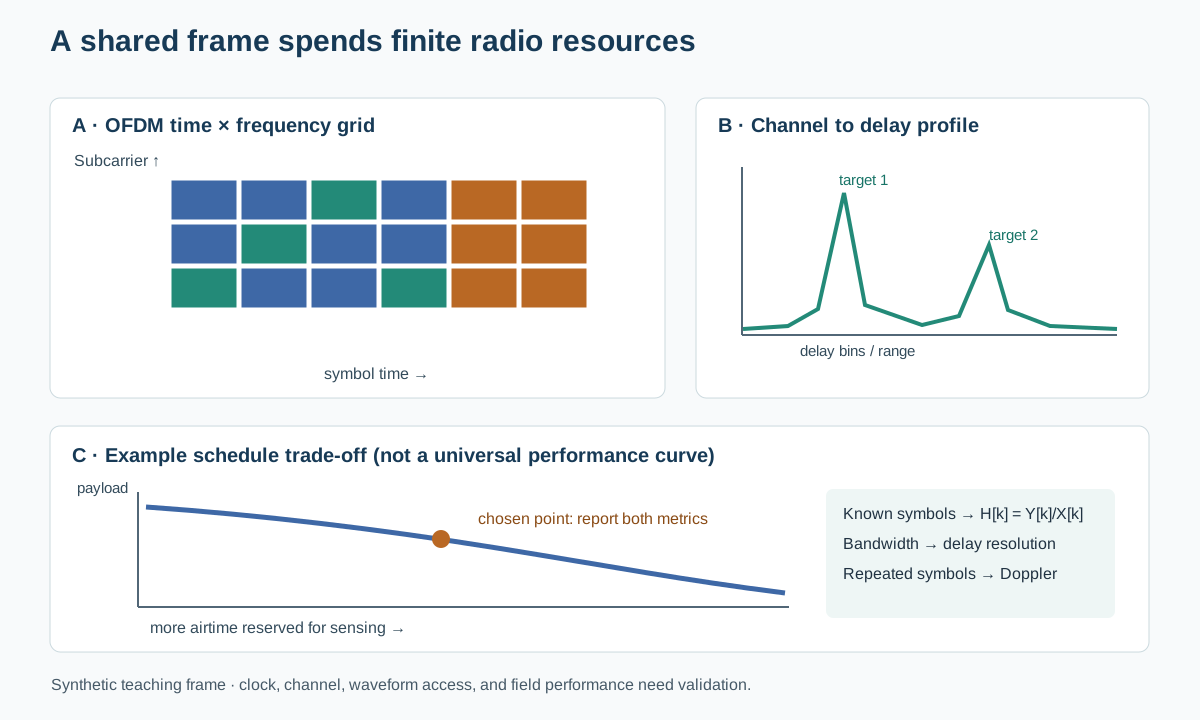
Blue cells carry payload, teal cells are known pilots, and amber cells reserve a denser sensing burst.
- The middle plot transforms the estimated channel into two delay peaks; close echoes could merge if their delay bins are too wide.
- A chosen operating point must report both link and sensing metrics.
Major section
Understand current and future use
An IoT designer today can use Wi-Fi CSI from supported hardware, communication-channel measurements, positioning features, or a dedicated radar beside the network.
- 3GPP Release 19 includes a study on integrated sensing and communication, while the ITU IMT-2030 framework names ISAC as a future usage scenario.
- A study, framework, prototype, or vendor demonstration is not the same as an interoperable sensing service available on every 5G-Advanced network.
- Candidate use cases include drone or object detection, factory monitoring, transport safety, mapping, and occupancy.
- Each one needs its own range, field of view, update rate, false-alarm cost, and privacy boundary.
Major section
Summary
ISAC shares radio resources, but it does not erase engineering trade-offs.
- Known OFDM symbols support a channel estimate, frequency structure supports a delay profile, and repeated symbols can support Doppler.
- Every design must state what is shared, what is calibrated, and how communication and sensing outcomes were measured together.
- $H[k]=Y[k]/X[k]$ is useful only where the transmitted symbol is known and non-zero.
Deck summary
Key takeaways
Radio Remi is helping a factory send control messages across a busy hall.
- Sharing may include waveform, spectrum, antennas, clocks, compute, or scheduling; it does not mean every communication packet becomes a complete radar.
- Where $X[k]$ is known and non-zero, the channel estimate is $H[k]=Y[k]/X[k]$.
- Blue cells carry payload, teal cells are known pilots, and amber cells reserve a denser sensing burst.
- An IoT designer today can use Wi-Fi CSI from supported hardware, communication-channel measurements, positioning features, or a dedicated radar beside the network.
Retrieval practice
Recall check

Radio Remi says: answer from memory, then check your reasoning.
Q1Why must the receiver know or decode an OFDM symbol before using Y[k]/X[k] as a channel estimate?
Show answer
Answer: A The received value contains both the transmitted symbol and the channel response, so the symbol must be known or decoded before division.
Q2What proves a chosen ISAC schedule?
Show answer
Answer: A Judge link and sensing results side by side.
Print reference
Answers
Answer key.
- A · The received value contains both the transmitted symbol and the channel response, so the symbol must be known or decoded before division.
- A · Judge link and sensing results side by side.