RFID, NFC & UWB · Study deck

ISA100.11a vs WirelessHART

Picture a pressure sensor in a plant.

Radio Remi is your guide for this deck.

isa100protocolstack
Radio Remi, the module guide, in a scene from this chapter.
iotclass.org

After studying this chapter

Learning objectives

You will be able to:

  • Compare ISA100.11a and WirelessHART by layer without treating shared radio hardware as protocol compatibility.
  • Explain where IPv6, 6LoWPAN, gateway translation, routing, security, and management ownership affect deployment risk.
  • Separate application compatibility from wireless link behavior.
  • Identify which flows benefit from ISA100.11a flexibility and which flows benefit from HART-native operation.
iotclass.org

Major section

Start With the Story

Its reading must cross a shared wireless site, reach the right system, and remain useful when one route is blocked.

  • Choosing the radio alone does not prove that whole path.
  • A protocol is a shared set of rules for communication.
  • An industrial stack joins several rule sets, from the radio link up to device data and management.

Key terms

ISA100.11a
ISA100.11a is one such stack for industrial wireless systems.

Numbers to remember

11aISA100.11a is one such stack for industrial wireless systems.
iotclass.org

Major section

Start With the Story (continued)

ISA100.11a is one such stack for industrial wireless systems.

  • The simple stack view has limits.
  • Similar radio parts do not make two systems equal in operations or trust.
  • ISA100.11a and WirelessHART can both support industrial wireless monitoring, so the decision cannot stop at "industrial mesh." The practical difference is where management, routing, security, interoperability, and gateway ownership sit.
iotclass.org

Major section

Minimum Viable Understanding

Shared PHY does not mean shared stack.

  • ISA100.11a is more integration-oriented.
  • Its IPv6 and 6LoWPAN fit can help with plant-network integration, but only when gateway, diagnostic, and ownership records are clear.
  • WirelessHART is more HART-oriented.
  • Its strongest fit is a plant that already depends on HART instruments, tools, and command workflows.

Numbers to remember

11aISA100.11a is more integration-oriented.
iotclass.org

Major section

Minimum Viable Understanding (continued)

Security is a boundary question.

  • Link protection, payload protection, management keys, route visibility, and gateway trust boundaries are not the same thing.
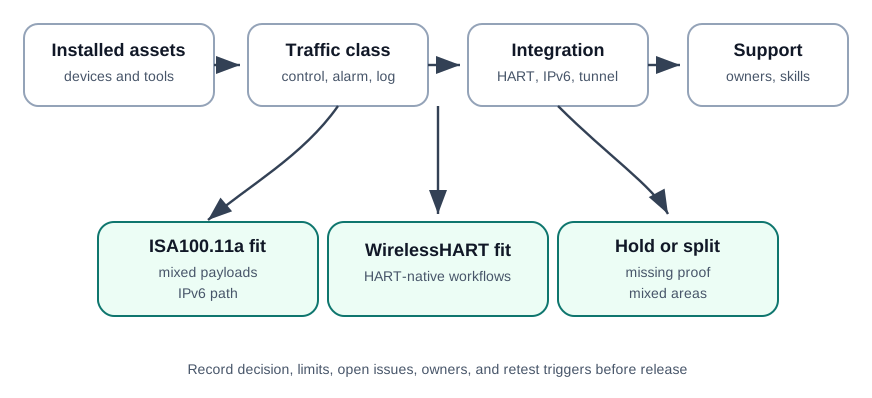
  • Protocol choice is an evidence decision.
  • Device availability, owner skill, diagnostics, coexistence, gateway support, and replacement workflow matter as much as layer diagrams.
iotclass.org

Major section

Same Radio, Different Operating Model
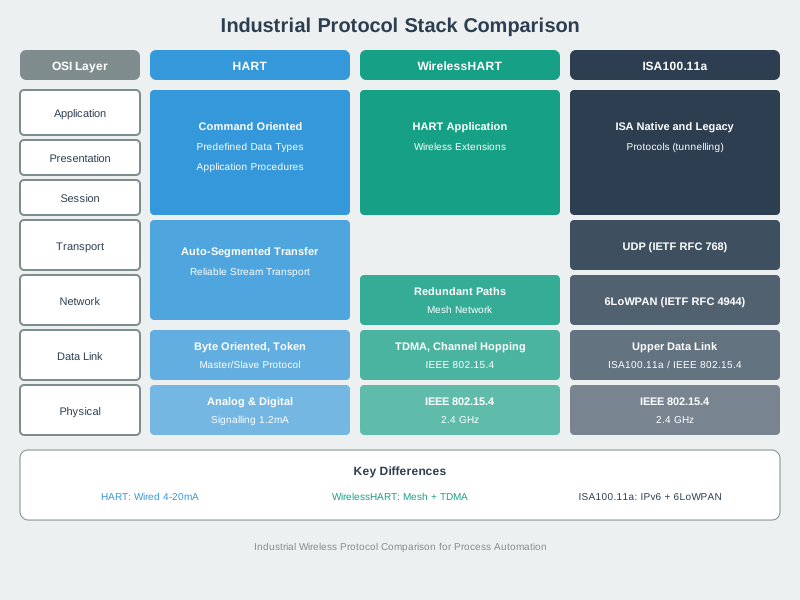
WirelessHART is standardized as IEC 62591.

  • ISA100.11a is standardized as IEC 62734.
  • The real difference is operating philosophy.
  • WirelessHART is a single prescriptive profile built around HART.
  • ISA100.11a is a configurable, IP-oriented framework built to carry several industrial protocol patterns.

Numbers to remember

11aISA100.11a and WirelessHART are the two dominant industrial wireless standards

Why it matters

That one choice explains most of the tradeoffs, because the shared radio does not mean shared engineering.

Industrial protocol stack comparison showing OSI layers across HART, WirelessHART, and ISA100.11a, including HART commands, WirelessHART mesh TDMA, ISA100.11a UDP, 6LoWPAN, upper data link, and IEEE 802.15.4 layers.
iotclass.org

Major section

Same Radio, Different Operating Model (continued)

If the condition-monitoring devices need IP-style integration, object data, or non-HART tunneling, ISA100.11a may fit that second group better.

  • A process unit has 40 wired-HART pressure and temperature instruments that report slowly, plus 8 newer condition-monitoring devices that publish richer diagnostics.
  • The standards can coexist in the same site, but the boundary must be explicit.
  • Each mesh has its own manager, keys, gateway mapping, alarm behavior, and maintenance evidence.
iotclass.org

Major section

Stack Boundaries

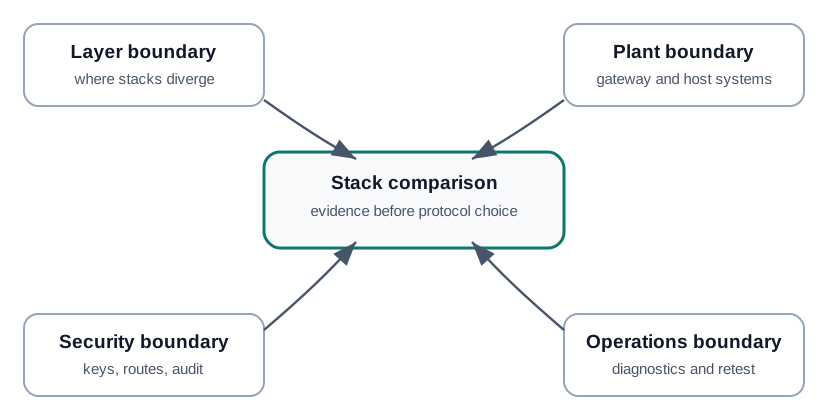
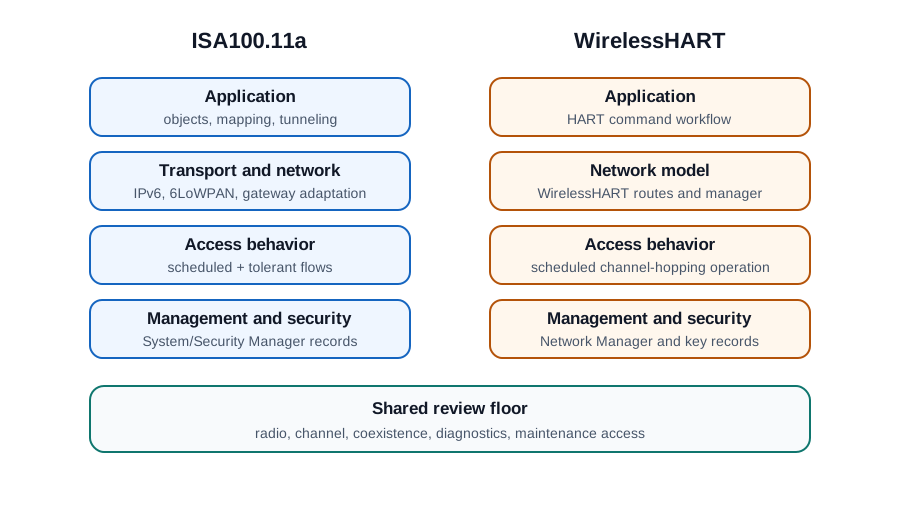
Layer diagrams are useful only when they show which team owns each boundary.

  • Application layer: ISA100.11a can expose native objects and support tunneled legacy payloads.
  • WirelessHART uses a WirelessHART-specific network model and route planning.
  • MAC and scheduling: ISA100.11a can mix scheduled and contention-tolerant behavior by flow.
  • Management plane: Both require management discipline.

Numbers to remember

11aApplication layer: ISA100.11a can expose native objects
ISA100.11a and WirelessHART stack boundary comparison from application and management layers through network, MAC, security, and IEEE 802.15.4 radio
iotclass.org

Major section

Head-to-Head Stack Tradeoffs

If the same site adds 6 vibration monitors with larger diagnostic payloads and a requirement to integrate through an IP-addressable gateway, the calculus changes.

  • Neither standard is better in isolation; they optimize different release risks.
  • The price of that flexibility is test scope.
  • A mixed plant should avoid pretending one comparison table decides every area.
iotclass.org

Major section

Routing, Access, and Security

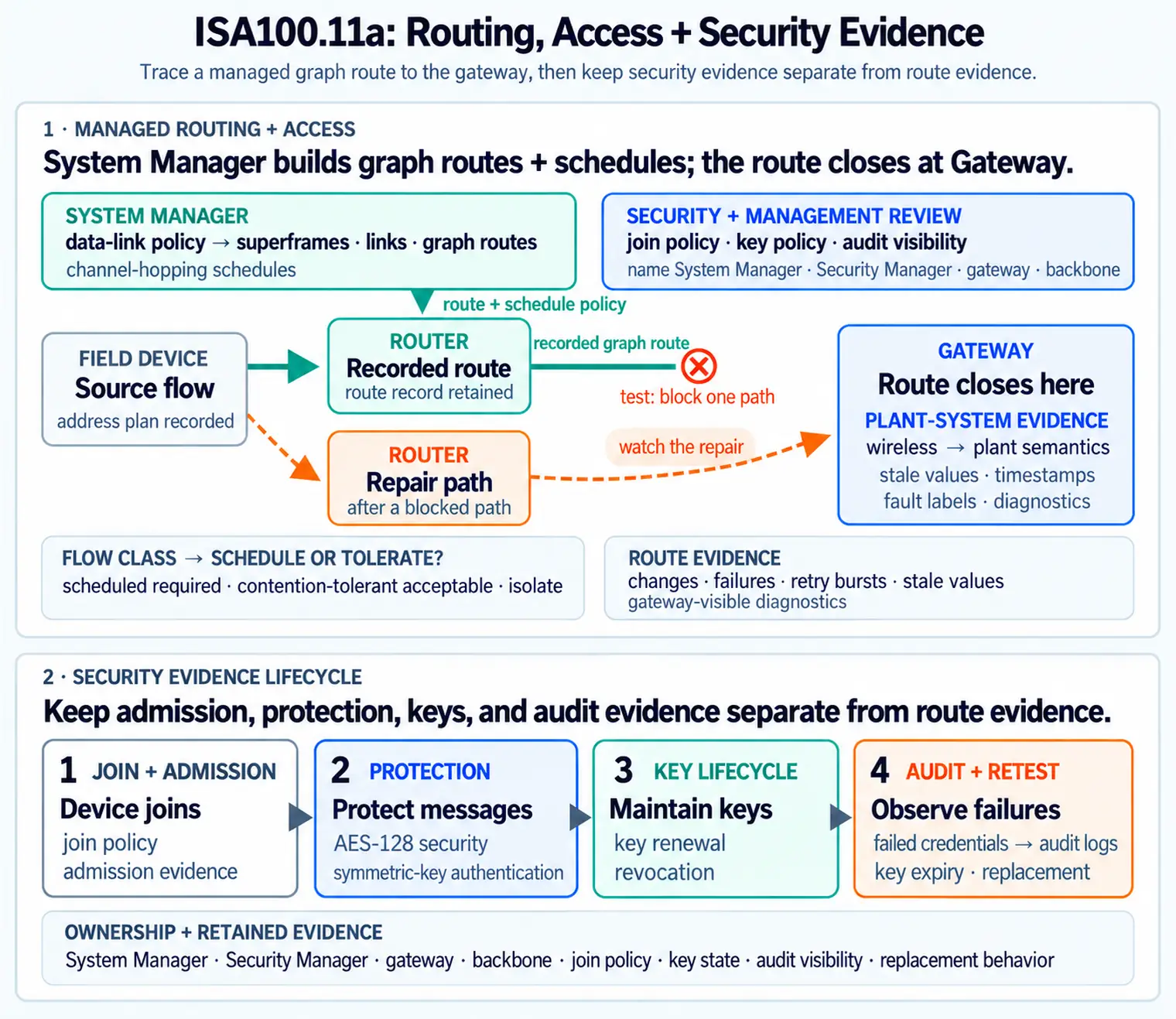
The most important differences appear when the wireless network is under maintenance pressure: a route changes, a device is replaced, a key expires, a gateway restarts, or a flow becomes urgent.

  • Access method evidence: For each flow, record whether scheduled access is required, contention-tolerant access is acceptable, or the flow must be isolated.
ISA100.11a and WirelessHART routing, access, and security comparison showing scheduled access, contention tolerance, route ownership, key ownership, and diagnostic evidence
iotclass.org

Major section

Prescriptive vs. Configurable Failure Modes

That design choice changes the failure modes.

  • With WirelessHART, the Network Manager can plan around a common slot model and a common payload expectation.
  • The exact schedule is manager-specific, but the integrator is not deciding the slot duration or inventing the application boundary.
  • ISA100.11a exposes degrees of freedom so multi-protocol integration is possible.

Numbers to remember

11aISA100.11a leaves more of that shape open: configurable slot timing

Why it matters

That rigidity is a feature in a HART plant because there are fewer parameters to get wrong, but it also means the network speaks HART and little else.

iotclass.org

Major section

Prescriptive vs. Configurable Failure Modes (continued)

ISA100.11a leaves more of that shape open: configurable slot timing, multiple hopping modes, IPv6 addressing, and an object model that can tunnel other protocols.

  • That flexibility is powerful for a heterogeneous plant and for connecting to IT systems, but every open parameter is one an integrator must configure and validate.
  • Above it, WirelessHART reduces degrees of freedom so HART interoperability is the default outcome.
  • Many sites run both, chosen per area by which tradeoff fits.
iotclass.org

Major section

Common Pitfalls

Shared radio shortcut: assuming that common IEEE 802.15.4 radio behavior makes ISA100.11a and WirelessHART interoperable above the PHY layer.

  • Feature-list selection: choosing the standard with more options without proving who will operate those options.
  • HART fit ignored: overlooking existing HART tools, command workflows, gateway support, and operator practice.
  • No retest policy: failing to reopen the comparison after firmware, gateway, key-policy, route, enclosure, or interference changes.
iotclass.org

Major section

Summary

ISA100.11a and WirelessHART should be compared as complete operating models, not as radio-only alternatives.

  • ISA100.11a tends to fit when IPv6 adaptation, multiple payload types, gateway mapping, and flexible flow handling are important and support ownership is clear.
  • WirelessHART tends to fit when HART-native instruments, tools, host-system integration, and scheduled operation dominate the deployment.
  • The right decision is the one backed by layer-specific evidence, operational ownership, gateway diagnostics, replacement workflow, and retest triggers.

Numbers to remember

11aISA100.11a and WirelessHART should be compared as complete operating models
iotclass.org

Deck summary

Key takeaways

Its reading must cross a shared wireless site, reach the right system, and remain useful when one route is blocked.

  • ISA100.11a is one such stack for industrial wireless systems.
  • Shared PHY does not mean shared stack.
  • Security is a boundary question.
  • WirelessHART is standardized as IEC 62591.
iotclass.org

Retrieval practice

Recall check 1 of 3

Radio Remi says: answer from memory, then check your reasoning.

Q1ISA100.11a and WirelessHART both use IEEE 802.15.4 radios. What follows about interoperability?

AThey are fully interchangeable because the radio layer is identical between them.
BThey differ above the radio and need gateway translation.
CThey cannot coexist in the same plant under any circumstances whatsoever.
DThey automatically share the same Network Manager by default configuration.
Show answer

Answer: B A common 802.15.4 radio does not make ISA100.11a and WirelessHART interchangeable; their upper layers differ.

iotclass.org

Retrieval practice

Recall check 2 of 3

Radio Remi says: answer from memory, then check your reasoning.

Q2A plant says ISA100.11a and WirelessHART are compatible because both use IEEE 802.15.4 radios. What is the best review response?

ACompare network, management, application, security, and gateway layers separately.
BAccept the claim because the physical layer determines the whole protocol stack.
CFavor ISA100.11a for familiar IPv6 addressing and network integration tools.
DFavor WirelessHART to reuse the plant's HART command and maintenance workflows.
Show answer

Answer: A Protocol-stack comparison must isolate the layer where a claim is true.

iotclass.org

Retrieval practice

Recall check 3 of 3

Radio Remi says: answer from memory, then check your reasoning.

Q3Two plants pick different industrial wireless standards. Plant A is all-HART and wants minimal configuration; Plant B mixes HART, Modbus, and Foundation Fieldbus and wants IP integration. Which fits each, given both use 802.15.4, TDMA, channel hopping, and AES-128?

APlant A: ISA100.11a; Plant B: WirelessHART, because WirelessHART tunnels the most protocols.
BEither works identically because they share the same PHY and TDMA, so the choice is arbitrary.
CPlant A: WirelessHART profile; Plant B: ISA100.11a IP and multi-protocol integration.
DBoth plants must use Wi-Fi because 802.15.4 cannot integrate with IT systems.
Show answer

Answer: C Both standards share low-power industrial wireless foundations, but WirelessHART is a prescriptive HART standard while ISA100.11a is a configurable 6LoWPAN and IPv6 framework for multiple industrial protocol patterns.

iotclass.org

Print reference

Answers

Answer key.

  1. B · A common 802.15.4 radio does not make ISA100.11a and WirelessHART interchangeable; their upper layers differ.
  2. A · Protocol-stack comparison must isolate the layer where a claim is true.
  3. C · Both standards share low-power industrial wireless foundations, but WirelessHART is a prescriptive HART standard while ISA100.11a is a configurable 6LoWPAN and IPv6 framework for multiple industrial protocol patterns.
iotclass.org