RFID, NFC & UWB · Study deck

Practice: ISA100.11a Security

Picture a new field device asking to join a plant network.

Radio Remi is your guide for this deck.

isa100security
iotclass.org

After studying this chapter

Learning objectives

You will be able to:

  • Design an ISA100.11a lab that tests security ownership rather than only packet delivery.
  • Trace secure join, role assignment, key lifecycle, diagnostics, and replacement evidence.
  • Separate hop security, payload confidentiality, routing visibility, and gateway trust boundaries.
  • Review tunneled industrial traffic without relying on brittle overhead shortcuts.
iotclass.org

Major section

Start With the Story

A quick success would admit the wrong identity; a silent failure would leave the installer guessing beside live equipment.

  • A gateway is the device that joins the field network to another system.
  • A payload is the useful data carried in a message.
  • One lab cannot prove the whole plant is secure.

Numbers to remember

11aFor ISA100.11a, that means secure join evidence

Why it matters

The device and gateway should fail closed, leave a clear audit record, and allow a bounded recovery that does not expose secret material.

iotclass.org

Major section

Start With the Story (continued)

The deeper sections connect join evidence, key life, message checks, and recovery so the release decision states what was and was not tested.

  • A security lab is useful when it turns invisible trust into artifacts.
  • For ISA100.11a, that means secure join evidence, key lifecycle records, traffic checks, coexistence observations, and a release decision that says what remains unproven.
  • The device and gateway should fail closed, leave a clear audit record, and allow a bounded recovery that does not expose secret material.
iotclass.org

Major section

Minimum Viable Understanding

A lab is an evidence record.

  • Screenshots, packet traces, join logs, route changes, and release notes matter more than synthetic performance scores.
  • Security is operational.
  • The System Manager and Security Manager must be part of join, key, revocation, audit, and replacement workflows.
  • Link protection, payload protection, routing metadata, and gateway translation protect different boundaries.
iotclass.org

Major section

Secure Join and Key Lifecycle
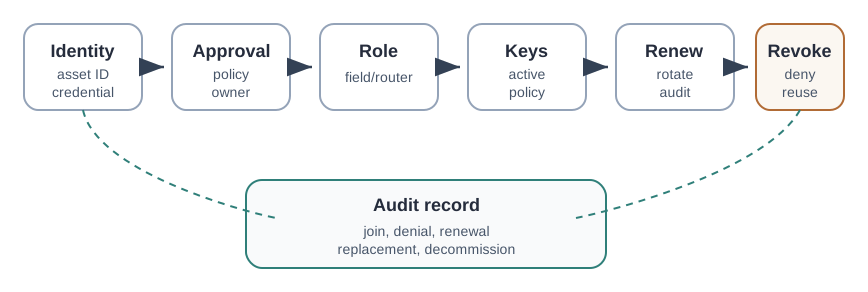
Secure join is not a one-time success message.

  • The comparison reaches replacement, decommission.
  • That ordering makes replacement, decommission depend on asset ID.
  • The conclusion in secure join and key lifecycle now has a named boundary.
ISA100.11a secure join and key lifecycle from device identity through approval, role assignment, key use, renewal, revocation, and decommissioning
iotclass.org

Major section

Joining and Key Management Evidence

A device becomes a trusted member through a managed join overseen by the Security Manager.

  • The lab task is to turn that abstract join into a repeatable commissioning, renewal, replacement, and removal procedure.
  • Skipping: Encrypt/Sign would leave: Every stage requires security controls and audit logging unsupported.
  • Reopen joining and key management evidence whenever: Encrypt/Sign changes.

Key terms

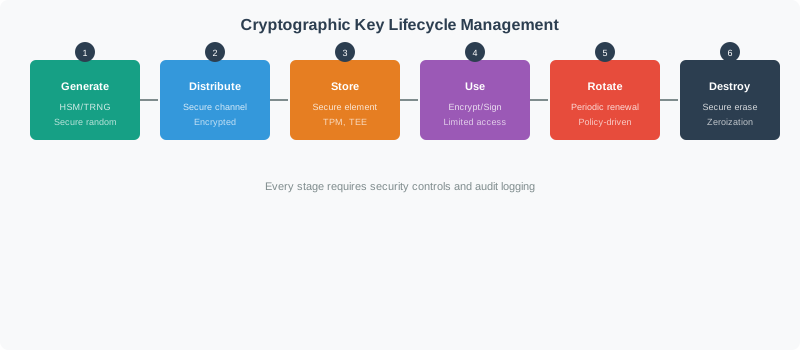
Because keys
Because keys are centrally managed, revoking one compromised device does not force re-keying the whole plant.
Cryptographic key lifecycle management showing generation, distribution, storage, use, rotation, and destruction stages
iotclass.org

Major section

Joining and Key Management Evidence (continued)
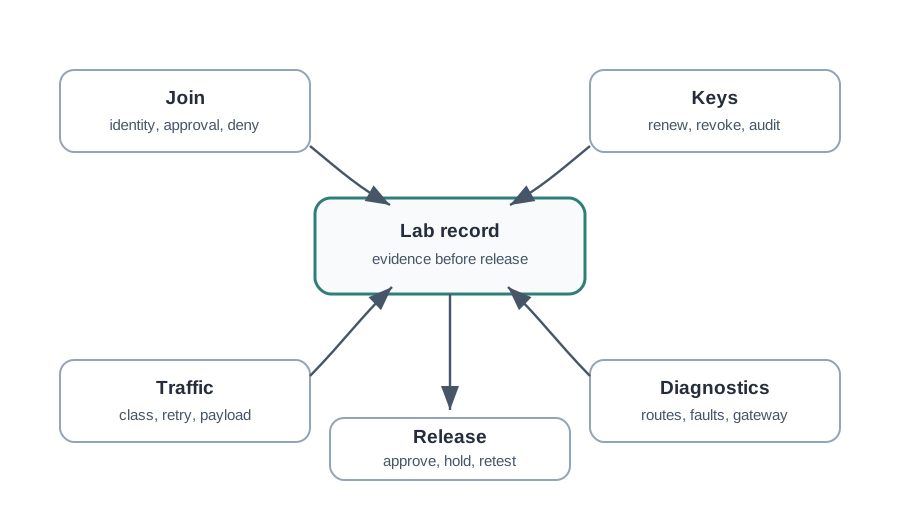
To test joining and key management evidence, inspect how: Generate relates to: Encrypt/Sign in it.: Every stage requires security controls and audit logging marks the next check.

  • The lifecycle view keeps the lab from stopping at a successful join.
  • Generation, provisioning, protected storage, use, derived purpose keys, rotation or revocation, destruction, and key inventory evidence each need an owner and an audit record.
  • The lab should still prove this with a replacement drill.
iotclass.org

Major section

Joining and Key Management Evidence (continued)

The new device authenticates using a pre-configured join key, proving it is allowed onto this network.

  • The Security Manager handles ongoing lifecycle work: distribution, rotation, and revocation for a device that must be removed.
  • The Security Manager rotates the affected keys while the rest of the network keeps running.
  • Practitioners should also separate scheduled process traffic from maintenance traffic during the key exercise.
iotclass.org

Major section

Security Boundaries

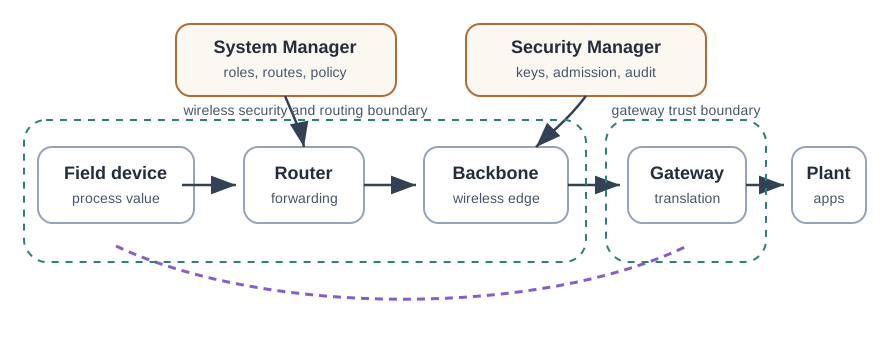
ISA100.11a security review should avoid vague statements such as "the network is encrypted." The question is which boundary is protected, who can inspect metadata, and where trust changes.

  • For the evidence behind security boundaries, use it to distinguish process value from translation.
  • A fault should remain attached to process value or translation.
ISA100.11a security boundaries showing field device, router, backbone router, gateway, System Manager, Security Manager, and plant systems
iotclass.org

Major section

Security at Two Layers, Not One

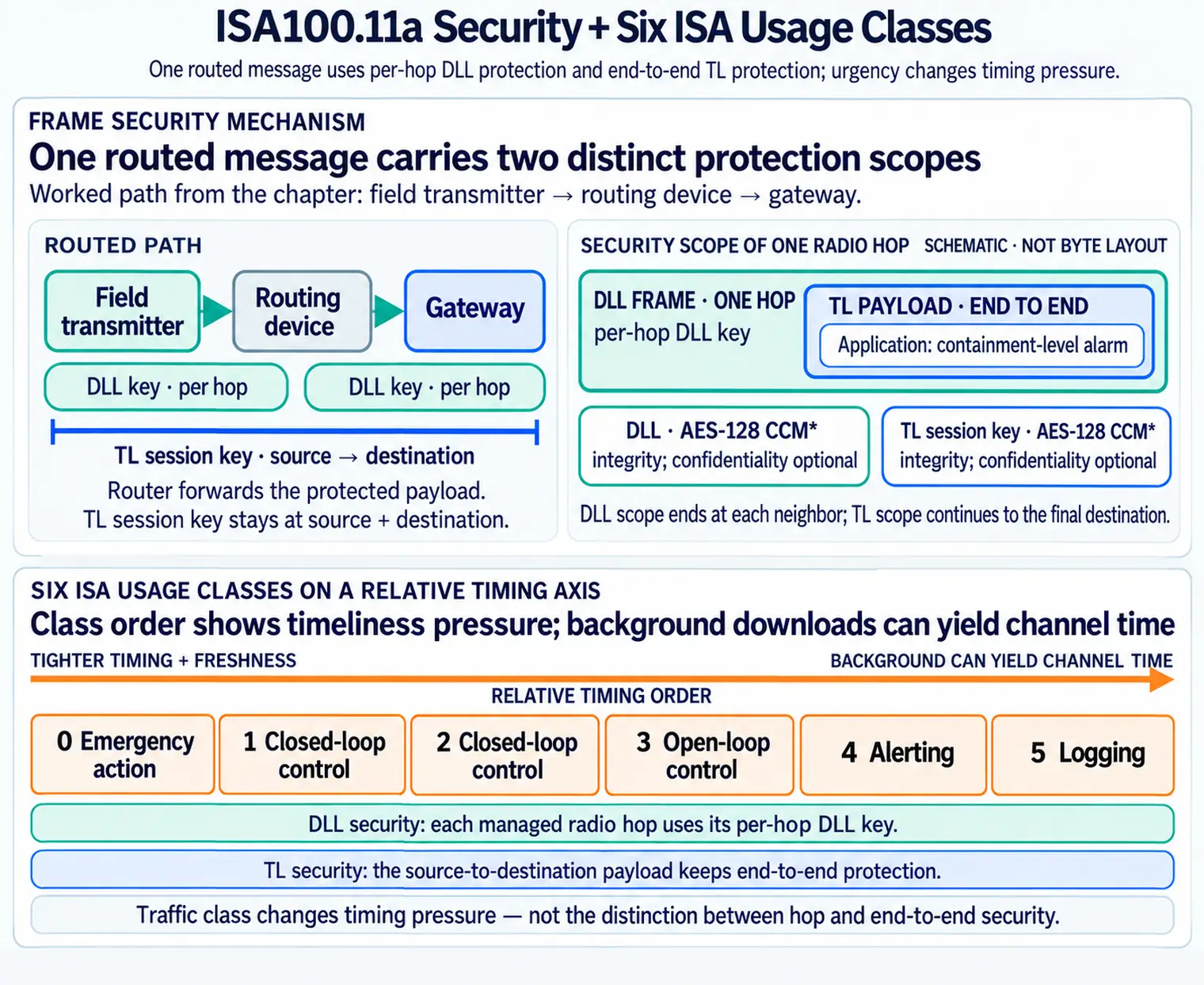
The: Two-layer rule keeps data-link protection on each managed hop distinct from transport or application security between endpoints.

  • ISA100.11a protects traffic at two layers at once.
  • ISA100.11a does both, so a relay node in the middle can forward a message it cannot read or forge.

Numbers to remember

11aISA100.11a protects traffic at two layers at once.
ISA100 usage classes from emergency action to logging are aligned with link and end-to-end security duties.
iotclass.org

Major section

Security at Two Layers, Not One (continued)

In a lab, that distinction should be visible in the evidence rather than treated as a diagram label.

  • A field transmitter might send a containment-level alarm through one routing device to a gateway.
  • If the denied join produces no operator-visible log, the lab has found a release issue even if normal traffic works.
  • The security lab therefore sits between protocol theory and plant operations.
iotclass.org

Major section

What Each Layer Defends Against

A compromised middle node becomes an untrusted forwarder rather than a man in the middle.

  • The two layers stop different attacks.
  • DLL hop-by-hop security means every relay checks the integrity of each frame it receives before forwarding, so an attacker cannot inject or alter frames on a single radio link without detection.
  • The conservative conclusion is that cryptography gives the deployment a defendable boundary, but the lab must prove the boundary is operated correctly.

Numbers to remember

11aA release-ready ISA100.11a security lab shows accepted joins
iotclass.org

Major section

What Each Layer Defends Against (continued)

The payload is protected with a session key shared only by the true source and destination, so an intermediate router forwards ciphertext it cannot decrypt and cannot forge.

  • The wireless path might report per-hop retries, the tunnel might report a translation error, and the plant application might show only a stale value.
  • A release-ready ISA100.11a security lab shows accepted joins, denied joins, role assignment, key renewal, revocation, routed-path diagnostics, gateway translation evidence, and retest triggers.
  • Hop-by-hop alone would still let a compromised router read and rewrite the payload it forwards, because it necessarily holds the link key.
iotclass.org

Major section

Release Notes

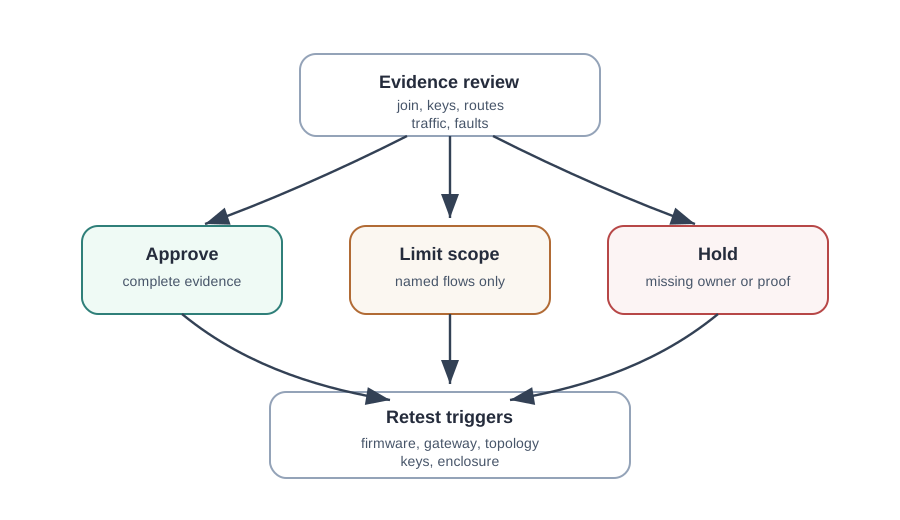
The final lab output should be a release decision that a plant engineer can review later.

  • Retest: Retest after firmware changes, key-policy changes, device replacement, gateway replacement, topology changes, enclosure moves, or interference changes.
ISA100.11a release evidence linking lab results, open issues, owners, retest triggers, and deployment decision
iotclass.org

Major section

Common Pitfalls

Connected equals secure: a successful join does not prove identity approval, denied-join logging, key renewal, or revocation behavior.

  • Encryption scope confusion: link protection, payload protection, route visibility, and gateway trust boundaries are different review items.
  • Hidden management ownership: no one can explain who changes roles, keys, schedules, routes, or gateway translation rules.
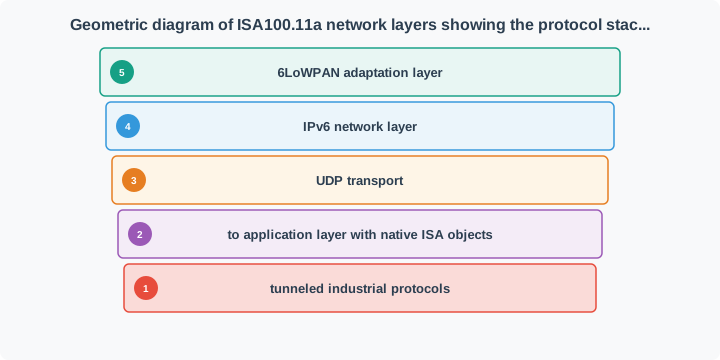
  • Tunneling blind spot: a legacy payload works in a small test but diagnostics, retries, fragmentation, or stale-value behavior are not reviewed.
iotclass.org

Deck summary

Key takeaways

A quick success would admit the wrong identity; a silent failure would leave the installer guessing beside live equipment.

  • The deeper sections connect join evidence, key life, message checks, and recovery so the release decision states what was and was not tested.
  • A lab is an evidence record.
  • Secure join is not a one-time success message.
  • A device becomes a trusted member through a managed join overseen by the Security Manager.
iotclass.org

Retrieval practice

Recall check 1 of 3

Radio Remi says: answer from memory, then check your reasoning.

Q1Beyond showing a successful join, what does a security-reviewable ISA100.11a lab most need to record?

AKey provisioning, rotation, and revocation evidence
BThe exact radio signal strength in dBm at the moment of join
CThe color scheme and layout of the operator dashboard
DThe vendor's marketing name for the field device
Show answer

Answer: A A security-reviewable ISA100.11a lab records how keys are provisioned, rotated, and revoked, not just that a join worked.

iotclass.org

Retrieval practice

Recall check 2 of 3

Radio Remi says: answer from memory, then check your reasoning.

Q2In an ISA100.11a network, one routing device is compromised. Why can it still not read or forge the sensor payloads it relays?

AThe relay never sees the message because ISA100 avoids routing through field devices entirely.
BHop-by-hop data-link encryption alone hides the payload contents from the relay.
CEnd-to-end transport security uses a source-destination session key.
DThe Security Manager inspects every message in transit so the relay cannot tamper.
Show answer

Answer: C ISA100.11a secures both hop-by-hop DLL and end-to-end TL traffic with AES-128-CCM*. The TL session key is shared only by source and destination, so a compromised relay forwards ciphertext it cannot read or forge.

iotclass.org

Retrieval practice

Recall check 3 of 3

Radio Remi says: answer from memory, then check your reasoning.

Q3An ISA100.11a lab shows that an approved device can join and publish data. Which missing test most directly checks whether the join process is security-reviewable?

ADenied-join evidence with usable device identity logs.
BIncrease the publish interval until the average latency looks lower.
CCapture only the gateway application value after the device joins.
DSkip the denied-join test because failed joins are not part of normal operation.
Show answer

Answer: A A lab that only proves successful communication is incomplete.

iotclass.org

Print reference

Answers

Answer key.

  1. A · A security-reviewable ISA100.11a lab records how keys are provisioned, rotated, and revoked, not just that a join worked.
  2. C · ISA100.11a secures both hop-by-hop DLL and end-to-end TL traffic with AES-128-CCM*. The TL session key is shared only by source and destination, so a compromised relay forwards ciphertext it cannot read or forge.
  3. A · A lab that only proves successful communication is incomplete.
iotclass.org