RFID, NFC & UWB · Study deck
ISA100.11a Fundamentals
Picture a chemical plant adding a wireless valve monitor beside older wired controls.
Radio Remi is your guide for this deck.

After studying this chapter
Learning objectives
You will be able to:
- Name the core ISA100.11a roles and explain what each role owns.
- Separate wireless field-network behavior from plant-backbone and application-system behavior.
- Explain why the System Manager and Security Manager are central to an ISA100.11a deployment.
- Choose star, mesh, or hybrid topology patterns from placement, power, maintenance, and path evidence.
Major section
Start With the Story
The radio can carry the reading, but safe use also depends on who admits the device, who sets traffic priority, how keys change, and how the plant sees a weak path before data is lost.
- A standard feature is not proof that staff can operate it through change.
- The wireless service can add observation and planned control only within its tested failure boundary.
- This opening does not approve a plant design or vendor.
Major section
Start With the Story (continued)
If any answer is no, keep the service out of a critical role.
- A clear small record is worth more than a broad claim that the radio is industrial.
- ISA100.11a starts to matter when an industrial wireless network needs explicit roles, traffic classes, management policy, IPv6 fit, security, and integration boundaries.
- The radio is only one part of the operating story.
Major section
Minimum Viable Understanding
ISA100.11a is centrally managed.
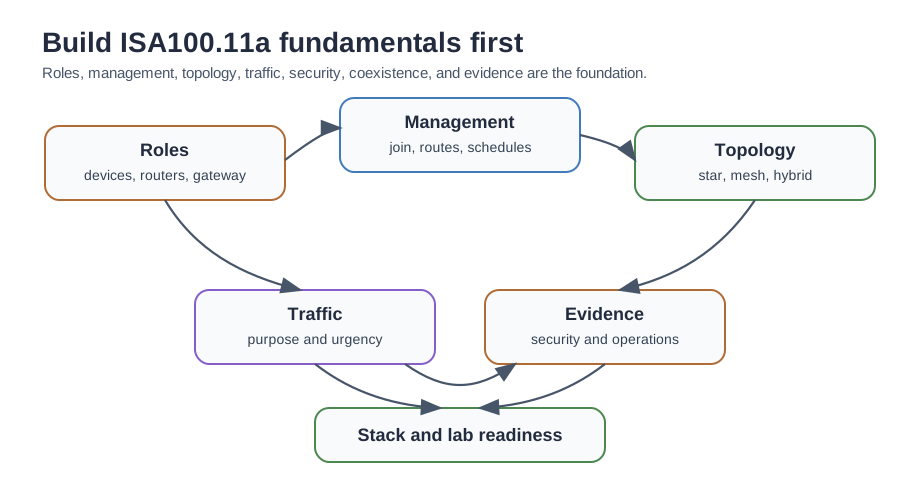
- Joining, schedules, routes, roles, and policies are not incidental details.
- Roles are design boundaries.
- Field device, router, backbone router, gateway, System Manager, and Security Manager work should be visible in the design record.
- Topology is a maintenance choice, not just a connectivity shape.
Major section
Minimum Viable Understanding (continued)
Routing devices need power, placement, access, and replacement plans.
- Scheduled access and contention-tolerant access should be selected from the behavior of each flow.
- Internet-native pieces still need industrial evidence.
- IPv6 and 6LoWPAN do not remove frame-size, fragmentation, diagnostics, security, or ownership concerns.
Major section
ISA100.11a Is a Flexible Industrial Stack on 802.15.4
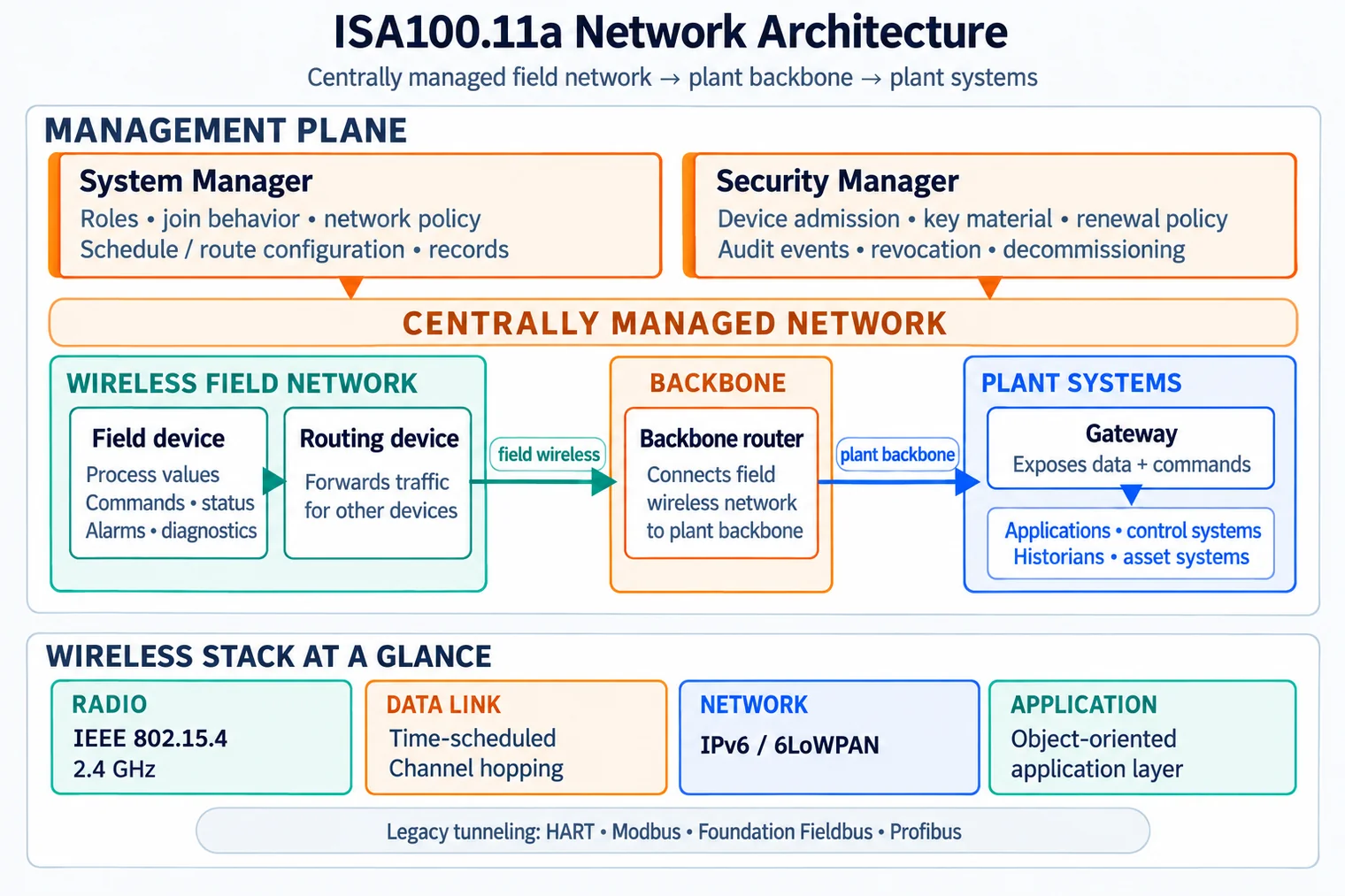
ISA100.11a, also published as: IEC 62734, is a wireless standard for industrial process automation.
- Flexibility is the theme: one network can carry HART, Modbus, Foundation Fieldbus, and Profibus traffic when the gateway and support model are designed for that mix.
Major section
ISA100.11a Is a Flexible Industrial Stack on 802.15.4 (continued)
That design makes ISA100.11a the more protocol-agnostic industrial wireless option, but it also adds configuration work.
- A chapter that says only "ISA100 uses IPv6" misses the industrial part of the problem.
- Success at: Industrial Wireless Standard for Process Automation cannot prove the: Detector boundary.
- Carry: Industrial Wireless Standard for Process Automation into the evidence for isa100.11a is a flexible industrial stack on 802.15.4.
Major section
ISA100.11a Is a Flexible Industrial Stack on 802.15.4 (continued)
A simple 2.4 GHz free-space estimate is FSPL = 40.05 + 20 log10(d_m), so 100 m gives about 80 dB path loss.
- If the enclosure, pipe rack, and fading budget consume 12 dB + 8 dB, only about 9 dB remains.
- That example does not certify a site, but it shows why ISA100.11a fundamentals are not just naming layers.
- Topology, antenna placement, channel hopping, routing eligibility, and retest triggers all decide whether a scheduled wireless design will keep working after installation.
Major section
Core Roles
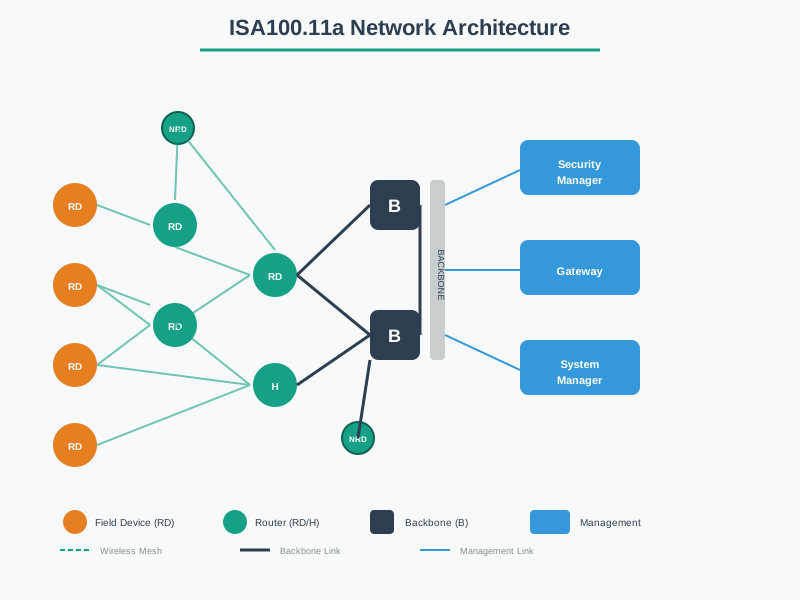
An ISA100.11a network is not simply "wireless sensors plus a gateway." It is a managed system with distinct responsibilities.
- To ground core roles, find the boundary between: RD and: Backbone (B) on it.: Management Link makes the purpose concrete.
- The hand-off to: Management Link needs an assigned owner.
- Reopen core roles whenever: Backbone (B) changes.
Major section
Managed Roles Need Ownership Records
An ISA100.11a network is centrally managed by two authorities plus the infrastructure that connects it out.
- In a design review, these roles should appear in the commissioning packet rather than only in a vendor diagram.
- The data-link layer uses TDMA with configurable slot timing and channel hopping so transmissions are scheduled and spread across channels to reduce interference exposure.
- Determinism still has to be budgeted.
Major section
Managed Roles Need Ownership Records (continued)
A 30 s trend loop can tolerate that; a hard trip loop should not be hidden inside the same assumption.
- A battery transmitter that reports tank level every minute can be a leaf device with a conservative retry policy.
- A line-powered device placed high on a pipe rack may be allowed to route for neighbors, but then its maintenance window affects several paths, not only its own measurement.
- A gateway that tunnels a legacy protocol may satisfy the control-system interface, but support must know whether a bad value came from the field device, the wireless hop, the tunnel, or the plant application.
Major section
Management Plane
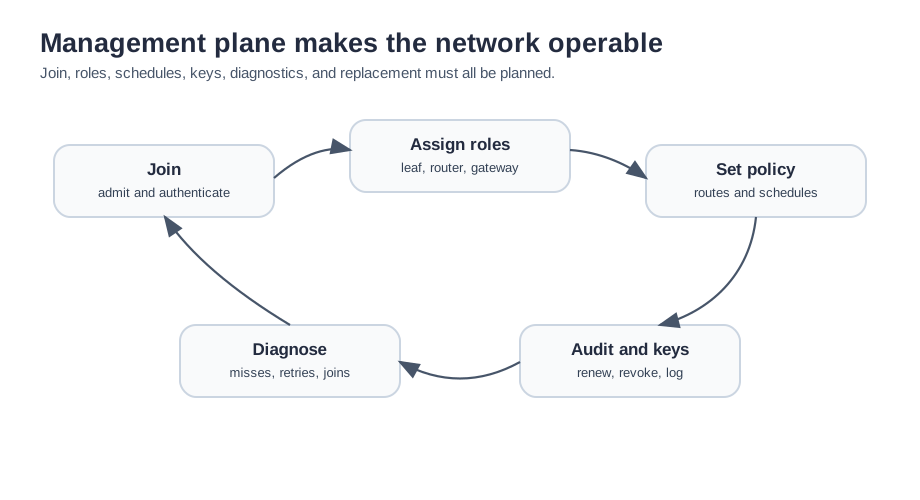
The management plane is where many industrial wireless designs either become reviewable or become operationally fragile.
- Joining: Who approves a device, what credential is used, how failed joins are investigated, and how unauthorized attempts are logged.
- Role assignment: Which devices are allowed to route, which are leaf devices, and how that choice changes when devices are replaced.
Major section
Topology Choices
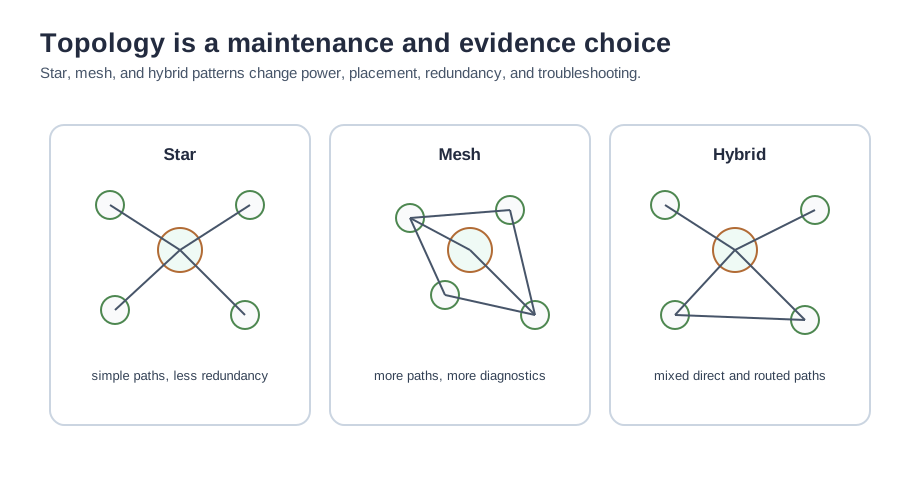
ISA100.11a can be described as flexible, but flexibility must be turned into a documented topology choice.
- The remaining question is mixed direct and routed paths.
- The choice depends on mixed direct and routed paths.
- Star pattern: Useful when devices can reach a gateway or backbone router directly and the team wants simpler routing behavior.
Major section
Topology Choices (continued)
Mesh pattern: Useful when routing through neighbors improves coverage or resilience.
- It increases dependence on router placement, power, and route diagnostics.
- Hybrid pattern: Useful when some devices can connect directly while others need routed paths.
- It requires clear records for which devices are allowed to forward.
Major section
Traffic and Access
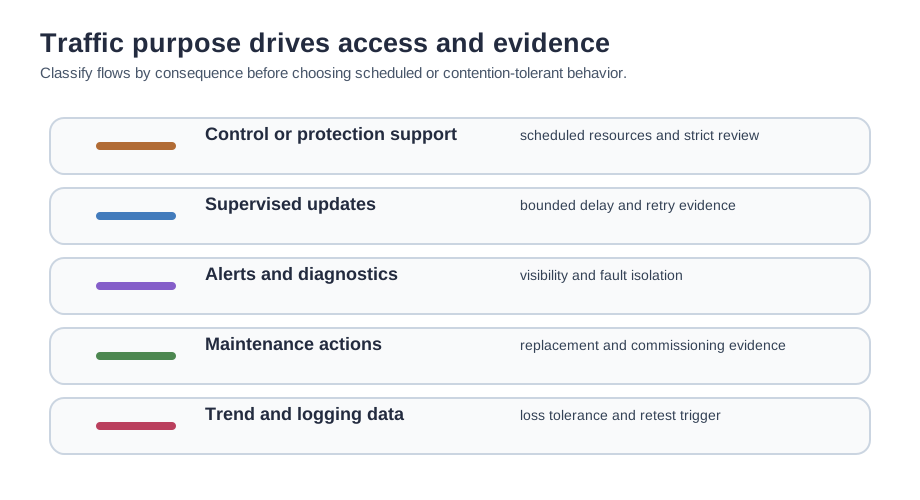
The access method should follow the purpose of each flow.
- To test traffic and access, anchor the review at: Traffic purpose drives access and evidence and visibility and fault isolation in it. Loss tolerance and retest trigger identifies the later check.
- The conclusion in traffic and access now has a named boundary.
Major section
IPv6 and Protocol Tunneling Still Need Budgets
On top of that IPv6 transport sits an object-oriented application layer that does not assume a single instrument protocol.
- The trade is complexity.
- The engineering catch is that IP-addressable does not mean Ethernet-sized.
- IEEE 802.15.4 frames are small, so 6LoWPAN compression and fragmentation matter.
Major section
Common Pitfalls
Topology by diagram: a mesh diagram looks resilient, but router power, placement, maintenance access, and route evidence are not reviewed.
- Traffic flattening: control, alerting, diagnostics, and logging are treated as one traffic class even though their delay and loss consequences differ.
- IPv6 overconfidence: standard addressing is assumed to make diagnostics easy, while compression, fragmentation, and border behavior remain untested.
- Tunneling blind spot: legacy protocol payloads are carried over the network without support ownership or gateway troubleshooting evidence.
Deck summary
Key takeaways
The radio can carry the reading, but safe use also depends on who admits the device, who sets traffic priority, how keys change, and how the plant sees a weak path before data is lost.
- If any answer is no, keep the service out of a critical role.
- ISA100.11a is centrally managed.
- Routing devices need power, placement, access, and replacement plans.
- ISA100.11a, also published as: IEC 62734, is a wireless standard for industrial process automation.
Retrieval practice
Recall check 1 of 3

Radio Remi says: answer from memory, then check your reasoning.
Q1In the ISA100.11a managed network model, which roles own network scheduling and key management?
Show answer
Answer: A ISA100.11a separates the System Manager (scheduling) from the Security Manager (key management) in its managed model.
Retrieval practice
Recall check 2 of 3

Radio Remi says: answer from memory, then check your reasoning.
Q2A plant runs a mix of HART, Modbus, and Foundation Fieldbus instruments and wants one wireless backbone that also integrates cleanly with its IP infrastructure. Which ISA100.11a design features make this possible?
Show answer
Answer: B ISA100.11a's 6LoWPAN/IPv6 network layer and object-oriented, protocol-agnostic application layer let it tunnel HART, Modbus, Foundation Fieldbus, and Profibus over one IP-addressable, TDMA-scheduled 802.15.4 network.
Retrieval practice
Recall check 3 of 3

Radio Remi says: answer from memory, then check your reasoning.
Q3A team has selected ISA100.11a for a utility monitoring pilot. They have a device list and gateway location, but no record of which devices may route, who owns the System Manager, how keys are renewed, or how missed updates are diagnosed. What should happen next?
Show answer
Answer: A A fundamentals review makes roles, topology, traffic, management, security, and diagnostics explicit before detailed stack work.
Print reference
Answers
Answer key.
- A · ISA100.11a separates the System Manager (scheduling) from the Security Manager (key management) in its managed model.
- B · ISA100.11a's 6LoWPAN/IPv6 network layer and object-oriented, protocol-agnostic application layer let it tunnel HART, Modbus, Foundation Fieldbus, and Profibus over one IP-addressable, TDMA-scheduled 802.15.4 network.
- A · A fundamentals review makes roles, topology, traffic, management, security, and diagnostics explicit before detailed stack work.