IoT Value and Product Strategy · Study deck
IoT Pricing: Value Metrics
This first route connects the customer outcome to a measurable value metric, then turns cost, willingness to pay, and service limits into defensible tiers.
Ada is your guide for this deck.

After studying this chapter
Learning objectives
You will be able to:
- Design Tiered Pricing: Create pricing tiers that match customer segments and willingness to pay
- Evaluate Revenue Models: Compare subscription, usage-based, and transaction fee approaches
- Calculate Unit Economics: Determine per-customer profitability at each tier using ARPU, churn, and margin analysis
- Optimize Conversion: Design upgrade paths that maximize customer lifetime value
Major section
Start With the Story
The hardware price looks fair, but the service also needs support, message delivery, repairs, and useful alerts for years.
- A cheap first sale can still fail both sides if the fee cannot fund that promise.
- Include a light user, a heavy user, a quiet month, a device failure, and a support call.
- Costs, behaviour, and competition change.
Major section
IoT Pricing Funds Service
Connectivity, cloud ingestion, storage, alerts, video retention, API calls, firmware updates, security support, warranty risk, and customer support can continue for years.
- A good price structure connects what the customer values to what the provider must keep running.
- A smart camera may charge for recording days and AI event detection.
- The important design choice is the value metric.
Major section
IoT Pricing Funds Service (continued)
If a video product includes unlimited retention, storage cost can grow faster than revenue.
- A fleet platform may charge by vehicle, driver, site, API usage, or compliance module.
- An industrial monitoring product may charge by asset, line, plant, SLA, or avoided downtime.
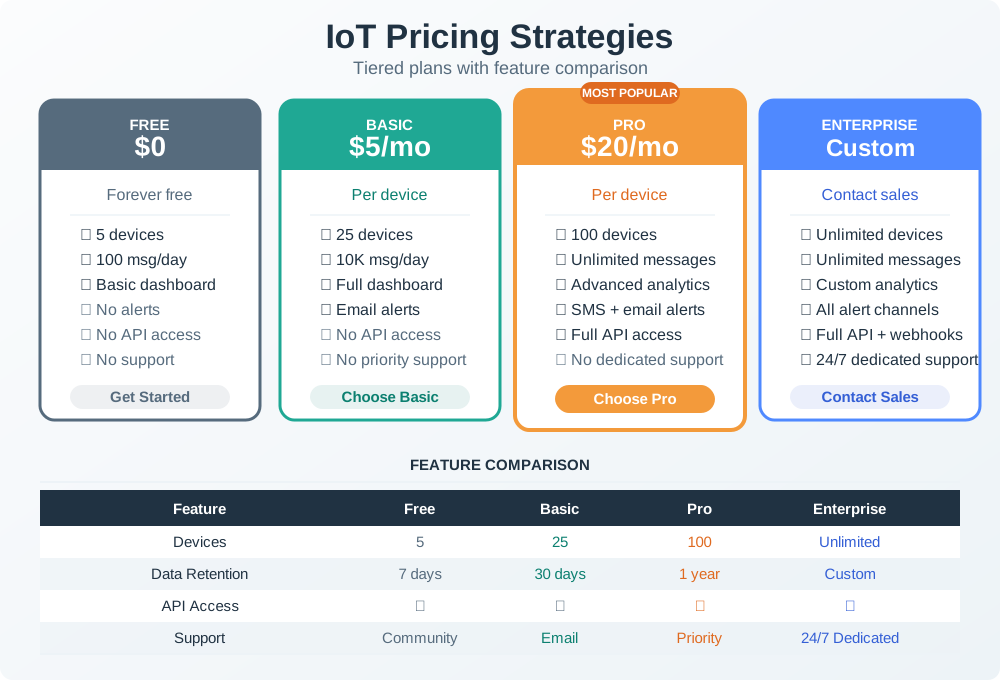
- A practical first pricing model usually separates entry, growth, and enterprise use.
Major section
IoT Pricing Funds Service (continued)
If a safety product charges for every heartbeat message, customers may reduce telemetry and make the service less reliable.
- Cost floor: The recurring cost that the price must cover, including cloud, connectivity, support, warranty, billing, and compliance work.
- Expansion path: The reason a customer naturally upgrades as deployments grow, risk increases, or integrations become more valuable.
- Growth pricing scales with normal expansion and keeps gross margin positive.
Major section
Price Outcomes, Not Overuse
Charging by site, SLA, or workflow module may fit enterprise buyers better than raw telemetry units.
- The safest pricing metric is easy to understand, hard to manipulate, and aligned with the outcome.
- Charging by device can work when each device creates clear value and cost.
- Product teams should calculate unit economics before publishing tiers.
Major section
Price Outcomes, Not Overuse (continued)
The pricing review should start with a small segment model, not an average customer.
- Charging by message can work for developer platforms, but it can discourage health pings, safety telemetry, or fault reporting if customers fear surprise bills.
- The home user may pay for video history.
- The retailer may pay for incident review across stores.
Major section
Price Outcomes, Not Overuse (continued)
For each tier, estimate bill of materials support, cellular or LPWAN connectivity, cloud ingestion, database storage, event processing, notification delivery, customer support, payment fees, warranty reserve, and security maintenance.
- A home camera user, a small retailer, a multi-site franchise, and an enterprise security team may all use similar devices but buy different outcomes.
- The enterprise may pay for SSO, retention policy, audit export, support response time, and integration with ServiceNow, Splunk, or a security operations workflow.
- Second, a growing customer should see an obvious upgrade reason before they hit a painful limit.
- Good pricing feels commercial, but it depends on operational details.
Major section
Pricing Needs Trust and Metering
Recurring IoT revenue only works when the platform can meter usage and enforce entitlements accurately.
- The system needs a durable customer id, device id, site id, plan id, feature flags, quota counters, billing period, usage events, and entitlement checks.
- A free tier may limit retention, alert types, integrations, and API access.
- Underpriced video retention can destroy margin.
Major section
Pricing Needs Trust and Metering (continued)
Surprise overage bills reduce trust.
- A device management service, API gateway, message broker, storage pipeline, and billing service must agree on what the customer bought.
- A professional tier may add webhook delivery, export jobs, SSO, or advanced analytics.
- A useful pricing system makes the cost visible while preserving the behaviors that keep the connected service healthy.
Major section
Pricing Needs Trust and Metering (continued)
An enterprise tier may add private networking, dedicated support, uptime SLA, SAML/OIDC, SCIM provisioning, data residency, and contract-specific retention rules.
- A pricing model that charges for every diagnostic message can make customers turn off the telemetry that protects reliability.
- The metering path should be designed like a production data pipeline.
- Entitlements: Gate features consistently across the app, API, broker, analytics jobs, and support tooling.
Deck summary
Key takeaways
The hardware price looks fair, but the service also needs support, message delivery, repairs, and useful alerts for years.
- Connectivity, cloud ingestion, storage, alerts, video retention, API calls, firmware updates, security support, warranty risk, and customer support can continue for years.
- If a video product includes unlimited retention, storage cost can grow faster than revenue.
- If a safety product charges for every heartbeat message, customers may reduce telemetry and make the service less reliable.
- Charging by site, SLA, or workflow module may fit enterprise buyers better than raw telemetry units.
Retrieval practice
Recall check 1 of 5

Ada says: answer from memory, then check your reasoning.
Q1The security-camera example calculates freemium conversion. Which denominator should it use?
Show answer
Answer: B The worked example divides paid users by the total user population.
Retrieval practice
Recall check 2 of 5
Ada says: answer from memory, then check your reasoning.
Q2A camera service serves households, growing shops, and firms that need audit exports and support promises. Which tier plan fits?
Show answer
Answer: B Correct: each tier matches a buyer outcome and the cost of serving that buyer.
Retrieval practice
Recall check 3 of 5
Ada says: answer from memory, then check your reasoning.
Q3A basic tier attracts users but few people upgrade. Which change should be tested?
Show answer
Answer: A A visible reason to upgrade can be tested against actual behavior.
Retrieval practice
Recall check 4 of 5
Ada says: answer from memory, then check your reasoning.
Q4A smart-camera company charges for recording retention. What should the price connect?
Show answer
Answer: C Storage, alerts, updates, and support continue after the device ships.
Retrieval practice
Recall check 5 of 5
Ada says: answer from memory, then check your reasoning.
Q5Basic has ARPU of $12 per customer-month, service cost of $8 per customer-month, and monthly churn of 10%. Pro has ARPU of $30, cost of $15, and churn of 5%. Which tier has higher monthly contribution and contribution LTV?
Show answer
Answer: B Correct: subtract service cost from ARPU, then divide monthly contribution by the churn fraction.
Print reference
Answers
Answer key.
- B · The worked example divides paid users by the total user population.
- B · Correct: each tier matches a buyer outcome and the cost of serving that buyer.
- A · A visible reason to upgrade can be tested against actual behavior.
- C · Storage, alerts, updates, and support continue after the device ships.
- B · Correct: subtract service cost from ARPU, then divide monthly contribution by the churn fraction.