IoT Value and Product Strategy · Study deck
IoT Value: Delivery Frameworks
Within the illustrative Five Verbs model, MOVE has the highest assumed CAGR of 16.5%; do not present this as a market finding or career advice.
Ada is your guide for this deck.

After studying this chapter
Learning objectives
You will be able to:
- Test five verbs market growth tool with a concrete scenario and pass criteria.
- Evaluate sensor to smart decision with range, error, power, and interface evidence.
- Explain: Explore how the Five Verbs markets will grow through 2030.
- Explain: Categorizing IoT Solutions: When you encounter a new IoT application, ask yourself: "Which fundamental human activity does this enhance?".
Major section
Five Verbs Market Growth Tool
Explore how the Five Verbs markets will grow through 2030.
- Within the illustrative Five Verbs model, MOVE has the highest assumed CAGR of 16.5%; do not present this as a market finding or career advice.
- SUSTAIN has the largest market ($1.1T by 2030): Climate change isn't going away, and every building, factory, and city needs energy optimization.
- FEED has the smallest but fastest-growing market: Agriculture is traditionally slow to adopt technology, but water scarcity and climate change are forcing rapid modernization.
Major section
How to Use the Five Verbs Framework
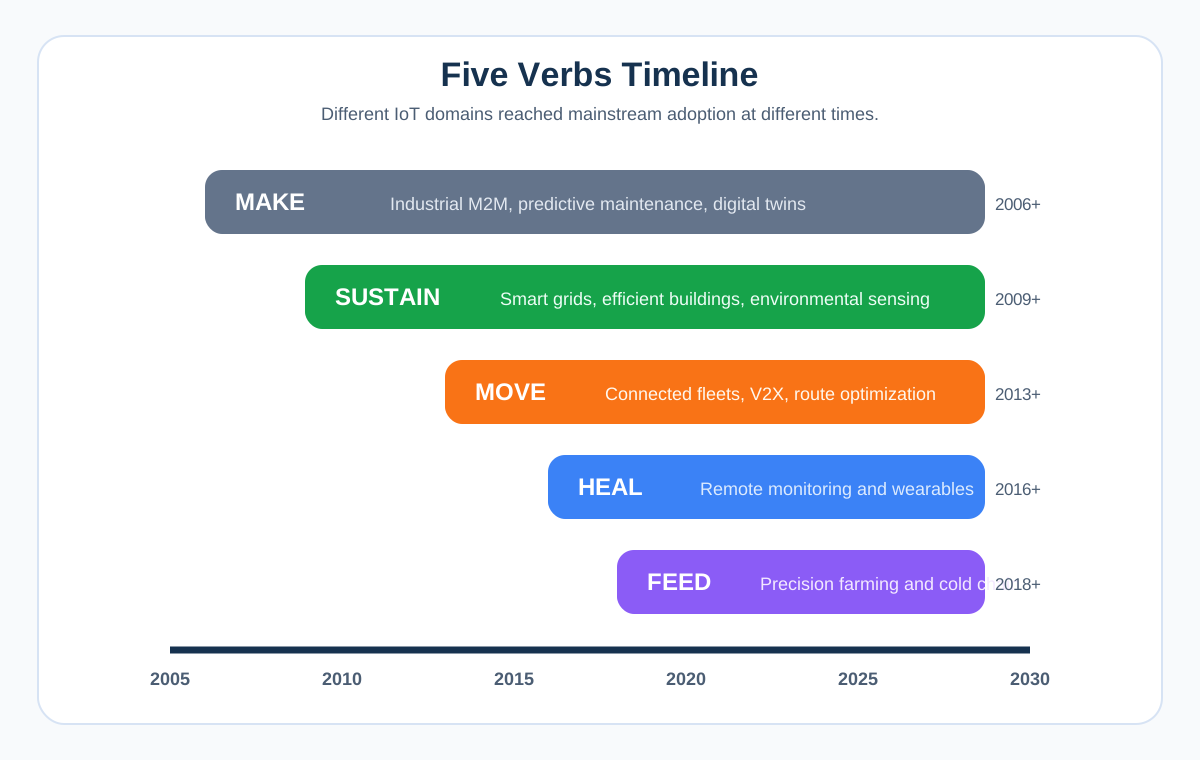
Categorizing IoT Solutions: When you encounter a new IoT application, ask yourself: "Which fundamental human activity does this enhance?".
- Smart thermostat ->: SUSTAIN (optimizes energy use, reduces carbon footprint).
- Connected ambulance ->: MOVE (transports patients) +: HEAL (transmits vital signs to hospital en route).
- Factory robot ->: MAKE (manufactures products with sensors and connectivity).
Major section
Common Pitfalls When Learning IoT
Pitfall 1: Confusing "smart" with "IoT.": A device with a microprocessor and display (like a basic digital thermostat) is a smart embedded device, not an IoT device.
- The critical differentiator is internet connectivity.
- Without the ability to send data to the cloud or receive remote commands, a device cannot participate in the IoT ecosystem.
- Students who focus only on consumer use cases miss the majority of career opportunities and economic value in IoT.
Major section
Common Pitfalls When Learning IoT (continued)
Pitfall 2: Assuming IoT is only about consumer gadgets: Smart speakers and fitness trackers get the most media attention, but the largest IoT markets are industrial.
- In the illustrative Five Verbs table, SUSTAIN is assigned $1.1T and MAKE $870B for 2030; avoid using those inputs to rank real career markets.
- A connected delivery truck both MOVEs goods and helps FEED people (cold chain monitoring for food safety).
- Forcing a single-verb classification misses the full value proposition and can lead to narrow designs that ignore important stakeholders.
- Pitfall 4: Ignoring the business case: Technical feasibility alone does not make a viable IoT product.
Major section
Smart vs IoT Confusion
The most frequent classification error in IoT is calling any device with a microprocessor "IoT.".
- This introductory chapter establishes the foundational concepts and real-world context for the module, explaining why these topics matter and how they fit within the broader IoT landscape.
- If even one ingredient is missing, find a more accurate classification.
- Your customers (and your return rate) will thank you.
Deck summary
Key takeaways
Explore how the Five Verbs markets will grow through 2030.
- Categorizing IoT Solutions: When you encounter a new IoT application, ask yourself: "Which fundamental human activity does this enhance?".
- Pitfall 1: Confusing "smart" with "IoT.": A device with a microprocessor and display (like a basic digital thermostat) is a smart embedded device, not an IoT device.
- Pitfall 2: Assuming IoT is only about consumer gadgets: Smart speakers and fitness trackers get the most media attention, but the largest IoT markets are industrial.
- The most frequent classification error in IoT is calling any device with a microprocessor "IoT.".
Retrieval practice
Recall check 1 of 4

Ada says: answer from memory, then check your reasoning.
Q1A connected ambulance transports a patient and transmits vital signs to an emergency room while en route. Which Five Verbs categories does this scenario serve?
Show answer
Answer: D The ambulance scenario spans MOVE through patient transport and HEAL through vital-sign telemetry to the emergency room.
Retrieval practice
Recall check 2 of 4
Ada says: answer from memory, then check your reasoning.
Q2In this chapter’s illustrative Five Verbs market model, which category has the highest assumed CAGR through 2030?
Show answer
Answer: B Within the chapter’s illustrative table, MOVE has the largest assumed CAGR at 16.5%; SUSTAIN has the largest assumed 2030 size. The model values should not be treated as observed market findings or career advice.
Retrieval practice
Recall check 3 of 4
Ada says: answer from memory, then check your reasoning.
Q3John Deere's "See and Spray" technology reduces herbicide use by 80% through targeted application. Which verb does this primarily serve, and what is the secondary benefit?
Show answer
Answer: C Primary: FEED - The technology directly serves agriculture by enabling precision farming and improving crop yields through targeted weed control.
Retrieval practice
Recall check 4 of 4
Ada says: answer from memory, then check your reasoning.
Q4What ties a physical measurement to its unit, time, location and quality before it becomes service evidence?
Show answer
Answer: B The physical thing and sensor create a measurement tied to a unit, time, location, and quality state; a cloud value without that context is not trustworthy evidence.
Q5Complete the healthcare IoT vital signs aggregator:
Show answer
Answer: A Negative slicing [-window_size:] takes the last N elements for a moving average.
Print reference
Answers 1 of 2
Answer key.
- D · The ambulance scenario spans MOVE through patient transport and HEAL through vital-sign telemetry to the emergency room.
- B · Within the chapter’s illustrative table, MOVE has the largest assumed CAGR at 16.5%; SUSTAIN has the largest assumed 2030 size. The model values should not be treated as observed market findings or career advice.
- C · Primary: FEED - The technology directly serves agriculture by enabling precision farming and improving crop yields through targeted weed control.
Print reference
Answers 2 of 2
Answer key.
- B · The physical thing and sensor create a measurement tied to a unit, time, location, and quality state; a cloud value without that context is not trustworthy evidence.
- A · Negative slicing [-window_size:] takes the last N elements for a moving average.