Applications & Use Cases · Study deck
Elderly Care IoT: Monitoring, Economics, and Autonomy
A fall-alert service can meet its response budget, but daily care depends on slower patterns as well as sudden events.
Blueprint Bina is your guide for this deck.

After studying this chapter
Learning objectives
You will be able to:
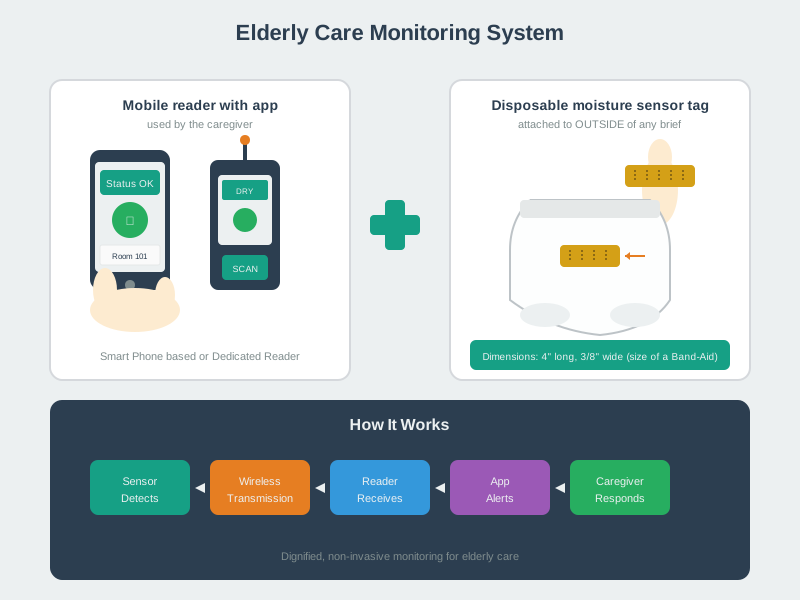
- Explain: The proposed monitoring pattern runs passively in the background: motion sensors record changes in movement, audio sensors track changes in speech, and a camera measures how long a task takes.
- Explain: A Parkinson's disease example in the source material makes the difference between an event alert and a progression record explicit.
- Explain: Symptoms can fluctuate continuously, so a monthly clinical check may not represent what happens between visits.
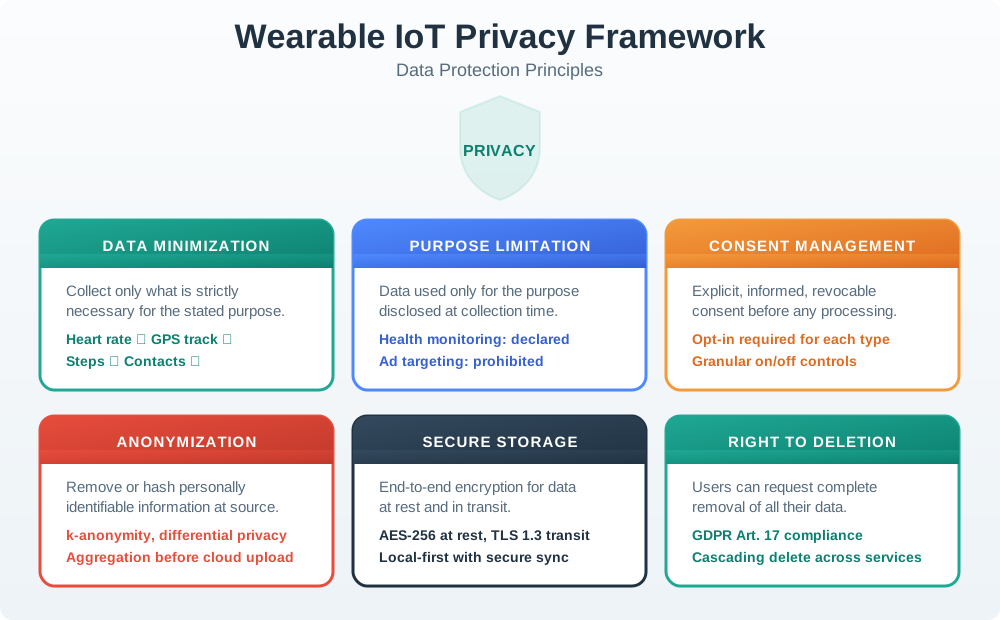
- Explain: Carry: Wearable IoT Privacy Framework into privacy and autonomy considerations; use: PRIVACY as its limiting condition.
Major section
Sensor Patterns to Clinical Insight
That labelled limit reconnects the visual to sensor patterns to clinical insight.
- Reduced kitchen activity: Sensor pattern shows 50% fewer fridge opens and 70% less cooking time.
- Delayed morning routine: Sensor pattern shows getting out of bed two hours later than baseline.
- Reduced outdoor activity: Sensor pattern shows no outdoor trips for five days.
Major section
Passive Progression Monitoring Between Assessments
A Parkinson's disease example in the source material makes the difference between an event alert and a progression record explicit.
- Symptoms can fluctuate continuously, so a monthly clinical check may not represent what happens between visits.
- The proposed monitoring pattern runs passively in the background: motion sensors record changes in movement, audio sensors track changes in speech, and a camera measures how long a task takes.
- For an operating record, keep the three evidence streams distinct.
Major section
Compelling Statistics
Predictive Analytics: Gait analysis can predict fall risk days in advance.
- Independence: Seniors can age in place rather than moving to care facilities.
- Individual or family: Value received is peace of mind, slowing decline, and aging in place.
- Health insurance: Value received is fewer hospitalizations and lower long-term care cost.
Major section
Privacy and Autonomy Considerations
Elderly IoT systems must balance safety monitoring with dignity and independence.
- Carry: Wearable IoT Privacy Framework into privacy and autonomy considerations; use: PRIVACY as its limiting condition.
Deck summary
Key takeaways
That labelled limit reconnects the visual to sensor patterns to clinical insight.
- A Parkinson's disease example in the source material makes the difference between an event alert and a progression record explicit.
- Predictive Analytics: Gait analysis can predict fall risk days in advance.
- Elderly IoT systems must balance safety monitoring with dignity and independence.
Retrieval practice
Recall check 1 of 5

Blueprint Bina says: answer from memory, then check your reasoning.
Q1A fall detection wearable uses a 3-axis accelerometer, gyroscope, and heart rate monitor. During testing, the system correctly detects 95 out of 100 actual falls (sensitivity = 95%). However, it also triggers 50 false alarms out of 1,000 non-fall events (specificity = 95%). If the device is deployed across 500 elderly patients who collectively experience an average of 2 real falls per day and 10,000 non-fall events per day, approximately how many total alerts (true + false) will caregivers receive daily?
Show answer
Answer: B Correct!
Retrieval practice
Recall check 2 of 5

Blueprint Bina says: answer from memory, then check your reasoning.
Q2An elderly care IoT system processes motion sensor data from 12 rooms in a patient's home. Under HIPAA and data minimization principles, which processing architecture is most appropriate?
Show answer
Answer: B Correct!
Retrieval practice
Recall check 3 of 5

Blueprint Bina says: answer from memory, then check your reasoning.
Q3Under an illustrative scenario where each listed recurring service is furnished and billable in all 12 months (99453: $19 one-time setup, 99454: $62/month device, 99457: $51/month communication, 99458: $41/month additional), what is the first-year revenue per patient, and how does it compare with $40,000?
Show answer
Answer: A The recurring monthly components total $62 + $51 + $41 = $154.
Retrieval practice
Recall check 4 of 5

Blueprint Bina says: answer from memory, then check your reasoning.
Q4Place each fall-alert responsibility where it lives so you can trace whether a false or delayed escalation came from evidence, the cancel-and-delivery path, or caregiver response.
Show answer
Answer: A A trustworthy fall-alert system separates multi-sensor evidence, wearer-controlled delivery, and caregiver response so safety does not require surrendering autonomy.
Retrieval practice
Recall check 5 of 5

Blueprint Bina says: answer from memory, then check your reasoning.
Q5Complete the elderly fall-alert escalation gate:
Show answer
Answer: A Fall-alert escalation should respect wearer self-cancel, device state, posture evidence, confidence, and the 30-second cancel window before notifying caregivers.
Print reference
Answers
Answer key.
- B · Correct!
- B · Correct!
- A · The recurring monthly components total $62 + $51 + $41 = $154.
- A · A trustworthy fall-alert system separates multi-sensor evidence, wearer-controlled delivery, and caregiver response so safety does not require surrendering autonomy.
- A · Fall-alert escalation should respect wearer self-cancel, device state, posture evidence, confidence, and the 30-second cancel window before notifying caregivers.