Applications & Use Cases · Study deck
Smart Contact Lenses: Power, Data, and Safety
A lens prototype can sense and store a reading, but its power margin is tiny and the phone must decide whether the reading is fresh enough to show.
Blueprint Bina is your guide for this deck.

After studying this chapter
Learning objectives
You will be able to:
- Explain: The app can then decide whether a trend is ready to show, whether a repeat reader session is needed, or whether a clinician-facing record should mark the sample as research-only or low-confidence.
- Explain: For blood-to-tear glucose delay, the useful result is the reasoning chain: observed condition, governing constraint, calculation or classification, and operational consequence.
- Explain: Result: If signal quality is 68, relay age is 2 minutes, and calibration is valid, the correct app state is still trend unavailable.
- Explain: Key Insight: For smart contact lenses, data-quality labels are safety controls.
Major section
Blood-to-Tear Glucose Delay
Clinical Implication: The lag makes smart contact lenses unsuitable for real-time insulin dosing decisions.
- For blood-to-tear glucose delay, the useful result is the reasoning chain: observed condition, governing constraint, calculation or classification, and operational consequence.
- Where the panel supplies several choices, reject each distractor against the chapter's named mechanism instead of relying on wording cues.
- They excel at trend detection (rising/falling/stable) but cannot replace fingerstick meters for critical decisions.
Major section
Body-Area Relay and Clinical Data Flow
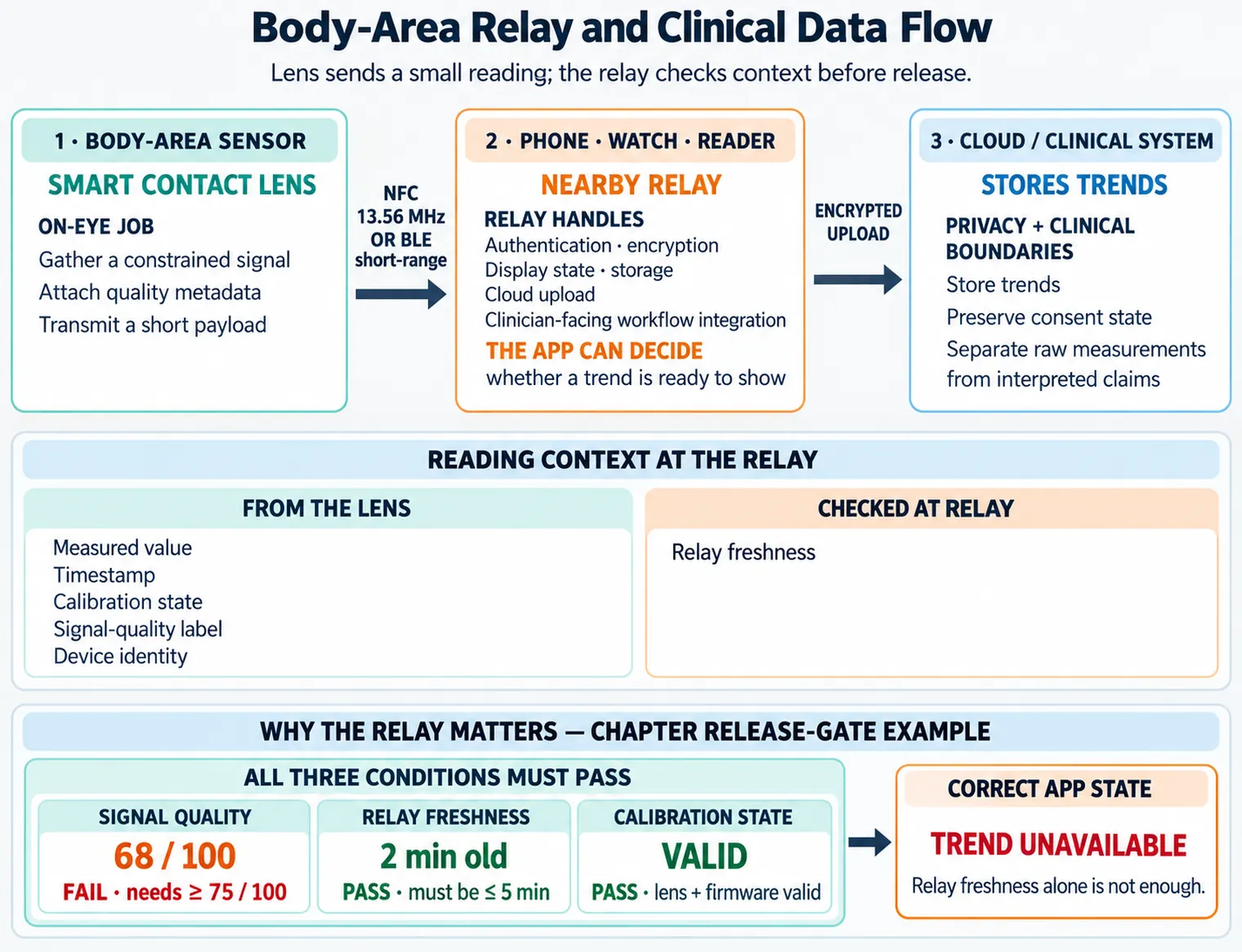
The app can then decide whether a trend is ready to show, whether a repeat reader session is needed, or whether a clinician-facing record should mark the sample as research-only or low-confidence.
- The relay also gives the product a place to enforce privacy and clinical boundaries.
Major section
Lens vs Wrist Wearable Choice
The lens should win only when the intended signal or display experience genuinely depends on the eye.
- Key insight: The product question is not whether electronics can fit on the eye.
- Scenario: A research team is testing a tear-glucose smart lens that can show a wellness trend in an app.
- Relay freshness alone is not enough.
Major section
Lens vs Wrist Wearable Choice (continued)
Key Insight: For smart contact lenses, data-quality labels are safety controls.
- The app is not allowed to recommend insulin dosing.
- Result: If signal quality is 68, relay age is 2 minutes, and calibration is valid, the correct app state is still trend unavailable.
- The power and lag sections describe what the lens can measure.
Deck summary
Key takeaways
Clinical Implication: The lag makes smart contact lenses unsuitable for real-time insulin dosing decisions.
- The app can then decide whether a trend is ready to show, whether a repeat reader session is needed, or whether a clinician-facing record should mark the sample as research-only or low-confidence.
- The lens should win only when the intended signal or display experience genuinely depends on the eye.
- Key Insight: For smart contact lenses, data-quality labels are safety controls.
Retrieval practice
Recall check 1 of 5

Blueprint Bina says: answer from memory, then check your reasoning.
Q1What is the typical total power budget for a smart contact lens?
Show answer
Answer: B B) 10-50 microwatts (uW) is correct.
Q2In the smart contact lens IoT architecture, what communication technology is most commonly used to transfer data from the lens to the patient's phone?
Show answer
Answer: C C) NFC or BLE (near-field / short-range) is correct.
Retrieval practice
Recall check 2 of 5

Blueprint Bina says: answer from memory, then check your reasoning.
Q3A smart contact lens relay is fresh, but the sample has low signal quality and expired calibration. What should the app do?
Show answer
Answer: C Withhold the trend and show a repeat-reader or calibration-required state is correct.
Retrieval practice
Recall check 3 of 5

Blueprint Bina says: answer from memory, then check your reasoning.
Q4Which provenance record best supports safe review of a smart contact lens reading?
Show answer
Answer: C Device version, lens lot, calibration state, timestamp source, signal quality, and relay id is correct.
Retrieval practice
Recall check 4 of 5

Blueprint Bina says: answer from memory, then check your reasoning.
Q5Complete the smart contact lens reading gate:
Show answer
Answer: A A smart contact lens reading gate should separately check signal quality, relay freshness, and calibration state before displaying a confident trend.
Retrieval practice
Recall check 5 of 5

Blueprint Bina says: answer from memory, then check your reasoning.
Q6A smart contact lens for health monitoring must operate within a strict power budget. Given that the lens sits directly on the eye, what is the primary constraint that limits the power budget to 10-50 microwatts?
Show answer
Answer: D The cornea is highly sensitive to temperature changes.
Print reference
Answers 1 of 2
Answer key.
- B · B) 10-50 microwatts (uW) is correct.
- C · C) NFC or BLE (near-field / short-range) is correct.
- C · Withhold the trend and show a repeat-reader or calibration-required state is correct.
- C · Device version, lens lot, calibration state, timestamp source, signal quality, and relay id is correct.
- A · A smart contact lens reading gate should separately check signal quality, relay freshness, and calibration state before displaying a confident trend.
Print reference
Answers 2 of 2
Answer key.
- D · The cornea is highly sensitive to temperature changes.