Connected Health and Wearables · Study deck
Smart Contact Lenses: Power and Architecture
Researchers are testing tear-glucose lenses, but none described here replaces blood-glucose testing.
Ada is your guide for this deck.

After studying this chapter
Learning objectives
You will be able to:
- Trace power and data through a smart contact lens architecture.
- Compare AR and health-monitoring lenses by safety, sensing, and energy constraints.
- Evaluate biocompatibility requirements that constrain materials, form factor, and thermal dissipation
- Compare smart lens platforms from Google/Verily, Mojo Vision, and InWith for different application domains
Major section
For Kids: Meet the Sensor Squad
It gives us just enough power to run everything!".
- Eleven-year-old Amir has diabetes, which means his body has trouble managing sugar in his blood.
- Every day, he has to prick his finger to check his blood sugar -- and it really hurts!
- Peel an onion and notice your eyes watering -- those are tears!
Major section
For Kids: Meet the Sensor Squad (continued)
Researchers have not shown that a lens can safely guide food or insulin decisions, so Amir keeps checking blood glucose as advised by his care team.
- In this future story, Amir imagines a special pair of contact lenses that researchers might invent one day.
- Think about what might be dissolved in those tears (salt, proteins, sugar).
- That sensor would need to be thinner than a hair and softer than jelly.
Major section
Smart Lens Power and Data Flow
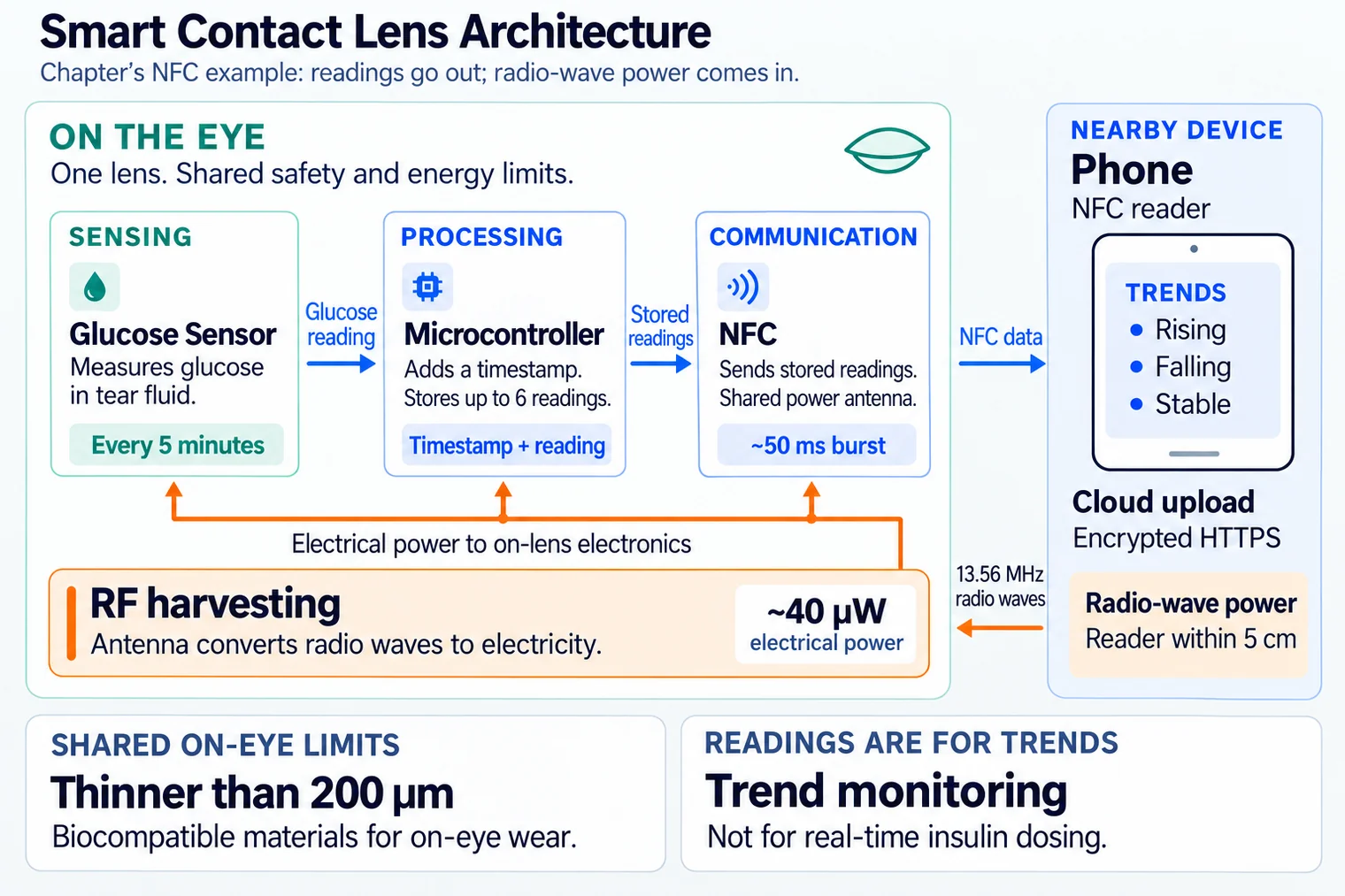
The lens's antenna captures these invisible waves and converts them into ~40 microwatts of electrical power - just enough to run the sensors and transmitter for a brief moment.
- Step 2: Sensing Tear Glucose: A glucose sensor (smaller than a grain of salt) sits between two layers of the soft lens material.
- Tear fluid naturally wicks through tiny channels to reach the sensor.
- The sensor measures this current and converts it to a digital glucose reading.
Major section
Smart Lens Power and Data Flow (continued)
Step 3: Processing and Storage: A microcontroller (the "brain" of the lens, about 1 mm²) receives the glucose reading, adds a timestamp, and stores it in memory.
- The lens transmits the stored glucose readings as a burst of data (~50 milliseconds).
- Your phone receives the data, processes it, and displays trends: "Glucose rising slowly - within target range.".
- The cloud analytics platform detects patterns (e.g., "glucose spikes after lunch every day") and sends alerts to your diabetes management team.
Major section
Smart Contact Lens Architecture
Understanding the layered architecture of a smart contact lens reveals why this is one of the most challenging IoT form factors to engineer.
- Every subsystem must operate within microwatt power budgets, millimeter-scale dimensions, and strict biocompatibility constraints.
- Those limits are why the phone shows trends and never a dosing instruction.
Major section
Smart Contact Lens Architecture (continued)
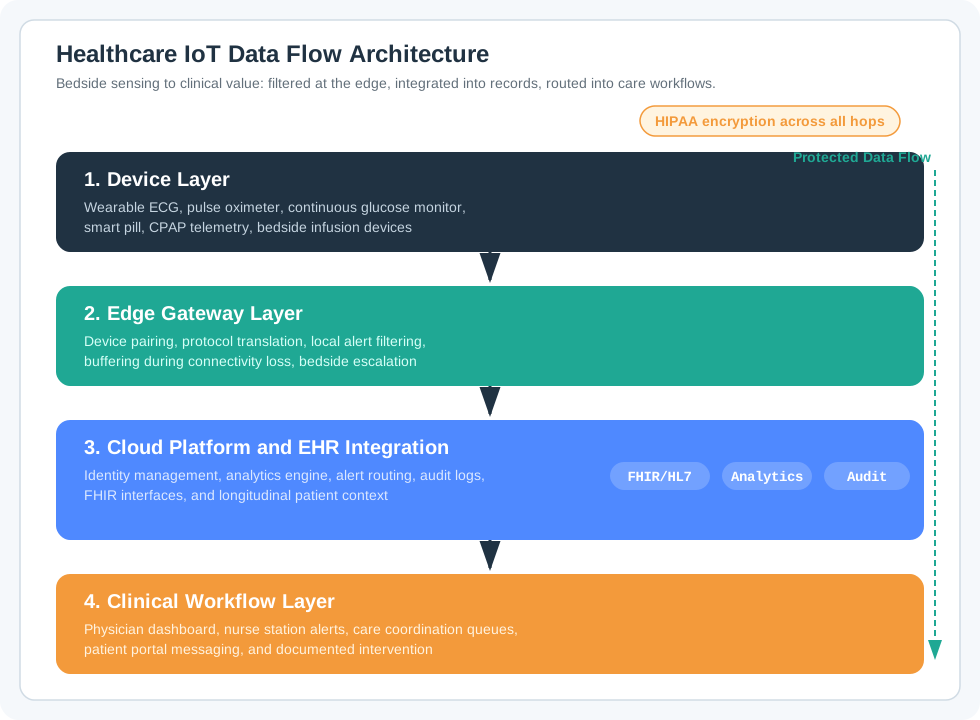
The last branch routes alerts and trends to clinicians or the patient portal.
- That same antenna turns the reader's radio waves into roughly forty microwatts, and this is the whole budget the sensing and storage steps must live inside.
- The band across the bottom is the real limit: everything on the eye must stay thinner than a fifth of a millimetre and stay biocompatible.
- No lens described here is validated for clinical glucose decisions.
Major section
Smart Contact Lens Architecture (continued)
The edge gateway handles local processing and any decision that cannot tolerate a cloud round trip.
- Each boundary needs protected transport, identity, and audit evidence, while the clinical workflow remains responsible for acting on the result.
- Integrated pressure sensors can also measure intraocular pressure, which may support glaucoma monitoring in an authorized clinical workflow.
- A lens can wirelessly transmit measurements to a paired device for review.
Major section
Tear-to-Blood Glucose Lag
Tear-glucose measurements are a research approach.
- Their relationship to blood glucose and the delay can vary with the person and tear collection, so no lens described here is validated for real-time insulin dosing or established as a clinical trend-alert tool.
- For a lens, the store is the hard part.
Major section
Tear-to-Blood Glucose Lag (continued)
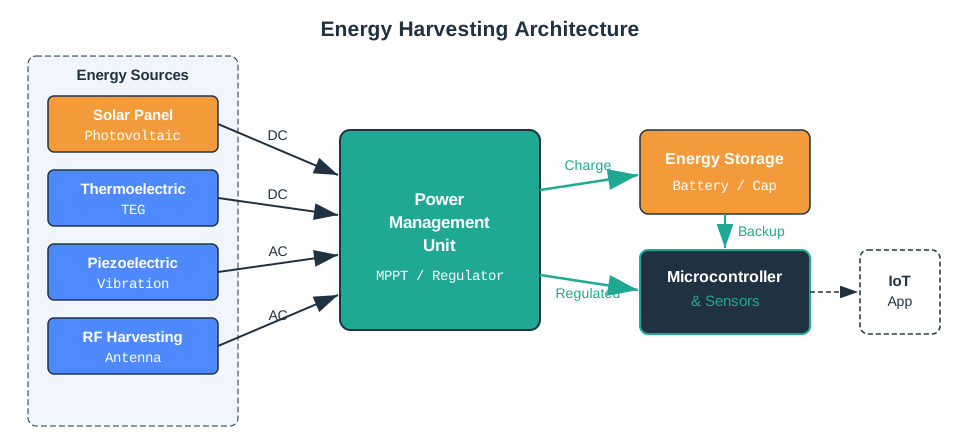
Traditional batteries are too large, too heavy, and produce too much heat for on-eye use.
- Everything then funnels into one power management unit, which is the part that keeps working even when a source does not.
- Its output charges a store, and the store, rather than the source, is what supplies the microcontroller and sensors at a steady voltage.
- Anything large enough to smooth an intermittent source is exactly what cannot sit on an eye.
Major section
Putting Numbers to It
A duty-cycled glucose sensor that draws 2 µW for 150 ms every 5 minutes is active for only 0.05% of the interval.
- If the sleep draw is 0.2 µW, the average is about 0.201 µW: roughly 0.001 µW from sensing plus 0.2 µW from sleep.
- Beyond health monitoring, smart contact lenses are poised to revolutionize human-computer interaction through AR.
- By incorporating micro-displays and optical components, these lenses can project digital information directly onto the wearer's retina, overlaying virtual elements onto the real-world view.
Major section
AR Lenses vs. Health Monitoring Lenses
Tear-glucose sensing remains research; it is not a validated clinical replacement for blood-glucose testing.
- AR lens availability also remains uncertain.
- The unique physiological characteristics of the iris make it a reliable biometric identifier.
- Despite the significant promise of smart contact lenses, several challenges remain.
Major section
Challenge-to-Solution Mapping
Scenario: An IoT startup is designing a glucose-monitoring smart contact lens for diabetic patients.
- The lens must measure tear glucose every 5 minutes and transmit accumulated readings to the patient's smartphone every 30 minutes via NFC.
- Result: The lens requires only 0.50 uW average power, well within the 40 uW RF harvesting capability.
- The patient only needs their phone near their face for ~14 minutes total per day to fully power the lens.
Deck summary
Key takeaways
It gives us just enough power to run everything!".
- Researchers have not shown that a lens can safely guide food or insulin decisions, so Amir keeps checking blood glucose as advised by his care team.
- The lens's antenna captures these invisible waves and converts them into ~40 microwatts of electrical power - just enough to run the sensors and transmitter for a brief moment.
- Step 3: Processing and Storage: A microcontroller (the "brain" of the lens, about 1 mm²) receives the glucose reading, adds a timestamp, and stores it in memory.
- The last branch routes alerts and trends to clinicians or the patient portal.
Retrieval practice
Recall check 1 of 4
Ada says: answer from memory, then check your reasoning.
Q1In the lens example, the phone approaches after readings have been stored. What role does the shared antenna serve?
Show answer
Answer: C The example uses the nearby reader for both energy harvesting and a communication channel.
Retrieval practice
Recall check 2 of 4
Ada says: answer from memory, then check your reasoning.
Q2A smart lens passes its radio test but warms the eye and blocks oxygen. What should the design review conclude?
Show answer
Answer: B Biocompatibility and heat limits apply to the whole lens.
Retrieval practice
Recall check 3 of 4
Ada says: answer from memory, then check your reasoning.
Q3A team adds a wireless subsystem to the on-eye lens. What budget must it share with sensing and processing?
Show answer
Answer: B The architecture places the subsystems under the same form-factor and safety constraints.
Retrieval practice
Recall check 4 of 4
Ada says: answer from memory, then check your reasoning.
Q4A team wants a lens signal related to glaucoma. Which sensing path fits that goal?
Show answer
Answer: D Pressure sensing relates to the eye-pressure question but still needs validation.
Print reference
Answers
Answer key.
- C · The example uses the nearby reader for both energy harvesting and a communication channel.
- B · Biocompatibility and heat limits apply to the whole lens.
- B · The architecture places the subsystems under the same form-factor and safety constraints.
- D · Pressure sensing relates to the eye-pressure question but still needs validation.