Applications & Use Cases · Study deck
Lessons from Real Deployments: Volkswagen Predictive Maintenance and Cross-Case Lessons
The maintenance lead wants early warning, but a false stop wastes production and a missed fault can damage the line.
Blueprint Bina is your guide for this deck.

After studying this chapter
Learning objectives
You will be able to:
- explain Volkswagen's predictive-maintenance deployment path from pilot to plant-wide rollout
- evaluate why edge processing and multi-sensor fusion changed industrial alert performance
- recompute the payback and ROI logic behind the Volkswagen case
- compare Volkswagen and Barcelona case evidence using the six-phase deployment framework
Major section
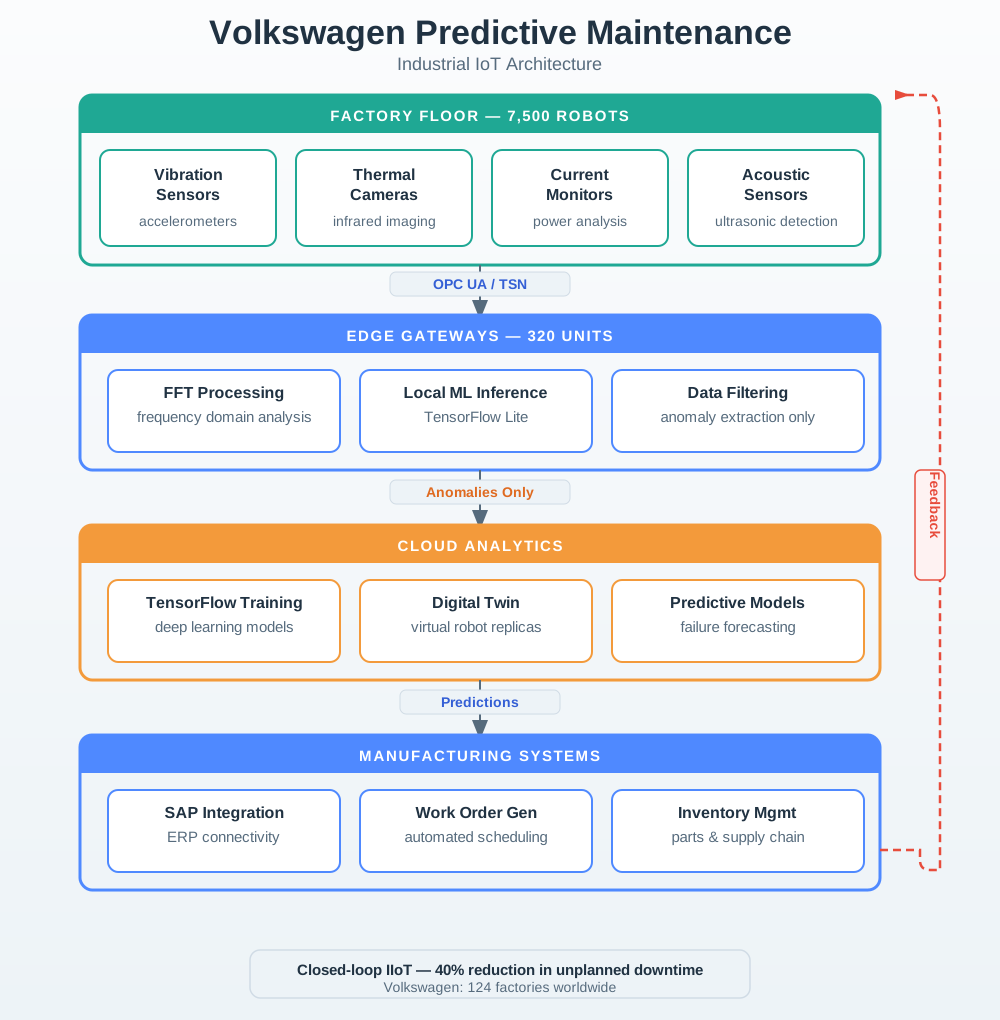
VW Maintenance Prediction
The maintenance lead wants early warning, but a false stop wastes production and a missed fault can damage the line.
- The useful case is not the size of the factory.
- A strong return in one line or machine does not prove the same return everywhere.
Major section
Predictive Maintenance Decision Pipeline
Gateways run FFT and windowing every few seconds to compress raw waveforms into health indicators.
- Low-risk cases keep monitoring, medium-risk cases schedule maintenance, and severe cases trigger immediate alerts.
Major section
Putting Numbers to It
The 5-year ROI calculation is (($47M x 5) - $23M) / $23M x 100%, or about 921.7%.
- This explains why predictive maintenance achieves payback about 3.1x faster than Volkswagen's 18-month target.
Major section
Volkswagen Lessons Learned
Edge Computing is Essential for Industrial IoT.
- 30,000 sensors generating 85TB/day is impossible to send to cloud.
- Lesson: Process data at the edge; cloud is for training models and historical analysis.
- Sensor Fusion Dramatically Improves Accuracy.
- Different failure modes have different signatures.
Major section
Volkswagen Lessons Learned (continued)
Lesson: Establish data labeling processes early; engage technicians in recording failure modes.
- "Boy who cried wolf" effect: Three false alarms and technicians stop responding.
- Lesson: Optimize for minimizing false positives; user trust is fragile.
- Integration with Existing Systems is Critical.
- Lesson: IoT system value depends on workflow integration.
Major section
Typical ROI by Implementation Approach
For typical roi by implementation approach, the useful result is the reasoning chain: observed condition, governing constraint, calculation or classification, and operational consequence.
- Where the panel supplies several choices, reject each distractor against the chapter's named mechanism instead of relying on wording cues.
Major section
Smart City vs Industrial IoT
Understanding how deployment strategies differ across domains helps practitioners select the right approach for their context.
- Citizens, city departments, and startups had to buy into Barcelona's platform; technicians had to trust Volkswagen's alerts.
- ROI must be legible early.
Major section
Enterprise IoT Pitfalls
Pitfall 1: Technology-First Thinking: Teams select sensors and platforms before understanding the workflow they need to improve.
- Many IoT budgets allocate 80% to hardware and software, leaving insufficient resources for the integration "glue" that makes systems work together.
- Pitfall 4: Planning for Deployment Without Planning for Maintenance: Sensor lifespan varies from 3-7 years.
Major section
Case Study Lessons Framework
Quantify where downtime, waste, energy cost, or service friction is highest before selecting technology.
- Improve labels, calibration, and false-positive performance until the system supports real workflow decisions.
- Standardize deployment patterns, use pilot savings to fund rollout, and avoid all-at-once expansion.
Major section
Summary
False positive reduction (18% to <5%) was the critical factor for user adoption -- not model accuracy.
- Integrate with existing workflows (SAP work orders, municipal services) -- standalone dashboards fail.
- Budget 40-50% of effort for integration and change management -- the "invisible" work that determines success.
Deck summary
Key takeaways
The maintenance lead wants early warning, but a false stop wastes production and a missed fault can damage the line.
- Gateways run FFT and windowing every few seconds to compress raw waveforms into health indicators.
- The 5-year ROI calculation is (($47M x 5) - $23M) / $23M x 100%, or about 921.7%.
- Edge Computing is Essential for Industrial IoT.
- Lesson: Establish data labeling processes early; engage technicians in recording failure modes.
Retrieval practice
Recall check 1 of 5

Blueprint Bina says: answer from memory, then check your reasoning.
Q1Volkswagen's 30,000 sensors generate 85TB of data per day. Their edge processing strategy reduced data transmitted to the cloud by 99.8%. If the edge gateways failed and ALL data had to be sent to the cloud, what would be the most immediate operational impact?
Show answer
Answer: B Correct!
Retrieval practice
Recall check 2 of 5

Blueprint Bina says: answer from memory, then check your reasoning.
Q2Volkswagen's predictive maintenance pilot achieved 87% accuracy in predicting equipment failures, but early deployment saw technicians ignoring alerts. What was the root cause, and what metric needed optimization?
Show answer
Answer: B Correct!
Retrieval practice
Recall check 3 of 5

Blueprint Bina says: answer from memory, then check your reasoning.
Q3A mid-sized city (population 400,000) wants to replicate Barcelona's smart city approach. They have a limited budget and want to maximize first-year impact. Based on the case study lessons, which deployment strategy should they prioritize?
Show answer
Answer: B Correct!
Retrieval practice
Recall check 4 of 5

Blueprint Bina says: answer from memory, then check your reasoning.
Q4Both Barcelona and Volkswagen invested heavily in change management. Volkswagen ran a 6-month parallel operation before going live. What was the primary purpose of this parallel period?
Show answer
Answer: C Correct!
Retrieval practice
Recall check 5 of 5

Blueprint Bina says: answer from memory, then check your reasoning.
Q5Place each predictive-maintenance responsibility where it lives so you can trace whether a missed machine fault came from condition sensing, fault inference, or the maintenance workflow.
Show answer
Answer: A Predictive maintenance creates value only when machine-specific evidence becomes a qualified inference and then an accountable work-and-learning loop.
Q6Complete the deployment evidence gate for case-study alerts:
Show answer
Answer: A Deployment case-study alerts should connect model confidence and operational workflow before they become technician work.
Print reference
Answers
Answer key.
- B · Correct!
- B · Correct!
- B · Correct!
- C · Correct!
- A · Predictive maintenance creates value only when machine-specific evidence becomes a qualified inference and then an accountable work-and-learning loop.
- A · Deployment case-study alerts should connect model confidence and operational workflow before they become technician work.