Integration & Gateways · Study deck
IoT Interoperability Challenges
Begin with one exchanged value and climb @fig-iot-std-interoperability-levels around it.
Gateway Gus is your guide for this deck.

After studying this chapter
Learning objectives
You will be able to:
- Explain: A Universal Middleware Bridge style design, for example, uses adaptors to convert local middleware messages into a shared metadata form and a core router to send those messages to the right adaptor.
- Explain: It discovers a native device, interprets its description, maps selected behavior into a virtual device, routes commands and events, and keeps both identities correlated for as long as the endpoint is exposed.
- Explain: A Matter controller may request a new level, but a wired wall switch, safety limit, or native building controller can still be the source of truth for the physical result.
Major section
Overview: Connecting Is Not Interoperating
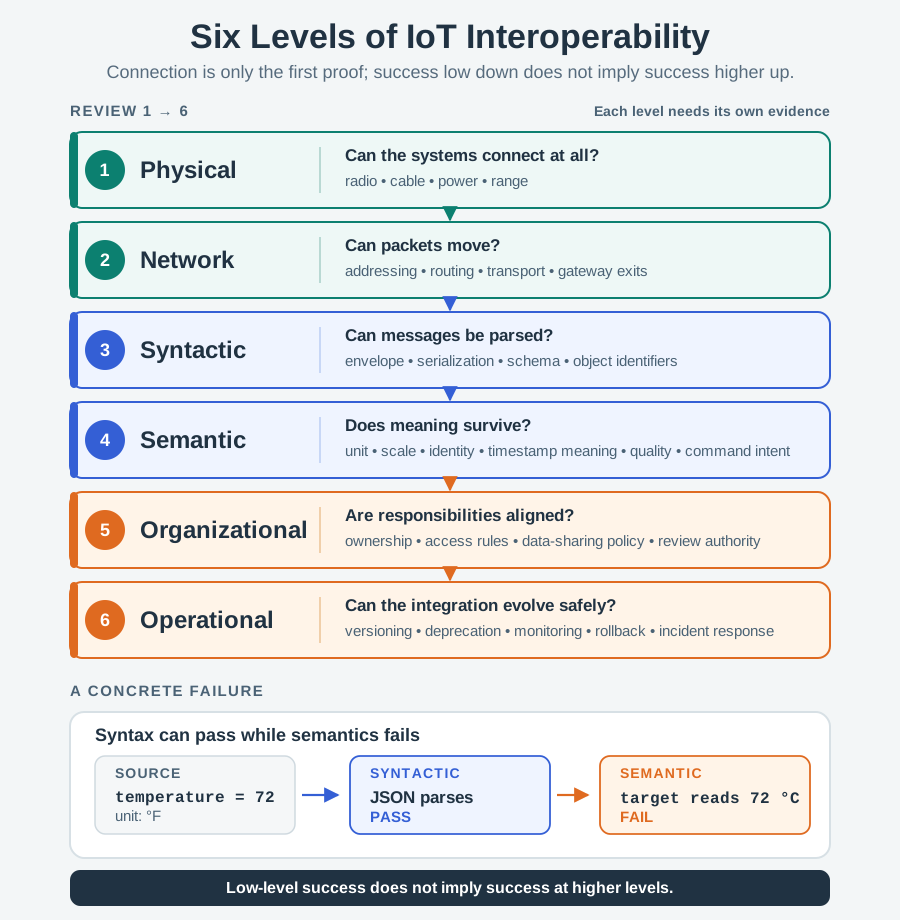
Two systems exchanging messages is not proof of interoperability.
- A bridge can parse a payload, publish a message, and update a dashboard while quietly corrupting the decision that depends on the value.
- Until someone can do that trace, "it connects" is a hope, not evidence.
- A numeric field arrives without a unit or scale.
Major section
Overview: Connecting Is Not Interoperating (continued)
The reason this is hard is that interoperability has levels, and success at a low level says nothing about the higher ones.
- Most painful integration failures live above the network, in the layers where everything looks compatible right up until it is not.
- If you only need the intuition, this layer is enough: interoperability is a review discipline, not a connection status.
- A stale value is repeated with no quality flag.
Major section
Overview: Connecting Is Not Interoperating (continued)
A device identity changes between provisioning, routing, and reporting.
- An optional field is accepted without anyone deciding whether it is trustworthy.
- A release claims support for a standard without recording the profile and feature set that were actually tested.
- User and Device Interoperability A useful interoperability review separates user interoperability from device interoperability.
Major section
Overview: Connecting Is Not Interoperating (continued)
The One-Minute View: Levels, Meaning, Contracts Levels, not a switch Physical, network, syntactic, semantic, organizational, operational — success low down does not imply success higher up.
- Meaning is the hard part Most failures are semantic: unit, time, identity, quality, and state that look compatible but are not.
- Two systems exchange a field named temperature; the source means degrees Fahrenheit and the target reads it as Celsius — perfect syntax, broken meaning.
- A dashboard shows a reading "received," but the value has no quality flag, so a stale measurement looks like a fresh one.
Major section
Overview: Connecting Is Not Interoperating (continued)
"It supports the standard" tells you a family of behavior; "it implements this profile, version, and feature set, tested here" tells you what will actually interoperate.
- User interoperability asks whether a person can discover, identify, understand, and safely use devices that may come from different owners, languages, locations, and service descriptions.
- Device interoperability asks whether two devices can exchange commands, events, and state with compatible syntax and compatible meaning.
- The modern contract in this chapter should capture those details explicitly rather than treating discovery, parsing, and meaning as one success state.
Major section
Practitioner: Levels, the Semantic Contract, and Strategies
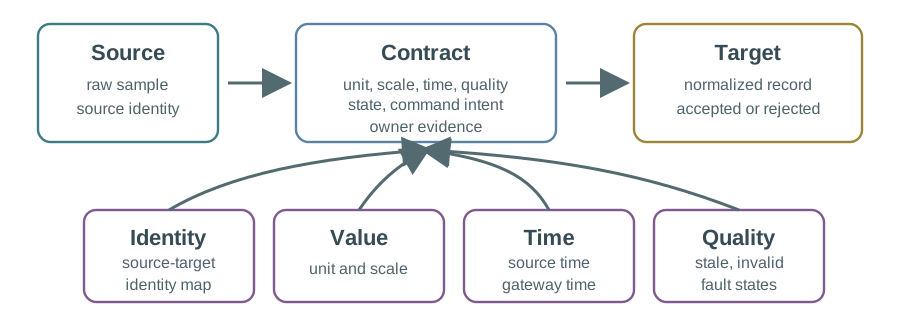
Choosing an Integration Strategy No single strategy solves every level; choose the smallest one that makes the release evidence reviewable.
- Middleware Bridges and Virtual Device Maps A middleware bridge is a gateway translation strategy with stronger bookkeeping.
- Without those records, a bridge may create a virtual device that is reachable but not actually interoperable.
Major section
Practitioner: Levels, the Semantic Contract, and Strategies (continued)
A Universal Middleware Bridge style design, for example, uses adaptors to convert local middleware messages into a shared metadata form and a core router to send those messages to the right adaptor.
- The smart-home HAN boundary makes this concrete.
- The bridge must also preserve who is authoritative.
- Adapter tests shipped with the release.
Major section
Practitioner: Levels, the Semantic Contract, and Strategies (continued)
Adapters multiply fast as systems are added.
- A bridge does not replace the native Zigbee coordinator, Z-Wave controller, KNX installation, or legacy service registry.
- Source protocols, addressing, timing, or reliability differ.
- The gateway can hide a semantic mismatch.
- Many sources need one shared target meaning.
Major section
Practitioner: Levels, the Semantic Contract, and Strategies (continued)
A Matter controller may request a new level, but a wired wall switch, safety limit, or native building controller can still be the source of truth for the physical result.
- An over-grown model becomes its own problem.
- A recognized information model or protocol profile fits.
- The claim must survive procurement or certification.
Major section
Practitioner: Levels, the Semantic Contract, and Strategies (continued)
It discovers a native device, interprets its description, maps selected behavior into a virtual device, routes commands and events, and keeps both identities correlated for as long as the endpoint is exposed.
- Conformance is not the same as interoperability.
- If you can place risk on a level, write the semantic contract, and pick the smallest workable strategy, you can stop here.
- A review starts by naming which level carries the real risk, because that decides what evidence you need.
Major section
Under the Hood: Profiles, Conformance, and Operational Drift
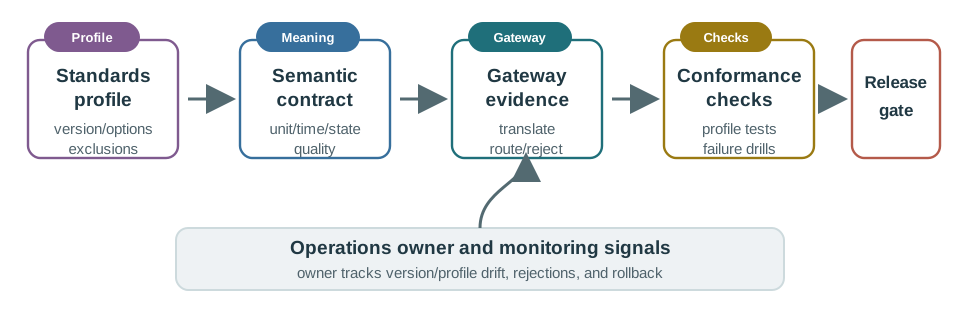
The deeper layer is about the two claims teams most often over-trust: that naming a standard describes a release, and that passing a conformance test means two systems will work together.
- None of them is a complete release contract.
- A parse pass is mistaken for understanding.
Major section
Under the Hood: Profiles, Conformance, and Operational Drift (continued)
Conflating conformance with interoperability.: A spec pass does not guarantee a particular partner pairing works.
- Conformance Is Not Interoperability These are two different tests and conflating them is a classic error.
- A number arrives with no unit or quality.
- The claimed standard is pinned to a profile.
Major section
Under the Hood: Profiles, Conformance, and Operational Drift (continued)
Monitoring signal, owner, version-change rule, rollback path.
- Forgetting the operations owner.: Assign an owner and a monitoring signal so a later schema or firmware change is caught.
- At this depth, interoperability is a review discipline that does not trust a single gateway, broker, platform, or standards label.
- A trustworthy review asks which level carries the risk, what proves meaning survived, and who keeps it working when the parts change.
Major section
Summary
A gateway is a device or service that passes data between unlike systems.: Interoperability means those systems can work together while keeping the meaning and rules that the task needs.
- The next system must know which room, which unit, when it was read, and whether it was sound.
- A working cable does not prove that any of those facts survived.
- Last, prove the people and support teams can run, change, and fix the link.
Major section
Summary (continued)
This Overview uses one clear value to show the six levels below.
- Real links may map many fields, versions, and optional rules.
- The deeper guidance shows how to pin a profile, trace each change, and retest after release.
- Optional fields are unsafe until the contract says whether they are ignored, validated, transformed, or blocked.
Major section
Summary (continued)
Connecting two systems does not prove interoperability; the proof is a traceable value whose identity, unit, timing, quality, state, permissions, and failure behavior survived the boundary.
- Most failures are semantic, where unit, time, identity, quality, and state look compatible but are not; a semantic contract records how the target record was derived, not just its shape.
- A standard name points to a family of behavior, so record the exact profile, version, feature set, exclusions, conformance result, and future-change owner.
- Operational interoperability decays after launch, so assign an owner and a monitoring signal, and keep a release evidence pack from boundary inventory through release decision.
Deck summary
Key takeaways
Two systems exchanging messages is not proof of interoperability.
- The reason this is hard is that interoperability has levels, and success at a low level says nothing about the higher ones.
- A device identity changes between provisioning, routing, and reporting.
- The One-Minute View: Levels, Meaning, Contracts Levels, not a switch Physical, network, syntactic, semantic, organizational, operational — success low down does not imply success higher up.
- "It supports the standard" tells you a family of behavior; "it implements this profile, version, and feature set, tested here" tells you what will actually interoperate.
Retrieval practice
Recall check 1 of 3

Gateway Gus says: answer from memory, then check your reasoning.
Q1Two systems exchange a JSON field named 'temperature'. The source sends 72 as degrees Fahrenheit, but the target treats it as degrees Celsius. Which interoperability level failed?
Show answer
Answer: C The field parses fine, so syntax is intact; the failure is that the two sides assign different meaning to the same number.
Retrieval practice
Recall check 2 of 3

Gateway Gus says: answer from memory, then check your reasoning.
Q2A gateway release note says it supports a standard protocol. Which follow-up question most directly protects the integration from content drift?
Show answer
Answer: D A standard name points to a family of behavior; the release needs the tested profile, feature set, and accepted exclusions to be reviewable.
Retrieval practice
Recall check 3 of 3

Gateway Gus says: answer from memory, then check your reasoning.
Q3A gateway passes the protocol's official conformance test, but in the field it cannot exchange usable data with a particular partner system that also claims to support the standard. What most likely happened, and what evidence resolves it?
Show answer
Answer: A Conformance proves the spec was followed; interoperability proves two implementations actually work together.
Print reference
Answers
Answer key.
- C · The field parses fine, so syntax is intact; the failure is that the two sides assign different meaning to the same number.
- D · A standard name points to a family of behavior; the release needs the tested profile, feature set, and accepted exclusions to be reviewable.
- A · Conformance proves the spec was followed; interoperability proves two implementations actually work together.