Security: Threats & Defense · Study deck
Common IoT Security Mistakes
Picture a device labeled patched while its update record names no installed version.
Shield Shelly is your guide for this deck.

After studying this chapter
Learning objectives
You will be able to:
- treat a security mistake as an evidence gap, not just a bad habit
- scope a correction to what was actually fixed and retested
- identify the six recurring IoT mistakes (default credentials, unencrypted transport, weak update path, exposed debug, sensitive logging)
- label an unverified security claim instead of presenting it as resolved
Major section
Start With The First Security Review
Firmware is stored device software.
- The password was never rotated, the management page is reachable from the sensor network, or the update record says "patched" without showing the build that actually installed.
- The mistake is the gap between the claim and the evidence.
- For each mistake, ask what claim the team is making, what evidence should exist, what correction narrows the gap, and what retest keeps it from returning.
Major section
Overview: Mistakes Are Evidence Gaps
Most IoT security mistakes are not exotic.
- A device may claim to be protected while still sharing credentials, accepting management traffic from the wrong place, running unverified firmware, recording secrets in logs, or depending on a security label that was never tested.
- An attacker tests the evidence, not the sign.
Major section
Overview: Mistakes Are Evidence Gaps (continued)
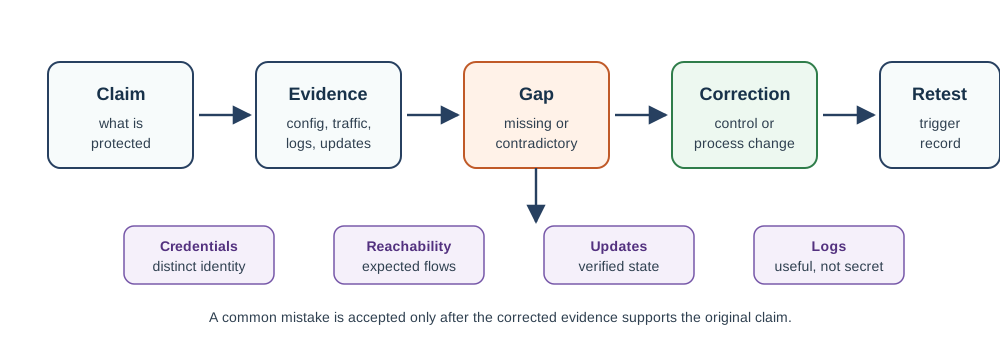
The fix is a scoped correction plus the evidence and the retest trigger that keep the claim honest.
- Writing a mistake as an evidence gap, rather than as "weak security," makes it possible to fix and to retest.
- If the evidence gap is shared credentials, the fix is identity provisioning and revocation evidence, not a vague rewrite of the whole security plan.
- Those named elements make the claim concrete rather than merely directional.
Major section
Overview: Mistakes Are Evidence Gaps (continued)
If the gap is exposed management access, the fix is a management boundary and denied-path proof, not a claim that every network path is now safe.
- If you only need the intuition, this layer is enough: a mistake is not just a missing control; it is a design that cannot prove the claim it makes.
- The sign is the claim; the dog, the lock, the camera, or the fence is the evidence.
- Many IoT mistakes are signs with nothing behind them: "encrypted," "segmented," "hardened," with no record that the control is actually present.
Major section
Overview: Mistakes Are Evidence Gaps (continued)
The decision in Overview: Mistakes Are Evidence Gaps becomes concrete only when the review flow: a claim is checked against evidence, classified as a gap when evidence is missing, corrected, and retested.
- The One-Minute ViewA mistake is a claim gap Write it as claim, evidence, gap, correction, and retest trigger, not as a vague "weak security" note.
- Corrections must be scopedChanging one password is not fixing the shared-credential process.
- Beginner ExamplesTaken together, these checks make the section reviewable.
- If you can frame a mistake as an evidence gap, you can stop here.
Major section
Practitioner: Six Recurring Mistakes and Their Corrections
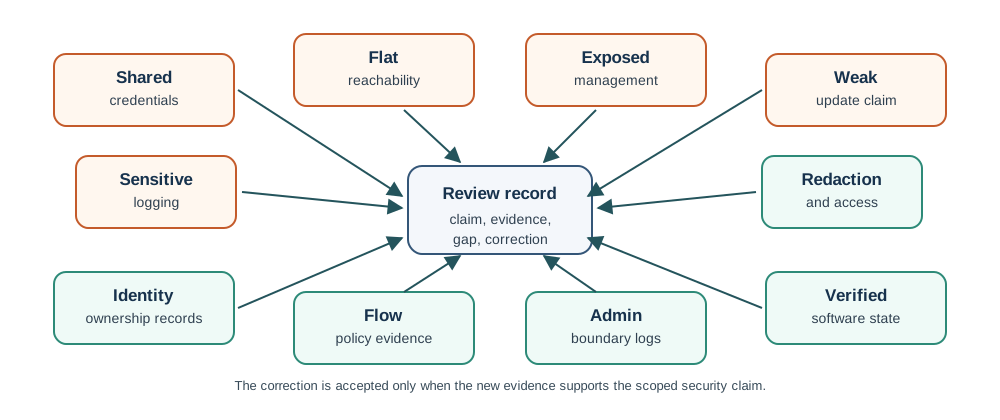
Each recurring mistake is easiest to fix when written with the same pattern: the claim, the evidence observed, the gap, the scoped correction, and the trigger that makes the evidence stale.
- This order keeps a local repair from becoming an unsupported statement about the whole system.
- "Each device and operator is accountable.".
Major section
Practitioner: Six Recurring Mistakes and Their Corrections (continued)
Provisioning or identity-provider change.
- The later rows keep the same discipline—: Exposed management is tested with: Admin boundary logs, and: Sensitive logging with: Redaction and access.
- Those mappings prepare the six-mistake ledger below: each correction must leave observable evidence and a defensible retest boundary.
- "Devices are isolated.".
Major section
Practitioner: Six Recurring Mistakes and Their Corrections (continued)
Worked Review RecordAn environmental monitoring deployment has sensors, a gateway, an application service, and an operations console.
- Distinct identities, first-use setup, rotation and revocation, per-actor auth logs.
- Network policy, gateway, or device-move change.
- "Management is restricted.".
- Configuration or management-role change.
Major section
Practitioner: Six Recurring Mistakes and Their Corrections (continued)
Evidence gapsMultiple devices use the same setup credential; the management interface is reachable from the telemetry network; logs include full authorization headers captured during debugging.
- "Updates are trusted.".
- New software, key, or policy change.
- "Logging supports response.".
- Event content without secrets, redaction, log access controls, denied-event records.
Major section
Practitioner: Six Recurring Mistakes and Their Corrections (continued)
Logging or log-forwarding change.
- Any change to the claimed control.
- The design record says devices are hardened.
- Scoped correctionsReplace shared setup credentials during provisioning and record ownership; restrict management access to the documented administration path; redact authorization material before logs are stored or forwarded; add monitoring for denied management attempts.
Major section
Under the Hood: Why These Mistakes Recur
The Mirai botnet is the practical warning behind this rule.
- Devices that were reachable on the network with unchanged factory credentials became easy recruits for large-scale distributed denial-of-service traffic.
- Once a credential exists, its strength is also a claim that needs evidence, not an assumption.

Major section
Under the Hood: Why These Mistakes Recur (continued)
Exposed Debug InterfacesHardware debug interfaces are a frequent blind spot for reviews that only look at the network.
- A policy that states only "strong passwords required," with none of this evidence, is an unverified claim in the same sense as an unproven "encrypted" label further down this chapter.
- An "encrypted" label without this evidence is an unverified claim.
- The failure mode is not only an unpatched device.
Major section
Under the Hood: Why These Mistakes Recur (continued)
Unencrypted Transport and Untested "Encrypted" Claims "Traffic is encrypted" is a claim that needs session or configuration evidence.
- Many IoT protocols can run in a plaintext mode by default, so a design that assumes encryption without checking the negotiated session may be sending telemetry or credentials in the clear.
- The review should confirm which protocol mode is actually in use, whether peers are authenticated as part of the session, and whether fallback to an unprotected mode is possible.
- No Real Update Mechanism "Update supported" is not the same as a reviewable update claim.
Major section
Under the Hood: Why These Mistakes Recur (continued)
The system must be able to prove which software or firmware state is installed, verify the package before installation, define rollback or recovery for a failed install, and run post-update checks.
- If the method cannot prove which state is installed, it cannot support a security claim about that state, which quietly undermines every later patch.
- A bad update can also brick equipment if rollout targeting, model compatibility, and recovery are not checked.
- That physical chain is the point: a tool intended for legitimate programming reaches the target below the network stack.
Deck summary
Key takeaways
Firmware is stored device software.
- Most IoT security mistakes are not exotic.
- The fix is a scoped correction plus the evidence and the retest trigger that keep the claim honest.
- If the gap is exposed management access, the fix is a management boundary and denied-path proof, not a claim that every network path is now safe.
- The decision in Overview: Mistakes Are Evidence Gaps becomes concrete only when the review flow: a claim is checked against evidence, classified as a gap when evidence is missing, corrected, and retested.
Retrieval practice
Recall check 1 of 3

Shield Shelly says: answer from memory, then check your reasoning.
Q1What is the most useful way to frame a common IoT security mistake during review?
Show answer
Answer: B Framing the mistake as a claim-versus-evidence gap makes it specific enough to correct, own, and retest.
Retrieval practice
Recall check 2 of 3
Shield Shelly says: answer from memory, then check your reasoning.
Q2A review record says an IoT deployment is secure because traffic is encrypted, but the same setup credential is still accepted by every device. Which conclusion is most evidence-bound?
Show answer
Answer: C Encryption and identity are separate claims.
Retrieval practice
Recall check 3 of 3
Shield Shelly says: answer from memory, then check your reasoning.
Q3A network review concludes an IoT device is well protected, but the shipped hardware still has an enabled serial console (UART) and an open chip debug interface (JTAG). Why does this weaken the conclusion?
Show answer
Answer: B Exposed UART or JTAG is a local-access path that network controls do not cover; the review should record whether these interfaces are disabled, locked, or protected.
Print reference
Answers
Answer key.
- B · Framing the mistake as a claim-versus-evidence gap makes it specific enough to correct, own, and retest.
- C · Encryption and identity are separate claims.
- B · Exposed UART or JTAG is a local-access path that network controls do not cover; the review should record whether these interfaces are disabled, locked, or protected.