UX Design · Study deck
IoT Research Methods: Fieldwork and Synthesis
A home visit may reveal workarounds that an interview misses.
UX Uma is your guide for this deck.

After studying this chapter
Learning objectives
You will be able to:
- Explain: task and setting. Participant role. Relevant devices and infrastructure. Observed actions. Interruptions and workarounds. Device, app, service, and support states. Questions asked after observation. Evidence boundary and follow-up needs.
- Explain: A spike in overrides might mean the automation is wrong, the UI is unclear, the context changed, or users do not trust the system.
- Explain: Requirements should state what is sensed, what is not sensed, how data is summarized, who can see it, and how occupants can report problems.
- Explain: Reopen the plan when the guest role, offline access behavior, support process, or reader firmware changes.
Major section
Contextual Inquiry
Contextual inquiry means observing people in the environment where the product, task, or workaround happens.
- task and setting. Participant role. Relevant devices and infrastructure. Observed actions. Interruptions and workarounds. Device, app, service, and support states. Questions asked after observation. Evidence boundary and follow-up needs.
Major section
Prototype and Usability Tests
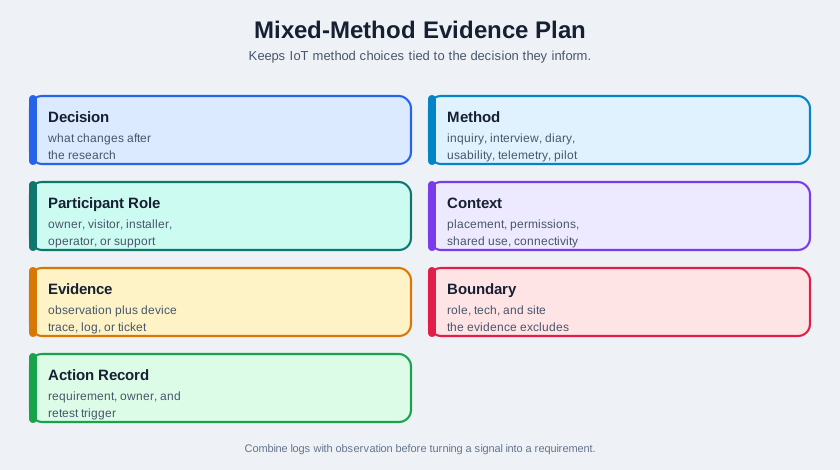
Prototype tests answer whether a design representation is understandable before the team commits to implementation.
- Prototype fidelity should match the question.
- A sketch may be enough for sequence and wording.
- A clickable prototype may be needed for flow comprehension.
- A bench prototype or field prototype may be needed when physical sensing, placement, timing, or feedback affects behavior.
Major section
Surveys
Surveys are useful after the team understands the pattern it wants to measure.
- "Would you use automatic home access?".
- "In the past month, how many times did you need to grant temporary access to someone while you were away from the entrance?".
Major section
Telemetry and Support Logs
Telemetry and support logs can show field signals that research sessions miss.
- Telemetry does not explain itself.
- A spike in overrides might mean the automation is wrong, the UI is unclear, the context changed, or users do not trust the system.
- Combine logs with observation, interviews, or support review before turning the signal into a requirement.
Major section
Incremental Examples
Contextual inquiry with account owners and household members during setup and first visitor use.
- Requirements should distinguish pending invite, active credential, revoked credential, phone permission issue, reader offline state, and account ownership conflict.
- Reopen the plan when the guest role, offline access behavior, support process, or reader firmware changes.
- Prototype tests for alert wording, acknowledgement, escalation, and exception-resolution screens.
Major section
Incremental Examples (continued)
Comfort findings from one building may not transfer to another building with different zones, work patterns, or governance.
- Requirements should state what is sensed, what is not sensed, how data is summarized, who can see it, and how occupants can report problems.
- Reopen the study when sensors, data retention, building zones, or automation policies change.
- Diary prompts for drivers and warehouse staff when alerts occur outside scheduled observation.
Major section
Incremental Examples (continued)
Field pilot across a small set of routes before expanding to more warehouses, carriers, and product categories.
- The pilot can support decisions about the tested routes, sensor models, firmware, trailer types, gateway placement, and escalation workflow.
- Requirements should separate product-temperature excursion, sensor fault, gateway offline state, delayed upload, driver acknowledgement, quality-manager release decision, and maintenance work order.
- Reopen the plan when probe model, calibration interval, firmware, route profile, carrier role, alert threshold, or data-retention policy changes.
Major section
Micro-Exercise: Reject the Mismatch
A survey asks whether users would trust automatic unlocking, but no one observes setup, proximity, or shared-access behavior.
- A field pilot records MQTT drop-offs but never interviews users or support staff about what the failures meant.
- A polished prototype test uses only happy-path device states even though the release decision depends on offline recovery.
Try it: Micro-Exercise: Reject the Mismatch in the chapter
Major section
Common Defects
Method mismatch: using a survey when the team needs field observation.
- Happy-path testing: testing setup success but not failure, maintenance, support, or shared use.
- Prototype theater: testing a polished flow after the decision has already been made.
- No evidence boundary: writing conclusions that sound broader than the research supports.
Major section
Summary
Research methods help IoT teams make better design decisions when they are matched to the evidence gap.
- Observation shows behavior and context.
- Prototype tests reveal comprehension and recovery problems.
- Surveys and telemetry help estimate scale after patterns are understood.
- The best research plan is not the largest plan.
Deck summary
Key takeaways
Contextual inquiry means observing people in the environment where the product, task, or workaround happens.
- Prototype tests answer whether a design representation is understandable before the team commits to implementation.
- Surveys are useful after the team understands the pattern it wants to measure.
- Telemetry and support logs can show field signals that research sessions miss.
- Contextual inquiry with account owners and household members during setup and first visitor use.
Retrieval practice
Recall check

UX Uma says: answer from memory, then check your reasoning.
Q1A team wants to understand why users abandon setup for a battery leak sensor under sinks and near appliances. Which research plan best matches the evidence gap?
Show answer
Answer: B Method choice should follow the decision and evidence gap.
Print reference
Answers
Answer key.
- B · Method choice should follow the decision and evidence gap.