Reference Architectures · Study deck
The Seven-Level IoT Architecture
Picture a cold-room sensor taking one temperature reading.
Blueprint Bina is your guide for this deck.

After studying this chapter
Learning objectives
You will be able to:
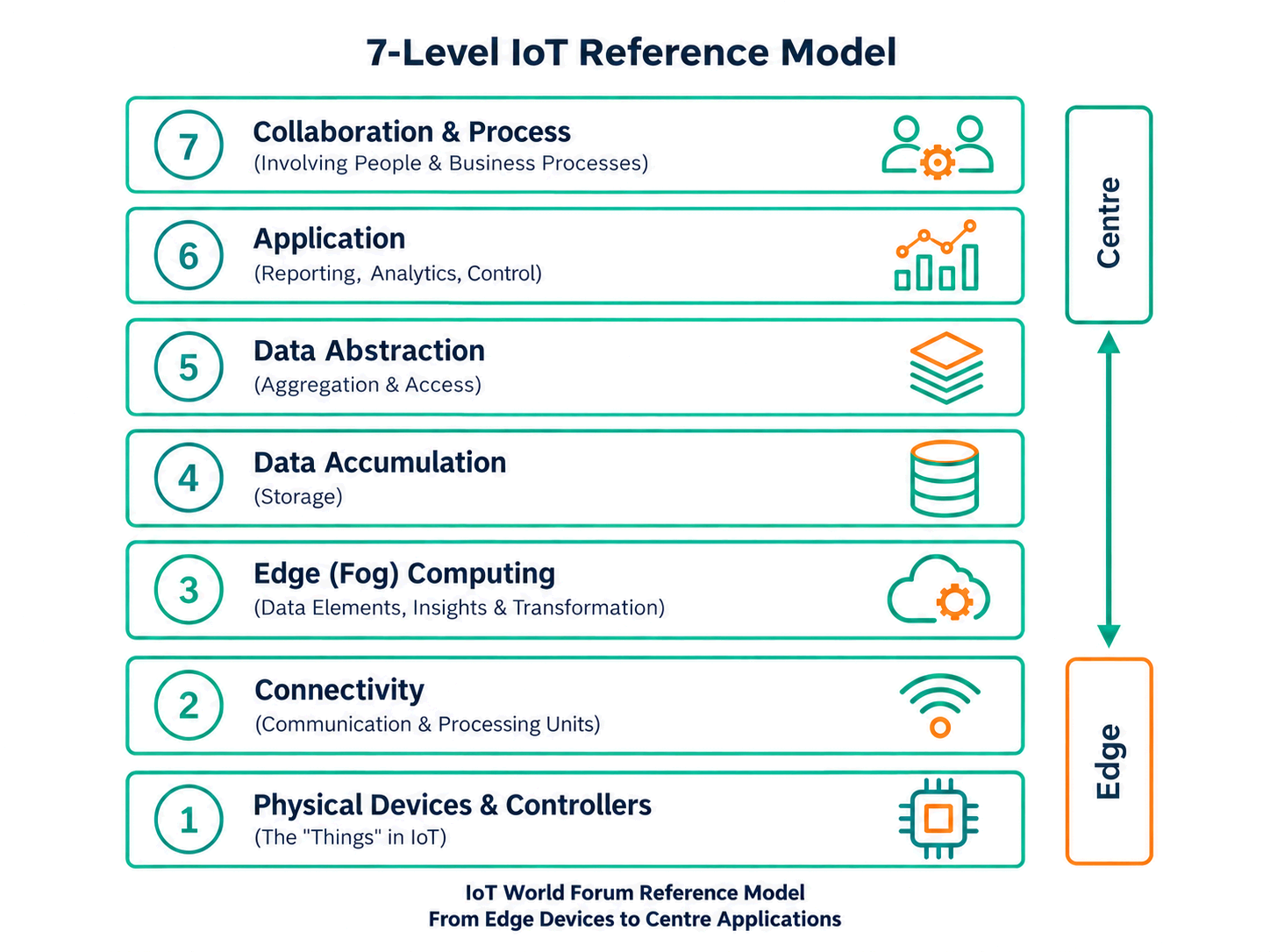
- Map a physical event through all seven levels (physical devices, connectivity, edge work, data accumulation, data abstraction, application, collaboration) and name what each level owns
- Trace a downward command or configuration path and distinguish its failure semantics (authorization, idempotence, rollback) from an upward observation path (freshness, duplicate handling)
- Build a seven-level trace record naming the review question, evidence to capture, and common blind spot for each level
- Explain why deployment placement, such as one gateway implementing several levels, does not remove the need to prove each logical responsibility separately
Major section
Start With the Path One Reading Takes
Under the Hood examines trust boundaries, failure meaning, and the places where a simple seven-step picture needs more detail.
- It must reach someone who can act.
- The seven-level model gives each job a place.
- Level one is the physical device.
- Level three can make a quick nearby decision.
Major section
Start With the Path One Reading Takes (continued)
The device senses it, the network moves it, edge logic cleans or reacts to it, accumulation keeps history, abstraction gives it a stable meaning, applications use it, and collaboration turns it into a decision.
- Level four keeps readings over time.
- Level five gives stored data a stable form and meaning.
- Level seven connects that service to people and work.
- The alarm may be late.
Major section
Seven Levels for IoT Review
The seven-level IoT architecture is a responsibility map.
- It separates physical devices, connectivity, edge work, data accumulation, data abstraction, application behavior, and collaboration so a team can trace how physical events become operational decisions and how commands or support actions move back toward devices.
- That bidirectional trace is the real value of the model.
Major section
Seven Levels for IoT Review (continued)
A cold-room gateway might sample a probe, validate the reading, buffer an outage, apply a local alarm rule, and forward a summarized event.
- Those actions touch several logical levels even though they run in one box.
- The model is credible only when both directions have owners and failure rules.
- The seven levels are logical responsibilities.
Major section
Seven Levels for IoT Review (continued)
The review should still ask which evidence proves the physical reading, which evidence proves delivery, which evidence proves local decision behavior, which evidence proves durable history, and which evidence proves the operator response.
- A configuration change, reset command, or maintenance instruction begins in an application or process workflow and moves downward through data meaning, stored state, edge enforcement, connectivity, and physical device behavior.
- On the return journey, follow an operator decision downward until it reaches device behavior.
- The ordered trace shows that levels describe logical responsibilities rather than mandatory boxes, connecting the model to the ownership and failure questions used throughout the chapter.
Major section
Seven Levels for IoT Review (continued)
Movement and local workConnectivity and edge processing move messages, filter noisy behavior, buffer interruptions, and decide what must happen locally.
- Data meaningAccumulation and abstraction preserve records, normalize meaning, apply access boundaries, and prepare data for applications.
- Human and process actionApplications and collaboration turn prepared information into alerts, reports, commands, workflows, and support decisions.
- One gateway, service, or product may implement several levels, but the review still needs separate ownership and evidence for each responsibility.
Major section
Seven-Level Trace Record
The practitioner move is to choose one important behavior and trace it through the levels.
- A temperature alert, valve command, firmware configuration change, battery fault, or missing-data event will expose different boundaries.
- Delivery behavior, retry limits, duplicate handling, gateway translation, and timing.
- Rule traces, buffer limits, fallback behavior, and local override records.
Major section
Seven-Level Trace Record (continued)
The edge-work row stays vague until it is broken into named functions.
- Naming which of those five functions a gateway performs is what turns "edge work" from a label into an auditable responsibility.
- The level 3-to-4 boundary is also where the system's timing model changes.
- The architecture is credible only if each handoff has an owner and a testable evidence point.
Major section
Boundaries and Failure Semantics
A work order can be closed without confirming the physical condition changed.
- Under the hood, the seven-level model is not a strict runtime pipeline.
- Commands, configuration, and support actions often move downward.
- The deeper review asks whether each boundary preserves meaning.
- A timestamp can be lost.
Major section
Boundaries and Failure Semantics (continued)
Collaboration paths need role ownership, escalation, audit, and proof that the physical outcome was checked.
- A retry can duplicate a command.
- A gateway can convert a unit incorrectly.
- A dashboard can show a stale value without warning.
- Direction matters because each path has different failure semantics.
Major section
Boundaries and Failure Semantics (continued)
Observation paths need freshness, calibration context, duplicate handling, and missing-data rules.
- Command paths need authorization, idempotence, acknowledgement, rollback, and safe-state behavior.
- Each trace should name the owner of the boundary, the evidence used to close the step, and the condition that reopens the architecture decision.
- Freshness and meaning must survive the path.
Major section
Boundaries and Failure Semantics (continued)
A downward reset trace should show authorization, command construction, gateway delivery, device acknowledgement, safe output state, and rollback if the acknowledgement never arrives.
- These traces expose where a combined deployment still has separate responsibilities.
- Observation pathPhysical state becomes a message, then a record, then a domain view, then a decision.
- Command pathAn application or procedure may send configuration or actuation downward.
- A gateway may contain physical I/O, connectivity, edge rules, buffering, and security state.
Major section
Boundaries and Failure Semantics (continued)
Exception pathMissing data, duplicate messages, stale values, local overrides, and operator acknowledgements need explicit handling across levels.
- Ownership pathEvery boundary needs a named owner for evidence, support, retest, and change control, even when one vendor or team implements several levels.
- The most important under-the-hood habit is to avoid confusing deployment placement with architecture responsibility.
- A cloud service may contain accumulation, abstraction, application logic, and collaboration workflow.
Deck summary
Key takeaways
Under the Hood examines trust boundaries, failure meaning, and the places where a simple seven-step picture needs more detail.
- The device senses it, the network moves it, edge logic cleans or reacts to it, accumulation keeps history, abstraction gives it a stable meaning, applications use it, and collaboration turns it into a decision.
- The seven-level IoT architecture is a responsibility map.
- A cold-room gateway might sample a probe, validate the reading, buffer an outage, apply a local alarm rule, and forward a summarized event.
- Movement and local workConnectivity and edge processing move messages, filter noisy behavior, buffer interruptions, and decide what must happen locally.
Retrieval practice
Recall check 1 of 4

Blueprint Bina says: answer from memory, then check your reasoning.
Q1What is the strongest reason to use the seven-level IoT architecture during an early design review?
Show answer
Answer: C The seven-level model is a review tool.
Retrieval practice
Recall check 2 of 4
Blueprint Bina says: answer from memory, then check your reasoning.
Q2A remote operator sends a reset command to a field node. What must the downward path prove?
Show answer
Answer: C A command needs proof through each boundary to the physical outcome.
Retrieval practice
Recall check 3 of 4
Blueprint Bina says: answer from memory, then check your reasoning.
Q3A team maps a cold-room alarm to the seven-level model. Which review action best proves the architecture is useful?
Show answer
Answer: B The seven-level model becomes useful when a real behavior is traced across every boundary, including the operational response.
Retrieval practice
Recall check 4 of 4
Blueprint Bina says: answer from memory, then check your reasoning.
Q4Why is deployment placement not enough to prove a seven-level IoT architecture?
Show answer
Answer: D The seven-level model separates logical responsibilities from deployment placement so reviewers can prove meaning and ownership across normal and degraded paths.
Print reference
Answers
Answer key.
- C · The seven-level model is a review tool.
- C · A command needs proof through each boundary to the physical outcome.
- B · The seven-level model becomes useful when a real behavior is traced across every boundary, including the operational response.
- D · The seven-level model separates logical responsibilities from deployment placement so reviewers can prove meaning and ownership across normal and degraded paths.