Reference Architectures · Study deck
Reference Models as Responsibility Maps
Use reference models to trace IoT responsibilities, handoffs, owners, and evidence from physical events to operational decisions.
Blueprint Bina is your guide for this deck.

After studying this chapter
Learning objectives
A useful model makes each handoff understandable and testable.
- A reading must retain its meaning across several responsibilities.Device, connectivity, local processing, storage, application, and workflow evidence connect the physical event to the final decision.
- Different operating flows need separate evidence paths.Observation, command, exception, and maintenance routes expose handoffs that a successful dashboard reading alone cannot prove.
- Logical responsibilities are separate from physical boxes.One gateway can perform several jobs, while one data responsibility can span devices and services.
- The model must identify reasons for renewed review.Changed devices, sampling, ownership, or recurring failures can invalidate a boundary contract after deployment.
Major section
Begin With One Reading and One Owner
Follow one high temperature reading and identify who owns every handoff.
- Device hardware and firmware have distinct acquisition jobs.The hardware samples the reading, while firmware prepares the message that enters the communication path.
- The link, gateway, store, and application each own a job.The reading can be carried, cleaned, retained, and displayed before a person decides what action is needed.
- Every boundary needs a reviewable handoff record.Input, output, owner, proof, and safe failure must remain explicit as the reading changes location or representation.
- A controlled break can test the responsibility map.A lost link, changed data shape, or delayed work order reveals which layer detects the fault and who must recover.
Major section
Start With One Sensor Reading
The first panel starts at the freezer.
- The next shows code, a network gateway, a store, and a screen between the reading and the person.
- It asks which layer owns each responsibility, which handoff can fail, and which evidence proves the reading still means the same thing at the end of the path.
Major section
Shared Map Before Diagram
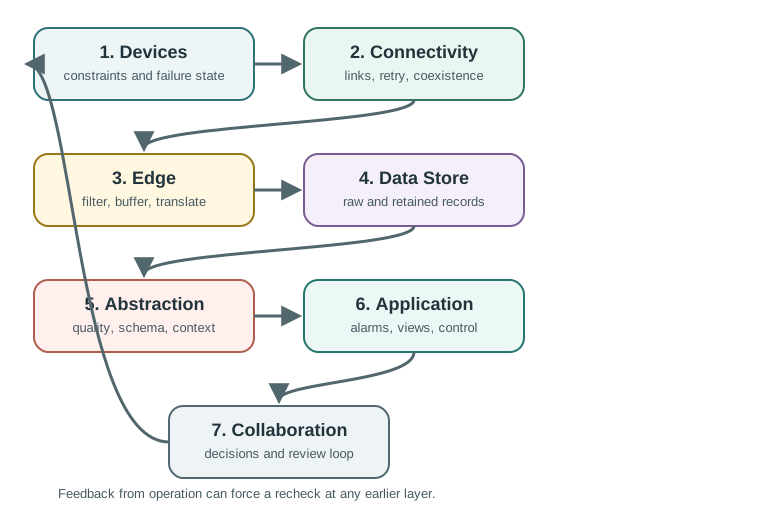
The evidence map links layers to review duties; begin at Devices and follow the reading downward.
- Devices establish the physical event before connectivity carries the observation.The first part of the map connects sensing responsibility with the link evidence needed by the next handoff.
- Edge work and storage must preserve reviewable records.Filtering and buffering need a connection to the raw and retained evidence shown in the middle of the map.
- Abstraction and applications must make records useful without losing meaning.Transformed fields, quality flags, and query paths connect stored observations with the displayed status.
- Workflow must connect the decision to ownership and review.The final map stage needs accountable action, closure evidence, and a way to reopen a broken boundary.
Major section
A Shared Vocabulary for Review
Choose the model for the risky boundaries it exposes.
- Shared vocabulary helps teams discuss the same responsibilities.A model separates devices, connectivity, processing, data, applications, and human workflow before a deployment diagram is finalized.
- The model must expose questions before product selection.The useful lens reveals boundaries the team must design, test, operate, and revisit when requirements change.
- Layer names cannot prove a working handoff.Meaning, timing, and failure behavior still need evidence from the actual system behind the labels.
- Evidence must connect the map to the running deployment.A trace, log, test, or review note shows whether the named responsibility remains satisfied after operation begins.
Major section
Dashboard Values and Command Buttons
A dashboard value and a command button depend on responsibilities beyond the screen.
- A displayed reading needs freshness and source evidence.Sensor placement, timestamps, gateway buffering, and storage can all affect whether the value still represents the room.
- A command needs a bounded delivery and failure path.Authorization, acknowledgement, retry behavior, and safe offline handling must connect the user’s intent to device action.
- A gateway label does not define its actual responsibilities.The gateway may route, filter, buffer, translate protocols, run rules, or own local recovery.
- Every gateway job needs its own review question.Capability must be supported by evidence rather than inferred from calling the box an edge layer.
Major section
Giving a Room Reading Meaning
Trace the room-monitoring responsibilities in the order that gives a reading meaning.
- Physical evidence must show what the sensor represents.Placement, calibration state, and enclosure effects determine whether the measurement remains a useful description of the room.
- Connectivity must account for imperfect message delivery.The next responsibility must account for loss, retries, duplicates, timestamps, and gateway receipt when interpreting the observation.
- Local processing must define behavior during cloud outages.Filtering, buffering, translation, and fallback rules determine what continues near the room when the remote path disappears.
- Data and workflow roles must support accountable decisions.The path beyond acquisition needs quality flags, freshness, alarm thresholds, acknowledgements, maintenance tickets, and closure evidence.
Major section
Common Layers and Cross-Cutting Controls
Shared models help teams untangle responsibilities across many application domains.
- Several broad responsibilities are common across application domains.Physical devices, infrastructure, platforms, and applications provide a shared vocabulary for otherwise different connected systems.
- Security and privacy must cross the layer boundaries.Their controls must work alongside the responsibilities rather than being treated as a separate final layer.
- Different isolation mechanisms must address different parts of the system.Hardware isolation, network segmentation, and software sandboxing may need to work together across the complete path.
- The shared vocabulary cannot replace deployment-specific proof.Each design still needs evidence for its own boundaries, ownership, operating behavior, and failure conditions.
Major section
A Stale Value After a Gateway Outage
An old dashboard value can expose a failure between otherwise functioning components.
- Buffered readings must retain evidence of their age.The gateway needs to distinguish an old observation from a fresh one when the remote connection resumes.
- Storage must retain the evidence required for review.Raw and transformed records help explain which value reached the application after the outage.
- The application and workflow must expose the exception.Freshness indication and facilities escalation connect the stale display to an owner who can act.
- Working components can still leave a boundary unproven.Each team may defend its own box while missing the handoff where the temperature claim stopped being current.
Activity 1 · Draw it
✎ Trace a stale room reading

I want you to show who notices when a reading stops describing the room.
Sketch sensor → gateway → storage → dashboard → operator. Mark evidence needed at each handoff after a gateway outage leaves an old temperature on screen.
4 minutes · Pen and paper · Answer: Activity 1
Major section
Reference Model Review Record
Start with a real behavior, then attach a model lens, flows, owners, and proof.
- System behavior must anchor the model review.The record begins with what the system senses, controls, reports, or helps people decide.
- The smallest useful model must expose risky boundaries.A companion lens is useful only when it reveals an additional ownership or lifecycle issue.
- Operating flows must be visible before the final diagram.Observation, command, exception, and maintenance routes establish payloads, timing rules, failure responses, and evidence sources.
- Every risky handoff needs ownership and renewed-review conditions.The record must retain a trace, test, log, or note and the change that would reopen its claim.
Major section
Four Flows, Four Evidence Records
Different operating flows need different records and review triggers.
- Observation evidence must connect the reading to its display.Raw timestamps, gateway receipt, storage writes, transformed fields, and dashboard queries trace the temperature path.
- Command evidence must connect authority to the final response.Authorization, the command message, device response, failure handling, and operator notification make the control path reviewable.
- Exception evidence must show who restores normal behavior.Alert source, suppression rule, owner, and closure note connect the abnormal state to recovery evidence.
- Maintenance evidence must preserve the changed configuration.Device identity, firmware or configuration version, validation check, and rollback plan support updates, replacement, and retirement.
Activity 2 · Match
✎ Match the flow to its evidence
I want you to match each handoff with proof that someone can inspect.
Match five boundaries to five evidence items. Boundaries: physical event, gateway receipt, stored transformation, command authority, workflow closure. Evidence: authorization check; units and calibration; closure note; receipt timestamp; transformed field and quality flag.
3 minutes · Pen and paper · Answer: Activity 2
Major section
Layers, Boundaries, Failures
Logical responsibilities remain separate even when the same gateway performs several jobs.
- A single device can host several logical responsibilities.Sensing, filtering, decisions, buffering, and communication retain distinct review questions when they share hardware.
- One responsibility can also span multiple services.The data lifecycle may include gateway storage, broker retention, cloud databases, and analytics.
- Shared hardware or distribution cannot remove ownership.A responsible owner still needs the evidence record for each boundary and its failure behavior.
- A familiar platform label does not define a contract.Freshness, security, support, and safe failure need explicit testable requirements beyond a layer name.
Major section
Moving Filtering Changes the Contract
Moving a responsibility can change the system contract without changing the dashboard.
- A moved processing responsibility changes where raw data travels.Filtering at the gateway changes the data contract compared with filtering inside the sensing device.
- The new placement needs a renewed operating review.Outage behavior, latency, power use, and diagnostics can all change when the filtering boundary moves.
- Ownership and evidence must follow the responsibility.The revised model needs to identify who operates the new processing location and which records prove its behavior.
- Logical and physical views must remain connected.The responsibility map makes consequences visible before the deployment diagram turns the placement choice into a fixed assumption.
Major section
Physical Meaning and Transport Failure
Preserve the physical event’s meaning before reviewing transport behavior.
- A network message needs evidence of its physical meaning.Units, identity, timestamps, and calibration state connect the reading to the sensor and event it represents.
- Transport contracts must cover imperfect input.Late, duplicated, reordered, missing, and malformed messages need defined behavior before processing can use their values.
- Sequence checks and buffer policies must be inspectable.Retry records, timestamp checks, and rejection logs provide evidence of the decisions made at the handoff.
- Missing contracts can produce plausible but incorrect state.Stale values, repeated commands, or rules firing from bad input can follow apparently valid message delivery.
Major section
Authoritative Data and Accountable Action
The data and workflow boundaries must preserve an authoritative value and accountable action.
- Transformed values need an explicit data-lifecycle contract.Schema, transformation notes, quality flags, storage writes, retention, and query paths establish which value is authoritative.
- A reviewable source of truth can explain disagreements.Dashboard and analytic results need evidence that identifies the retained value and its transformation history.
- Alerts must identify the expected role and procedure.Acknowledgement and escalation conditions connect an application warning to a person responsible for the response.
- Closure evidence must show that operational work finished.A closure note connects the visible alert with accountable action instead of leaving the warning indefinitely unresolved.
Major section
Finding the Failed Boundary
Troubleshoot the path behind the symptom and record the broken assumption.
- A stale dashboard can have several upstream causes.Sensing failure, prolonged retries, old buffers, cached fields, or suppressed alerts can produce the same visible symptom.
- A controlled disturbance can identify missing responsibility.Removing a component or breaking a handoff reveals who detects the condition and which boundary lacks evidence.
- The failure record must include local continuity and recovery.The review records what remains active, which data becomes stale, and what proves normal operation has resumed.
- Recurring exceptions should trigger another model review.Repeated support failures or changed procedures can reveal a contract that the original diagram never made explicit.
Major section
Summary and Key Takeaway
A reference model connects observations, responsibilities, and accountable action.
- A responsibility map connects each observation to its owner.The freezer reading must retain its meaning as it crosses device, network, service, and decision boundaries.
- The model should expose where behavior or data can change.Filtering, transport, storage, and control each create a boundary that needs an accountable owner and evidence.
- The review record makes the model useful during change.A changed workload, device, or destination should trigger a check of the affected responsibilities and tests.
Major section
Summary: A Responsibility Map
A responsibility map is useful when another reviewer can challenge its handoffs.
- System behavior must anchor observations and control decisions.The physical event and intended operational result determine which responsibilities the model needs to expose.
- Logical roles must remain distinct from deployment locations.A gateway can perform several jobs, while one responsibility can be distributed across device, edge, and cloud services.
- Important claims need owners and testable contracts.Boundary evidence must establish who validates, stores, decides, operates, and recovers as the event moves through the system.
- The operating flows need separately reviewable records.Observation, command, exception, and maintenance evidence prevent a successful happy path from hiding support or recovery gaps.
Major section
Keeping the Model Current
Keep the model current as devices, services, and operating assumptions change.
- A new device or workload can invalidate existing evidence.Sensor models, sampling intervals, and firmware classes can change the observation or maintenance path behind an earlier pass.
- Repeated failures can reveal a missing boundary contract.Stale readings, false alarms, missed alerts, and unresolved tickets are reasons to inspect the model again.
- Changed ownership needs a renewed evidence agreement.The incoming owner must know which records and operating duties keep the responsibility testable.
- Deployment changes must update the review record.A moved responsibility or retired support procedure can alter the system contract even when the screen remains familiar.
Deck summary
Key takeaways
A reference model connects system claims to accountable responsibilities.
- Physical events need handoffs that preserve meaning.Units, time, identity, calibration, transformation, and workflow evidence keep the final decision connected to the original reading.
- Logical layers describe responsibilities that can share or span hardware.One gateway can own several roles, and one data responsibility can cross multiple devices and services.
- Explicit contracts make failure behavior testable.Freshness, command safety, exception handling, and workflow closure need proof beyond familiar layer or platform names.
- Owners and review triggers keep the model useful after deployment.Changed devices, links, data rules, applications, or workflows can require renewed evidence for the accepted responsibility map.
Retrieval practice
Recall check 1 of 3
Blueprint Bina says: answer from memory, then check your reasoning.
Q1A team has device notes, network diagrams, cloud storage, dashboards, and support procedures, but no shared way to review how they connect. What is the strongest reason to introduce an IoT reference model?
Show answer
Answer: D The model gives the team a trace from device observation to network handoff, data meaning, application behavior, owner, and evidence.
Retrieval practice
Recall check 2 of 3
Blueprint Bina says: answer from memory, then check your reasoning.
Q2A facilities team says the room-monitoring model is complete because a diagram shows sensors, a gateway, cloud storage, and a dashboard. Which review note is strongest?
Show answer
Answer: D A diagram is useful only when it is tied to flows, owners, evidence, and change triggers.
Retrieval practice
Recall check 3 of 3
Blueprint Bina says: answer from memory, then check your reasoning.
Q3A gateway senses locally, filters data, buffers messages, translates protocols, and runs a fallback rule. Which reference-model interpretation is strongest?
Show answer
Answer: C Physical placement and logical responsibility are different.
Print reference
Answers
Answer key.
- D · The model gives the team a trace from device observation to network handoff, data meaning, application behavior, owner, and evidence.
- D · A diagram is useful only when it is tied to flows, owners, evidence, and change triggers.
- C · Physical placement and logical responsibility are different.
Print reference
Activity 1 answer
Model answer.
Draw it: Model sketch: sensor timestamp and calibration evidence → gateway receipt and buffered-data age → raw/transformed storage records → dashboard freshness indication → exception escalation and closure evidence. Assign an owner to every handoff.
Print reference
Activity 2 answer
Model answer.
Match: Physical event → units and calibration. Gateway receipt → receipt timestamp. Stored transformation → transformed field and quality flag. Command authority → authorization check. Workflow closure → closure note.