Reference Architectures · Study deck
Alternative IoT Reference Models
Picture two teams drawing the same connected factory.
Blueprint Bina is your guide for this deck.

After studying this chapter
Learning objectives
You will be able to:
- Choose an alternative reference-model lens (layer, service, view, constrained, domain) based on which responsibility or boundary the current model hides
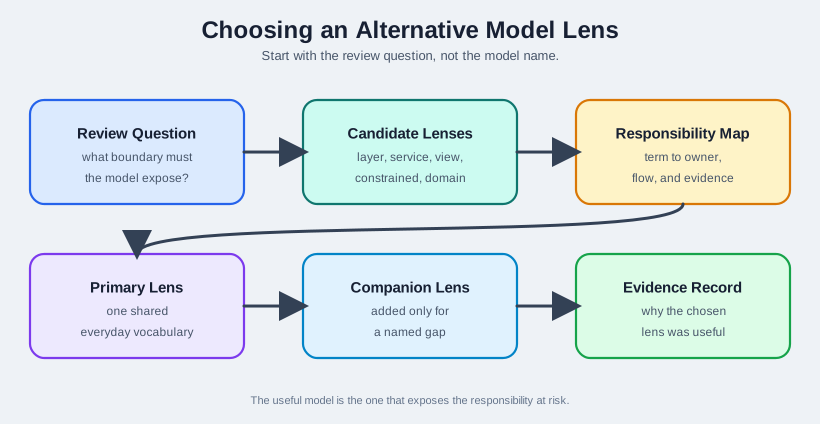
- Select a primary lens for a system and add a companion lens only when it exposes a specific evidence gap, instead of blending every model together
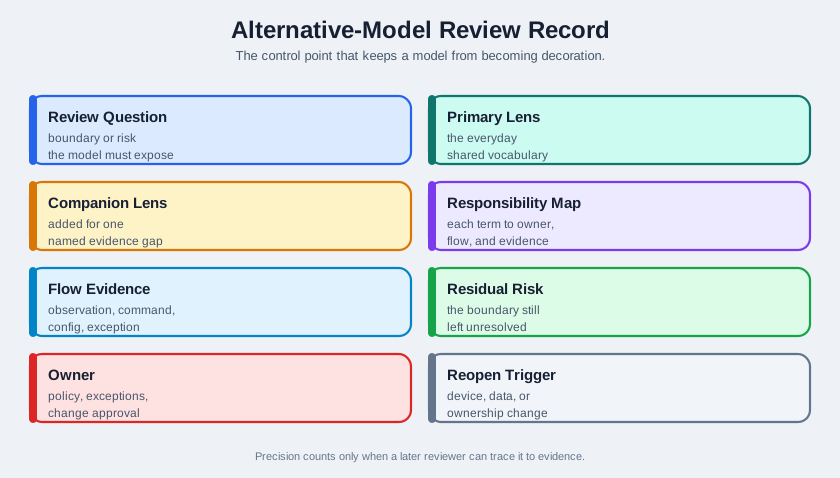
- Build a lens-selection record naming use case, evidence to capture, and reopen trigger
- Maintain semantic integrity by mapping each model term to a responsibility, flow, owner, and evidence source
Major section
Start With the Mismatch
One drawing shows layers from device to business.
- The other shows services and owners.
- A clean layer stack can hide the team that removes access.
- A service map can hide energy and radio limits.
- Adding a second view helps, but too many views can blur the decision.
Major section
Start With the Mismatch (continued)
This factory story cannot crown one model as the truth.
- The model still needs evidence from the real system.
- An alternative reference model usually becomes useful when the first model does not explain the system cleanly.
- A tiny battery network, an industrial cell, a service platform, and a city-scale deployment may all need different lenses even when they share sensors, gateways, and cloud services.
Major section
Alternative Models Are Review Lenses
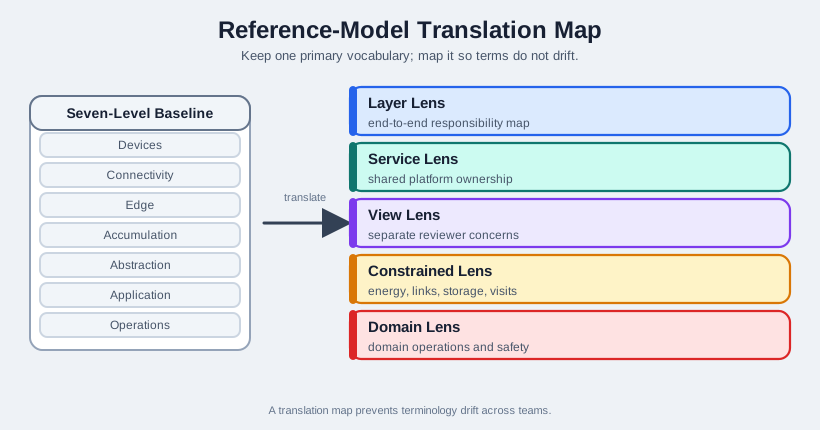
Alternative IoT reference models are not competing truths about the same system.
- One lens may emphasize layers, another services, another viewpoints, another constrained devices, and another domain operations.
- Layer Lens Best when the main question is where device, network, processing, data, application, and workflow responsibilities belong.
- The practical test is whether the lens changes the review conversation.
Major section
Alternative Models Are Review Lenses (continued)
Service Lens Best when registration, discovery, messaging, device management, data handling, and support functions need clean boundaries.
- View Lens Best when functional, information, deployment, and business workflow views need different reviewers.
- Domain Lens Best when domain operations, safety expectations, asset hierarchy, support workflow, or data stewardship shape the architecture.
- For example, a seven-level model is useful when a reviewer needs an end-to-end path from physical devices to collaboration processes.
Major section
Alternative Models Are Review Lenses (continued)
The reason to inspect alternative models are review lenses is concrete. Figure: Each lens family highlights a different review question depicts: Each lens family highlights a different review question.
- The route through Figure: Each lens family highlights a different review question is figure-specific: Same IoT System states one concern,: View Lens names another, and shapes the design? Closes the scope.
- An IoT-A style view model is useful when different reviewers need functional, information, deployment, and business viewpoints.
- A constrained-device lens is useful when sleepy nodes, lossy links, small buffers, and maintenance visits dominate risk.
Major section
Choose a Primary Lens
In practical architecture work, the safest pattern is to choose one primary vocabulary for everyday communication.
- The team needs a shared end-to-end map.
- Registration, routing, command, support, and management contracts.
- A service becomes shared, outsourced, or safety critical.
- Different reviewers need separate concerns.
Major section
Choose a Primary Lens (continued)
A stakeholder cannot validate the architecture from the current view.
- Battery, link quality, or site-access assumptions change.
- The resulting visual statement is: The lens decision should follow the dominant review signal, then record why any companion lens was added.
- A useful mapping table should be operational enough for design review.
Major section
Choose a Primary Lens (continued)
For an outdoor asset tracker, the seven-level primary lens might keep the team aligned on devices, connectivity, edge processing, accumulation, abstraction, application, and operations.
- The constrained companion lens then records wake interval, GNSS fix budget, LoRaWAN confirmed-message policy, local flash queue length, backoff rule, battery replacement interval, service-window owner, and what evidence proves those assumptions.
- For a shared platform, the companion service lens might name who owns device identity, certificate rotation, data retention, schema versioning, command authorization, and support impersonation.
- The table should also identify the test artifact, such as a field log, gateway trace, battery model, or support ticket sample.
Major section
Preserve Semantic Integrity
The hard part of alternative-model use is not drawing more boxes.
- This supports preserve semantic integrity.
- The visual summarizes: The review record is the control point that keeps an alternative model from becoming vague diagram decoration.
- Reopen Decisions Record the device, data, ownership, operating, or constraint change that forces a model review.
Major section
Preserve Semantic Integrity (continued)
When a term changes owner or implementation, the record shows which flows, tests, and agreements must be reviewed again.
- Failure mode:: A model can look precise while hiding an unresolved boundary.
- Preserving integrity usually means storing a small translation record beside the architecture decision.
- That record should also include negative evidence.
Major section
Preserve Semantic Integrity (continued)
The record can map "edge," "gateway," "service," "view," or "platform" to actual components, APIs, data stores, roles, and tests.
- In a building or industrial deployment, that might connect BACnet or OPC UA adapters, MQTT topics, a time-series database, a device registry, role-based dashboard access, and a maintenance workflow.
- If the chosen service lens says identity is centralized, the test should show what happens when a device presents an expired certificate or an unknown serial number.
- Those checks keep the model grounded in system behavior rather than vocabulary preference.
Deck summary
Key takeaways
One drawing shows layers from device to business.
- This factory story cannot crown one model as the truth.
- Alternative IoT reference models are not competing truths about the same system.
- Service Lens Best when registration, discovery, messaging, device management, data handling, and support functions need clean boundaries.
- The reason to inspect alternative models are review lenses is concrete. Figure: Each lens family highlights a different review question depicts: Each lens family highlights a different review question.
Retrieval practice
Recall check 1 of 3

Blueprint Bina says: answer from memory, then check your reasoning.
Q1Why should a team use an alternative IoT reference model?
Show answer
Answer: A Alternative IoT reference models help reviewers inspect specific boundaries.
Retrieval practice
Recall check 2 of 3

Blueprint Bina says: answer from memory, then check your reasoning.
Q2A team already uses a seven-level model, but outdoor battery nodes report through intermittent links and are serviced rarely. What is the strongest architecture move?
Show answer
Answer: A A stable primary lens plus a focused companion lens avoids terminology drift while making the hidden constraint visible.
Retrieval practice
Recall check 3 of 3

Blueprint Bina says: answer from memory, then check your reasoning.
Q3What must an alternative-model choice show before the architecture team accepts it?
Show answer
Answer: A Alternative model choices stay trustworthy when terms, boundaries, evidence, owners, and reopen triggers remain explicit.
Print reference
Answers
Answer key.
- A · Alternative IoT reference models help reviewers inspect specific boundaries.
- A · A stable primary lens plus a focused companion lens avoids terminology drift while making the hidden constraint visible.
- A · Alternative model choices stay trustworthy when terms, boundaries, evidence, owners, and reopen triggers remain explicit.