Reference Architectures · Study deck

Common Reference Architecture Pitfalls

Picture a neat system drawing with a device, a local bridge, and a central service.

Blueprint Bina is your guide for this deck.

Blueprint Bina, the module guide, in a scene from this chapter.
iotclass.org

After studying this chapter

Learning objectives

You will be able to:

  • Treat a reference-architecture diagram as an untested hypothesis and identify the assumption that would break the system if it were false
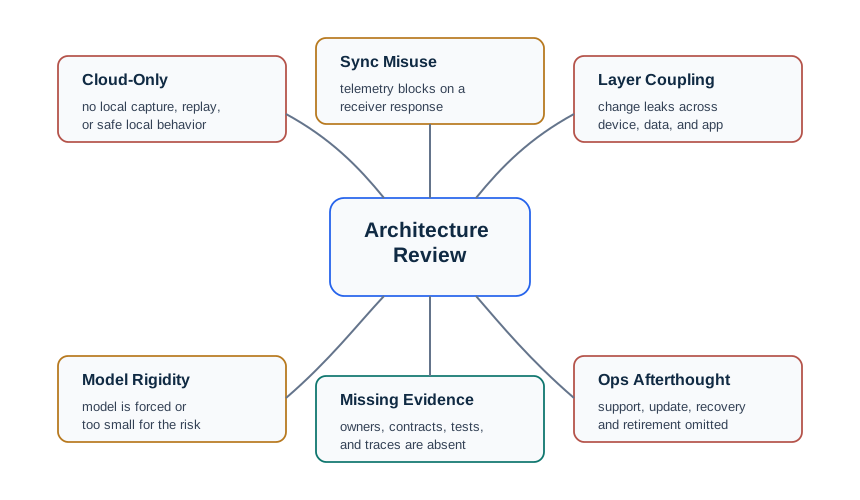
  • Recognize the six pitfall classes -- cloud-only dependency, synchronous flow misuse, layer coupling, model rigidity, missing evidence, and operations afterthoughts
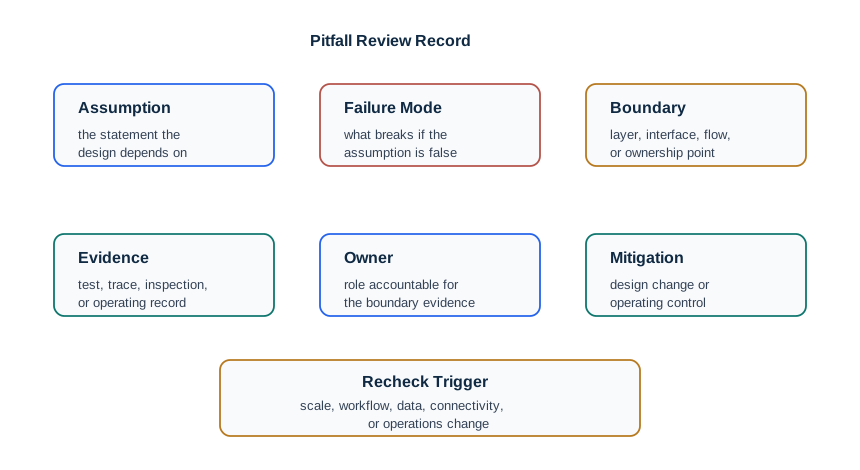
  • Write a pitfall review record naming assumption, affected boundary, evidence, owner, mitigation, and recheck trigger
  • Explain: The drawing hid an assumption: the central service would always be reachable.
iotclass.org

Major section

Start With the Failure You Can Measure

The drawing hid an assumption: the central service would always be reachable.

  • A reference architecture is a shared pattern for dividing system jobs.
  • It helps teams talk, but it is not proof that a design will work.
  • This first review does not find every weak point.

Key terms

Bandwidth
Bandwidth means how much data a link can carry in a set time.
iotclass.org

Major section

Start With the Failure You Can Measure (continued)

Bandwidth means how much data a link can carry in a set time. “The bridge stores data” becomes a full-store and replay test. “Teams share one data form” becomes a change and ownership test.

  • A pitfall is easiest to fix when it has a measurement attached.
  • A cloud-only design shows up as bandwidth cost or outage delay.
  • A weak abstraction boundary shows up as broken dashboards after a schema change.
iotclass.org

Major section

Diagram as Hypothesis
Most IoT reference architecture failures are not caused by choosing the wrong diagram.

  • If a weather station, pump monitor, or building controller depends on the cloud, ask what happens during an outage.
  • If a gateway forwards commands, ask what happens when an acknowledgement arrives late.
  • If a shared data model feeds several teams, ask who owns a schema change.

Why it matters

Otherwise the same assumption will return later as an incident, with no clear owner for the original architecture choice.

Use pitfall review to find weak assumptions before the architecture becomes a rollout dependency.
iotclass.org

Major section

Diagram as Hypothesis (continued)

The pitfall is not that these designs are always wrong; the pitfall is approving them before the risky assumption has an owner and a test.

  • This keeps the pitfall review concrete.
  • The test result should be tied to the architecture record.
  • Synchronous flow misuse Telemetry or commands block unnecessarily because every exchange is treated like request-response control.
iotclass.org

Major section

Pitfalls to Review Records

A practical pitfall review is a small evidence record, not a long policy document.

  • A cloud dependency record should show capture, retention, replay, duplicate handling, local safe behavior, and dashboard reconciliation.
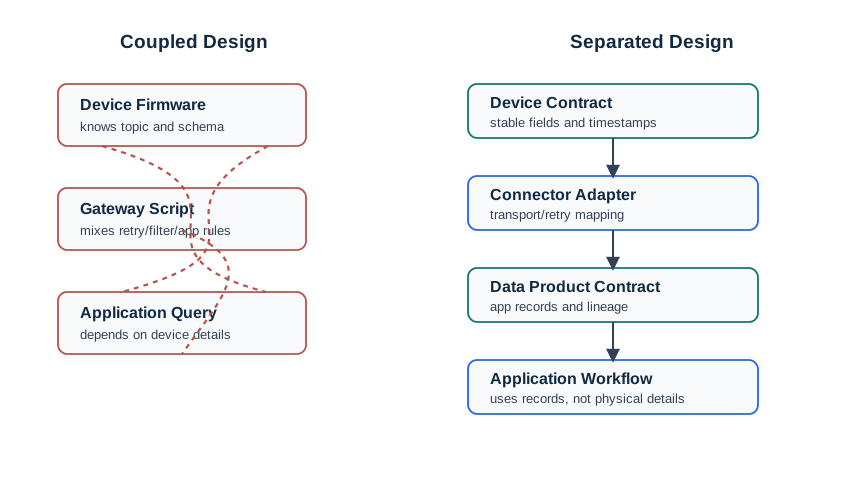
  • A layer-coupling record should show the interface contract, allowed data fields, owner, version rule, and failure behavior.
  • A checklist alone cannot settle pitfalls to review records.

Key terms

Their combined proposition
Their combined proposition is: A pitfall record keeps the review anchored in observable behavior and future recheck conditions.
A pitfall record keeps the review anchored in observable behavior and future recheck conditions.
iotclass.org

Major section

Pitfalls to Review Records (continued)
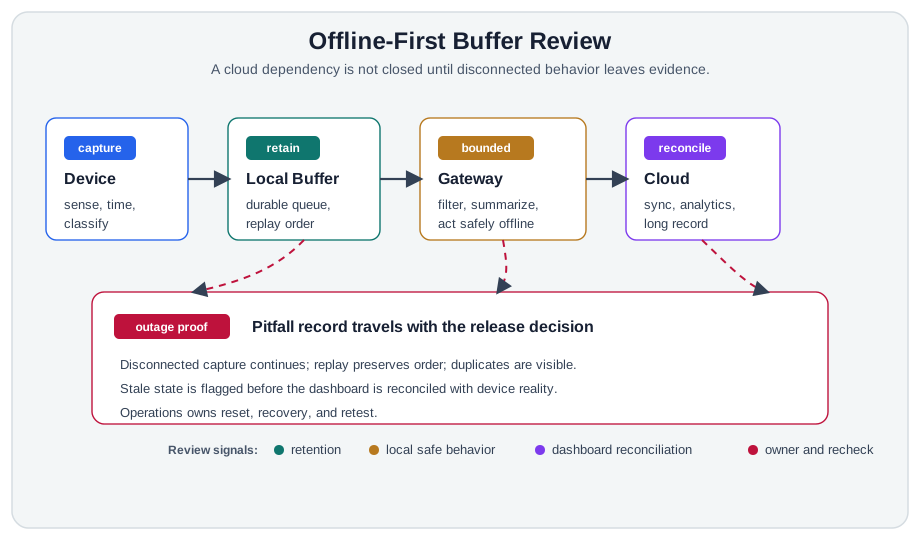
A synchronous-flow record should say which actor waits, how long it waits, what retries, and what happens when the answer arrives too late.

  • Their combined proposition is: A pitfall record keeps the review anchored in observable behavior and future recheck conditions.
  • Boundary Identify the layer, interface, data flow, owner, or operating handoff that carries the risk.
  • Evidence Require a test, trace, inspection, rollout record, or support procedure that proves the behavior.
iotclass.org

Major section

Pitfalls to Review Records (continued)

For layer coupling, keep device, connector, data, application, and operations contracts explicit.

  • Recheck trigger State what change in scale, workflow, data meaning, connectivity, or operations reopens the decision.
  • Operational proof completes the gate by showing who detects, diagnoses, repairs, and reviews the failure.
  • The pitfall record should include the failure condition that was exercised.
iotclass.org

Major section

Pitfalls Are Boundary Failures

Under the hood, architecture pitfalls are failures of boundary design.

  • A boundary should say what crosses it, who owns it, how it fails, how it is observed, and how it changes.
  • When those answers are missing, the architecture may still look complete while the system becomes brittle.
  • The same boundary can fail in several ways.

Key terms

If any column
If any column is blank, the architecture still has an unowned pitfall.
Good boundaries separate responsibilities without hiding the contracts that connect them.
iotclass.org

Major section

Pitfalls Are Boundary Failures (continued)
A device-to-gateway boundary can drop a payload, duplicate a payload, strip a quality flag, accept stale data, or hide a calibration state.

  • An operations boundary can leave no owner for reset, replacement, incident review, or retest.
  • Those checks make the reference architecture operational instead of decorative.
  • That table should travel with the release decision.
iotclass.org

Major section

Pitfalls Are Boundary Failures (continued)

The result should be a small table of boundary, failure mode, evidence, owner, and recheck trigger.

  • If any column is blank, the architecture still has an unowned pitfall.
  • It gives operations a concrete place to add new evidence when the site, scale, or workflow changes.
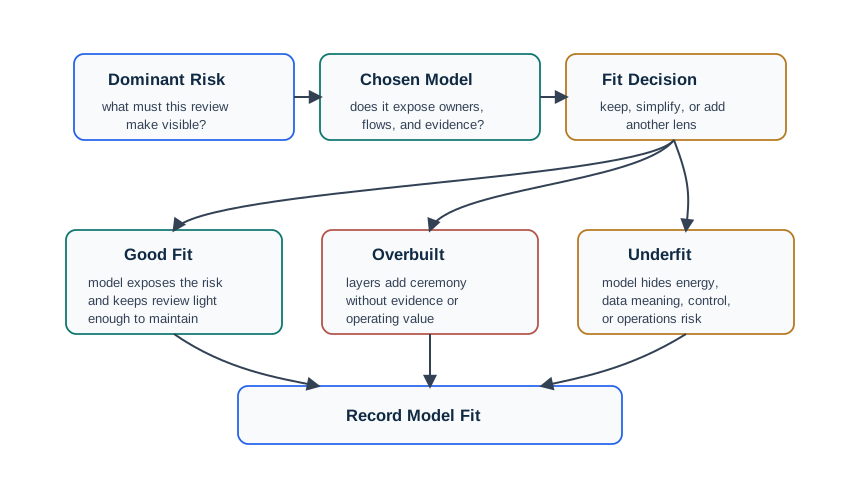
  • Focus first on Dominant Risk, then on: Record Model Fit.
iotclass.org

Major section

Summary

Evidence from loss, delay, restart, degraded service, maintenance, and recovery is what turns a diagram into a design that implementation and operations teams can safely share.

  • The recurring lesson is to treat every architecture drawing as a testable hypothesis.
  • More boxes do not repair weak contracts.
  • Architecture approval should include failure-condition evidence, not only a happy-path diagram or demo.
iotclass.org

Deck summary

Key takeaways

The drawing hid an assumption: the central service would always be reachable.

  • Bandwidth means how much data a link can carry in a set time. “The bridge stores data” becomes a full-store and replay test. “Teams share one data form” becomes a change and ownership test.
  • Most IoT reference architecture failures are not caused by choosing the wrong diagram.
  • The pitfall is not that these designs are always wrong; the pitfall is approving them before the risky assumption has an owner and a test.
  • A practical pitfall review is a small evidence record, not a long policy document.
iotclass.org

Retrieval practice

Recall check 1 of 3

Blueprint Bina says: answer from memory, then check your reasoning.

Q1What is the safest first question when reviewing a clean IoT reference architecture diagram?

AAsk which assumption can break, and what evidence proves it.
BWhich diagram has the most layers and therefore the most complete architecture?
CWhich cloud platform will be selected after implementation begins?
DCan the team remove all local behavior so the diagram stays simple?
Show answer

Answer: A A useful pitfall check names the risky assumption, the boundary it could break, the owner who must act, and the test or field evidence that would expose the failure.

iotclass.org

Retrieval practice

Recall check 2 of 3

Blueprint Bina says: answer from memory, then check your reasoning.

Q2A field-sensing design sends every reading directly upstream and stores nothing locally because the site is usually connected. What should the review require first?

ARequire offline capture, replay order, duplicates, and safe local behavior.
BA more detailed cloud dashboard mockup before any outage test is run.
CRemoval of all gateway behavior so the cloud diagram is easier to explain.
DA decision that normal connectivity is enough evidence for architecture approval.
Show answer

Answer: A Cloud-only dependency is mitigated by local retention, replay rules, duplicate handling, safe behavior, and evidence from outage conditions.

iotclass.org

Retrieval practice

Recall check 3 of 3

Blueprint Bina says: answer from memory, then check your reasoning.

Q3Why can a reference architecture with correct layer names still fail in deployment?

ALayer names still need contracts, owners, failures, observation, and rechecks.
BAll layered reference architectures are invalid for IoT systems.
CEvery system should always add more layers until each technology has its own box.
DOperations evidence is separate from architecture and should wait until after launch.
Show answer

Answer: A Pitfalls persist when architecture diagrams omit contracts, owners, failure modes, telemetry, and conditions that reopen decisions.

iotclass.org

Print reference

Answers

Answer key.

  1. A · A useful pitfall check names the risky assumption, the boundary it could break, the owner who must act, and the test or field evidence that would expose the failure.
  2. A · Cloud-only dependency is mitigated by local retention, replay rules, duplicate handling, safe behavior, and evidence from outage conditions.
  3. A · Pitfalls persist when architecture diagrams omit contracts, owners, failure modes, telemetry, and conditions that reopen decisions.
iotclass.org