Reference Architectures · Study deck

Smart Building Architecture Walkthrough

Picture a school room warming while its window is open.

Blueprint Bina is your guide for this deck.

example
Blueprint Bina, the module guide, in a scene from this chapter.
iotclass.org

After studying this chapter

Learning objectives

You will be able to:

  • Trace one requirement (a local comfort action, energy review, stale reading, or maintenance alert) through a smart-building architecture from device to human response
  • Build a traceability record linking a requirement to layer owner, architecture decision, validation evidence, and reopen trigger
  • Distinguish northbound sensing flow from southbound control flow by their different failure behavior and ownership
  • Explain: The building system should warn staff, avoid fighting the open window with more heating, and keep enough evidence for the facilities lead to review the result.
iotclass.org

Major section

Start With the Trace You Can Replay

The building system should warn staff, avoid fighting the open window with more heating, and keep enough evidence for the facilities lead to review the result.

  • A box diagram alone cannot prove that path.
  • Preserve identity, time, unit, quality, and software version whenever the record changes hands.
  • Under the Hood examines boundary timing, competing writers, saved state, access, reopening rules, and the gaps hidden when a complex system is shown as a clean stack.
iotclass.org

Major section

Reviewable Scenario Architecture

A smart-building worked example is not a tour of boxes.

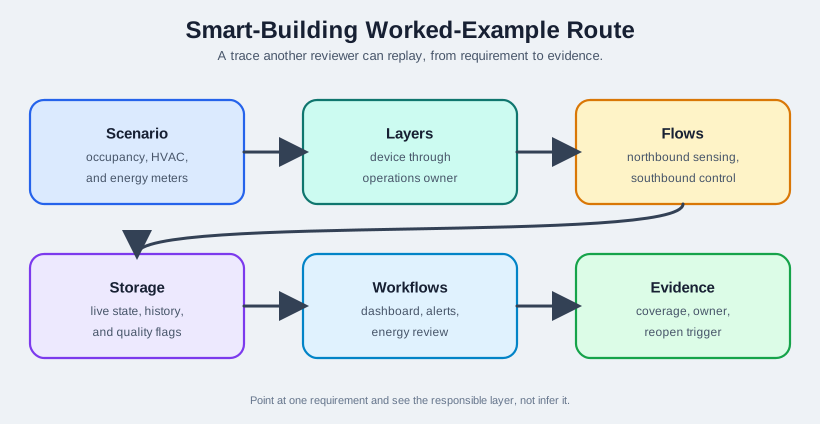
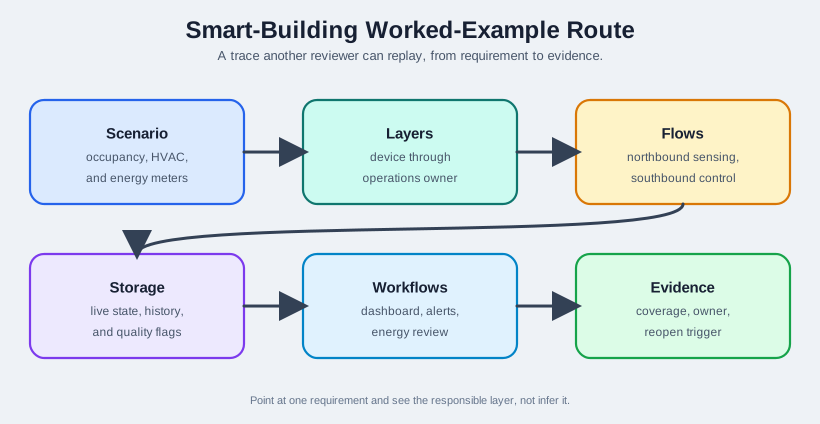
  • That sequence explains why Use the route as a review checklist: scenario, layers, flows, storage, workflows, and evidence.
  • Frame the scenario Name the physical purpose, device families, response budgets, retention needs, user roles, and operating constraints.
  • Energy meters support monthly reports and anomaly review.

Why it matters

The visual is worth pausing on because its caption identifies the intended design point: Use the route as a review checklist: scenario, layers, flows, storage, workflows, and evidence.

Use the route as a review checklist: scenario, layers, flows, storage, workflows, and evidence.
iotclass.org

Major section

Reviewable Scenario Architecture (continued)

The walkthrough also separates live comfort behavior from reporting behavior.

  • Applications expose live state, historical trends, alerts, and review reports.
  • For this scenario, the architecture decision is not "use cloud" or "use edge" in general.
  • Those two uses may involve the same sensors but different timing, privacy, storage, and audit needs.
iotclass.org

Major section

Reviewable Scenario Architecture (continued)

A reviewer should be able to point at one requirement and see the responsible layer, not infer it from a marketing architecture diagram.

  • A zone can use local occupancy and temperature state to avoid an uncomfortable delay, while aggregated interval data supports monthly energy analysis.
  • Keeping that distinction visible prevents the team from overloading one data path with every responsibility.
  • The exact device count is less important than the method.
iotclass.org

Major section

Map Layers, Flows, Evidence

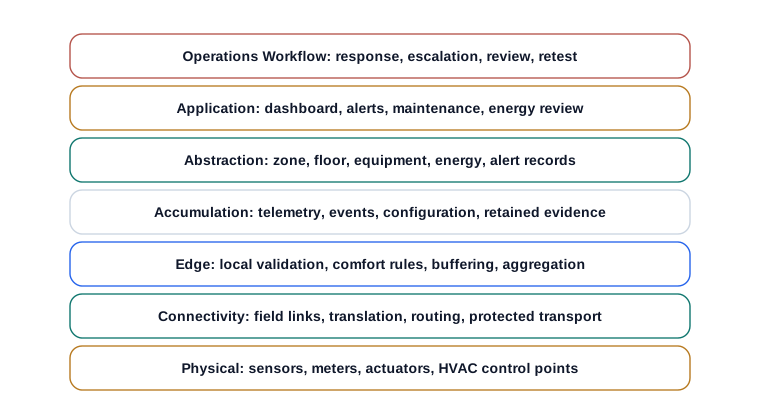
The practitioner task is to make responsibilities explicit.

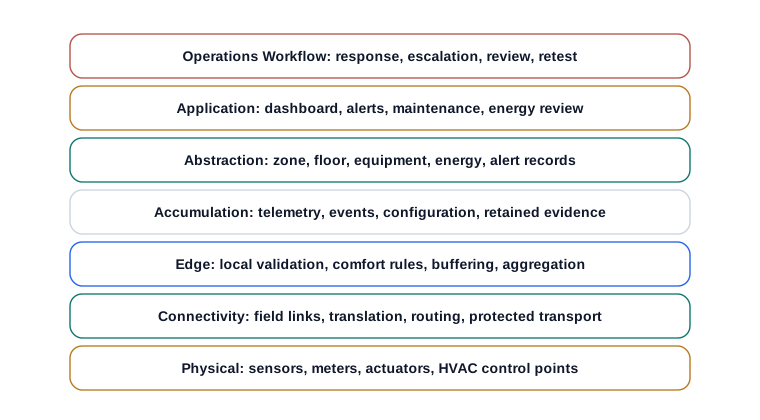
  • That sequence explains why The seven-layer map prevents device, gateway, data, application, and operations responsibilities from being blended into one box.
  • Accumulation Telemetry history, event history, configuration records, and retained evidence for review.
  • Operations Acknowledgement, escalation, repair evidence, monthly review, change approval, and retest process.

Why it matters

The visual is worth pausing on because its caption identifies the intended design point: The seven-layer map prevents device, gateway, data, application, and operations responsibilities from being blended into one box.

The seven-layer map prevents device, gateway, data, application, and operations responsibilities from being blended into one box.
iotclass.org

Major section

Map Layers, Flows, Evidence (continued)
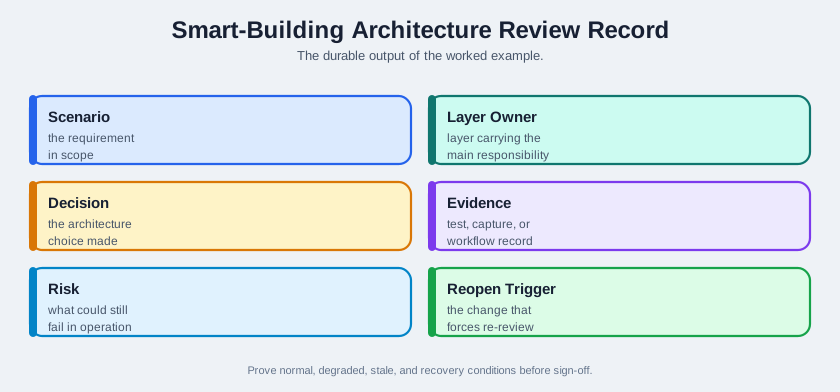
Requirement: what the system must do or preserve.

  • The visual is worth pausing on because its caption identifies the intended design point: Traceability turns a walkthrough into a record another reviewer can audit.
  • That sequence explains why Traceability turns a walkthrough into a record another reviewer can audit.
  • Layer owner: which layer carries the main responsibility.
iotclass.org

Major section

Map Layers, Flows, Evidence (continued)
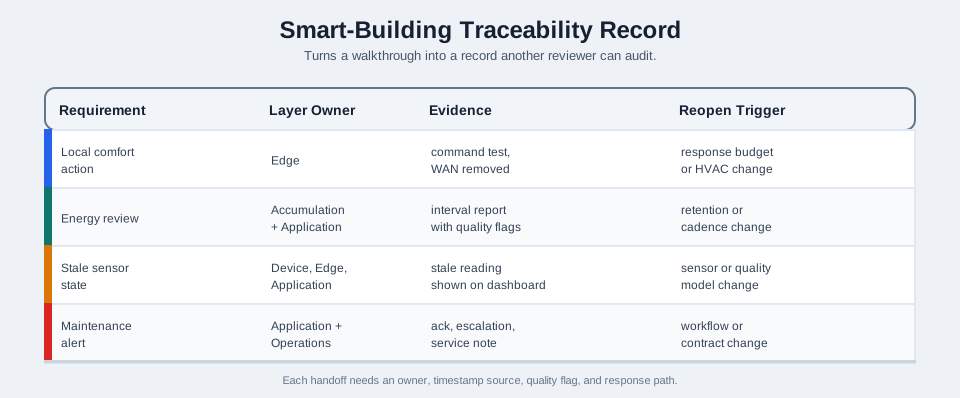
Reopen trigger: what change requires the design to be reviewed again.

  • The requirement states what must be preserved, the layer owner locates responsibility, the decision records the chosen boundary, and the evidence shows that boundary working.
  • The reopen trigger closes the chain by naming the change that invalidates the proof.
  • Reopen if retention or report cadence changes.
iotclass.org

Major section

Map Layers, Flows, Evidence (continued)
Keeping those fields together lets a reviewer trace building behavior without relying on the architecture diagram alone.

  • Reopen if response budget, gateway role, or HVAC integration changes.
  • Reopen if sensor type or quality model changes.
  • Reopen if the workflow or equipment contract changes.
  • In implementation terms, the record can name concrete handoff points.
iotclass.org

Major section

Map Layers, Flows, Evidence (continued)

BACnet/IP or Modbus TCP may expose equipment values to a gateway, MQTT or HTTPS may carry normalized telemetry upward, and a work-order system may own the final maintenance action.

  • The practitioner check is whether each handoff has an owner, timestamp source, quality flag, retry behavior, and human response path.
  • If those details are missing, the layer map still hides the real architecture risk.
  • A concrete subsystem map makes the physical and connectivity layers easier to audit.
iotclass.org

Major section

Flow Boundaries and Reopen Rules

The under-the-hood question is whether the architecture still makes sense when communication, data quality, storage, or operations behave imperfectly.

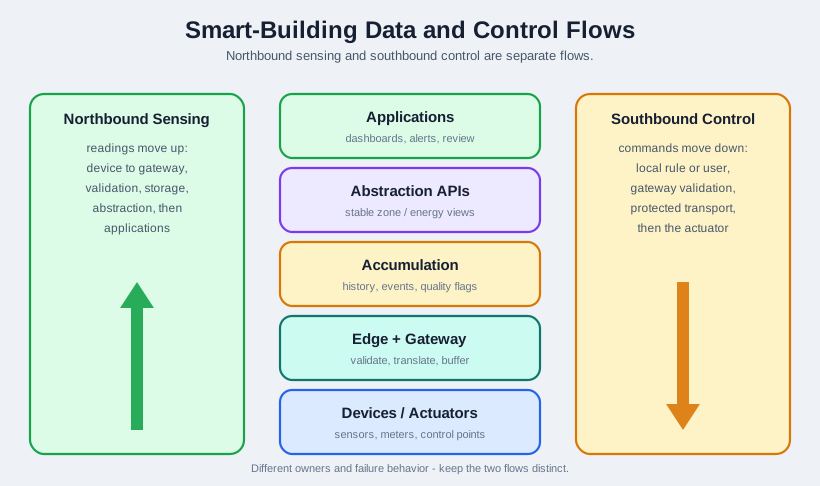
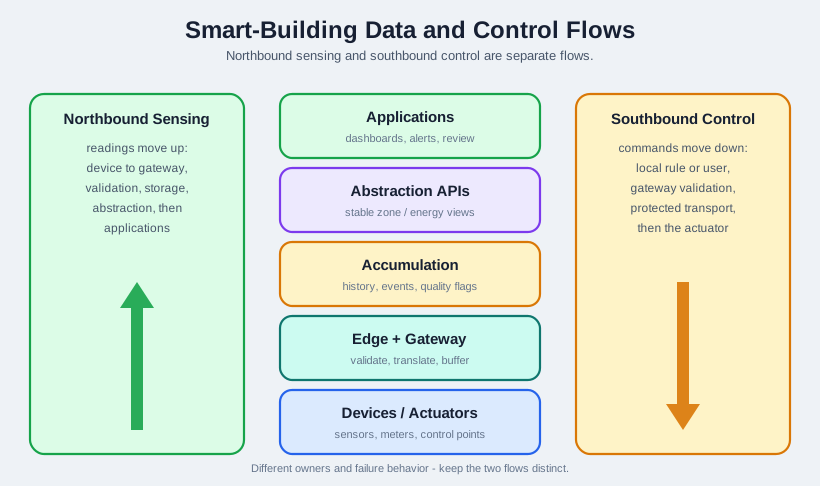
  • That sequence explains why Northbound sensing and southbound control are separate flows with different owners and failure behavior.
  • That sequence explains why The review record is the durable output of the worked example.

Key terms

Missing correlation
Missing correlation is itself a result that reopens the architecture.

Why it matters

The visual is worth pausing on because its caption identifies the intended design point: Northbound sensing and southbound control are separate flows with different owners and failure behavior.

Northbound sensing and southbound control are separate flows with different owners and failure behavior.
iotclass.org

Major section

Flow Boundaries and Reopen Rules (continued)

Southbound control Commands move from a user or local rule through validation and protected transport before actuators change state.

  • Data lifecycle Recent high-resolution state, summarized history, event evidence, quality flags, and review status have different retention rules.
  • Operations proof Alerts, acknowledgements, overrides, failed commands, gateway outages, and repair notes must be visible to people who act on them.
  • Missing correlation is itself a result that reopens the architecture.
iotclass.org

Major section

Flow Boundaries and Reopen Rules (continued)

Inject stale or invalid sensor data and prove the dashboard, alert, or quality flag does not imply fresh state.

  • The visual is worth pausing on because its caption identifies the intended design point: The review record is the durable output of the worked example.
  • This sequence proves that the smart-building architecture remains owned and understandable when communication, data, or service assumptions fail.
  • The under-the-hood evidence should be runnable, not just readable.
iotclass.org

Major section

Flow Boundaries and Reopen Rules (continued)

The gate should reveal whether local comfort control continues safely, whether stale state is labelled, whether replay preserves meaning, and whether an operator can close the incident with proof.

  • Replay buffered gateway events and prove duplicate, missing, and reordered records are handled as designed.
  • Testers can disconnect the WAN link, freeze a sensor timestamp, replay duplicate gateway messages, force a failed HVAC command, and close a maintenance ticket without repair evidence.
  • The visual is worth pausing on because its caption identifies the intended design point: Northbound sensing and southbound control are separate flows with different owners and failure behavior.
iotclass.org

Major section

Summary

The architecture remains credible during failure only when local control, stored history, dashboards, and human workflow degrade in known ways.

  • The example is complete when another reviewer can replay both the intended route and its limits.
  • Layer mapping starts with physical purpose, response budget, data lifecycle, user workflow, and operating constraints.
  • Local control belongs near the equipment when comfort or safety behavior must survive upstream connectivity problems.
iotclass.org

Deck summary

Key takeaways

The building system should warn staff, avoid fighting the open window with more heating, and keep enough evidence for the facilities lead to review the result.

  • A smart-building worked example is not a tour of boxes.
  • The walkthrough also separates live comfort behavior from reporting behavior.
  • A reviewer should be able to point at one requirement and see the responsible layer, not infer it from a marketing architecture diagram.
  • The practitioner task is to make responsibilities explicit.
iotclass.org

Retrieval practice

Recall check 1 of 3

Blueprint Bina says: answer from memory, then check your reasoning.

Q1What makes the smart-building worked example reviewable instead of just descriptive?

AIt links each requirement to layer ownership, flow behavior, validation evidence, and a trigger for reopening the decision.
BIt chooses a final technology stack before requirements, owners, or user workflows are recorded.
CIt proves the architecture by using a clean diagram with every possible platform component.
DIt avoids reopen triggers so the approved architecture cannot be challenged later.
Show answer

Answer: A A worked architecture example should leave an auditable trail from scenario requirement to layer owner, flow behavior, evidence, and future recheck condition.

iotclass.org

Retrieval practice

Recall check 2 of 3

Blueprint Bina says: answer from memory, then check your reasoning.

Q2In the smart-building review record, why is the occupancy-to-HVAC rule assigned to the edge layer?

AKeep the comfort-control loop local when upstream links are delayed or offline
BRemove HVAC and occupancy displays from every application view
CAvoid storing occupancy or command history for later review
DKeep all building data inside devices and skip gateway checks
Show answer

Answer: A A reference-model walkthrough should place availability-sensitive control decisions near the equipment while upstream layers record, analyze, and review the outcome.

iotclass.org

Retrieval practice

Recall check 3 of 3

Blueprint Bina says: answer from memory, then check your reasoning.

Q3Which evidence best proves the smart-building architecture is ready for review instead of just diagrammed?

ALayer owners, degraded-flow tests, quality flags, workflow proof, and reopen triggers
BLive dashboard values with no outage, stale-data, or workflow evidence
CA cloud diagram that leaves local control and gateway behavior implicit
DA product list that prevents future changes from reopening the decision
Show answer

Answer: A Under the hood, smart-building architecture review proves flow boundaries, data quality, operations ownership, and recheck triggers under realistic conditions.

iotclass.org

Print reference

Answers

Answer key.

  1. A · A worked architecture example should leave an auditable trail from scenario requirement to layer owner, flow behavior, evidence, and future recheck condition.
  2. A · A reference-model walkthrough should place availability-sensitive control decisions near the equipment while upstream layers record, analyze, and review the outcome.
  3. A · Under the hood, smart-building architecture review proves flow boundaries, data quality, operations ownership, and recheck triggers under realistic conditions.
iotclass.org