IoT Value and Product Strategy · Study deck
IoT Value: Qualification Tests
A manager proposes adding an app and a radio to an ordinary product and calling it IoT.
Ada is your guide for this deck.

After studying this chapter
Learning objectives
You will be able to:
- Explain: Smart Traffic Management: Adaptive traffic signals adjust timing based on real-time traffic flow Carnegie Mellon reports Surtrac cut average travel time by 25%; USDOT reports a Pittsburgh pilot cut emissions by 20%.
- Explain: Design Framework: When designing your own IoT solution, start with "Which human need am I addressing?" This keeps your design grounded in real-world value rather than technology for technology's sake.
- Explain: This framework, popularized by IoT thought leaders, helps categorize the vast landscape of IoT applications into memorable categories that reflect how technology enhances essential aspects of human civilization.
Major section
Three Ingredients Test
Connected sensing and control can improve efficiency in specific workflows.
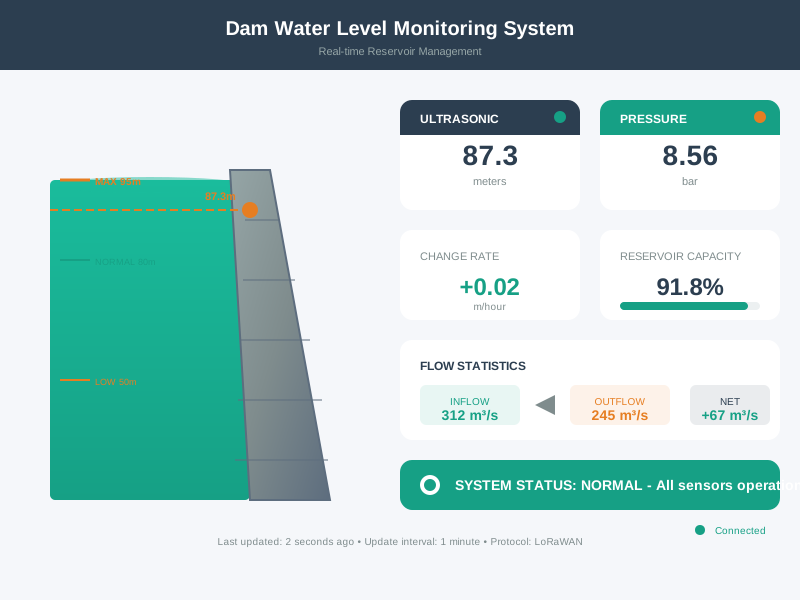
- The first measures the reservoir with two different sensor types, ultrasonic and pressure, against a marked reference level.
- The third stage shows who receives it, and the three listed uses are flood control, power generation and downstream release planning.
Major section
Interactive: IoT ROI Calculator
Smart coffee maker starts brewing when my alarm goes off.
- Consumer and industrial IoT payback varies with purchase price, tariffs, maintenance, scale, and measured savings.
- Scenario 1:: Your basic microwave has a digital timer and heating element.
- Smart fridge tells me what groceries I need to buy.
Try it: Interactive: IoT ROI Calculator in the chapter
Major section
The Five Verbs of IoT
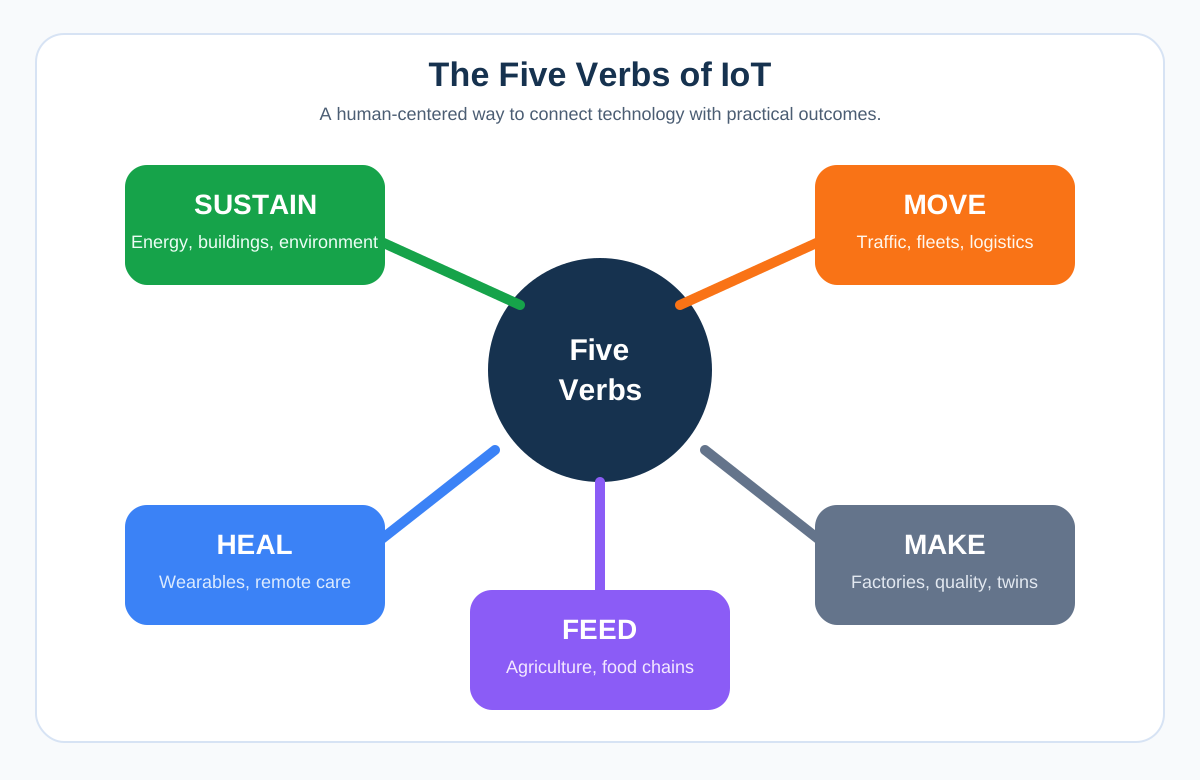
One powerful way to understand IoT's transformative impact is through the lens of five fundamental human activities: SUSTAIN: MOVE: HEAL: FEED, and: MAKE.
- This framework, popularized by IoT thought leaders, helps categorize the vast landscape of IoT applications into memorable categories that reflect how technology enhances essential aspects of human civilization.
Major section
Why This Framework Matters
Making IoT Memorable and Actionable: The Five Verbs framework transforms IoT from an overwhelming landscape of thousands of applications into five memorable categories that students, designers, and business leaders can easily understand and apply.
- Instead of trying to memorize "smart cities," "connected healthcare," "precision agriculture," and dozens of other domains, you can organize everything under five fundamental human activities.
- Categorization Tool: When you encounter a new IoT application, ask "Which verb does this serve?" This simple question helps you understand its purpose and value proposition immediately.
- Understanding these economics helps guide career decisions, investment priorities, and business strategies.
Major section
Why This Framework Matters (continued)
Design Framework: When designing your own IoT solution, start with "Which human need am I addressing?" This keeps your design grounded in real-world value rather than technology for technology's sake.
- Career Pathfinding: The five verbs map to distinct career paths - sustainability engineering (SUSTAIN), transportation tech (MOVE), health tech (HEAL), ag-tech (FEED), or industrial automation (MAKE).
- Market Analysis: The verbs reveal where investment is flowing ($3.3T total market) and which sectors have the highest growth rates.
- Quality cameras can inspect products at production speed; measure inspection coverage, downtime and defect rates for the specified line.
Major section
Why This Framework Matters (continued)
Business Storytelling: Executives and investors understand "We help manufacturers MAKE better products" more quickly than "We provide predictive maintenance IoT solutions".
- Environmental Monitoring Networks: Distributed sensors track air quality, water pollution, deforestation, and wildlife Air-quality sensors can inform traffic policy; name the city, sensor count and measured emissions change only with a municipal evaluation.
- Smart Building Management: DOE/PNNL modeled about 29% potential commercial-building energy savings from properly tuned HVAC, lighting and occupancy controls; verify each building’s baseline.
- DOE/PNNL The Edge developer reports that its Amsterdam building consumes 70% less electricity than typical office buildings.
Major section
Why This Framework Matters (continued)
Example: Maersk's Remote Container Management sends data from reefer containers for remote monitoring.
- Example: UPS's ORION system uses IoT to save 10M+ gallons of fuel annually through route optimization.
- Example: Waymo’s self-driving taxis have completed 1M+ autonomous miles using LiDAR, cameras, radar, and onboard compute; the driving task does not require a cellular signal.
- Medical Device Connectivity: Infusion pumps, ventilators, and monitors integrate with electronic health records.
Major section
Why This Framework Matters (continued)
Computer vision and sensor fusion can inspect items at production speed; specify measured coverage and false-negative rates for a given line.
- Smart Traffic Management: Adaptive traffic signals adjust timing based on real-time traffic flow Carnegie Mellon reports Surtrac cut average travel time by 25%; USDOT reports a Pittsburgh pilot cut emissions by 20%.
- Example: Philips reports that patients at hospitals with an eICU program were discharged from the ICU 20% faster; the VA case describes a network serving 1,800 ICU beds nationwide.
- Industrial vision systems can flag defects at line speed; report accuracy, throughput, sample and defect prevalence for a cited installation.
Deck summary
Key takeaways
Connected sensing and control can improve efficiency in specific workflows.
- Smart coffee maker starts brewing when my alarm goes off.
- One powerful way to understand IoT's transformative impact is through the lens of five fundamental human activities: SUSTAIN: MOVE: HEAL: FEED, and: MAKE.
- Making IoT Memorable and Actionable: The Five Verbs framework transforms IoT from an overwhelming landscape of thousands of applications into five memorable categories that students, designers, and business leaders can easily understand and apply.
- Business Storytelling: Executives and investors understand "We help manufacturers MAKE better products" more quickly than "We provide predictive maintenance IoT solutions".
Retrieval practice
Recall check 1 of 4

Ada says: answer from memory, then check your reasoning.
Q1A factory adds vibration sensing to schedule bearing repairs. How should its outcome be framed?
Show answer
Answer: C The maintenance decision supports the MAKE outcome.
Retrieval practice
Recall check 2 of 4
Ada says: answer from memory, then check your reasoning.
Q2A basic microwave has a digital timer, display screen, and heating element controlled by a microprocessor. Is this device considered IoT?
Show answer
Answer: C The basic microwave has a physical Thing and computation but no internet connectivity, so it is an embedded appliance in this example.
Retrieval practice
Recall check 3 of 4
Ada says: answer from memory, then check your reasoning.
Q3Your fitness tracker measures steps and heart rate, syncs to your smartphone via Bluetooth, and the phone app uploads data to a cloud server. Which component provides the "Internet connectivity" ingredient?
Show answer
Answer: B The phone is the internet gateway: it receives tracker data over Bluetooth and uploads it over Wi-Fi or cellular.
Retrieval practice
Recall check 4 of 4
Ada says: answer from memory, then check your reasoning.
Q4For this calculation, assume a $250 smart thermostat actually reduces a home’s $3,900 annual heating and cooling bill by 30%, with no other costs. What is its approximate simple payback period?
Show answer
Answer: D see answers page
Print reference
Answers 1 of 2
Answer key.
- C · The maintenance decision supports the MAKE outcome.
- C · The basic microwave has a physical Thing and computation but no internet connectivity, so it is an embedded appliance in this example.
- B · The phone is the internet gateway: it receives tracker data over Bluetooth and uploads it over Wi-Fi or cellular.
Print reference
Answers 2 of 2
Answer key.
- D · Under the exercise’s assumed 30% reduction, annual savings are $1,170 and average monthly savings are $97.50. The $250 purchase price divided by $97.50/month gives about 2.6 months of simple payback. Real savings and added costs must be measured for a real purchase decision.