Transport Protocols · Study deck

Protocol Overhead and Packet Budgets

A small temperature payload looks cheap until it is wrapped, protected and retried.

Packet Pete is your guide for this deck.

overheadanalysis
Packet Pete, the module guide, in a scene from this chapter.
iotclass.org

After studying this chapter

Learning objectives

You will be able to:

  • Explain: Byte efficiency is not the only outcome; crossing a frame limit changes the failure mode. Figure: The fragmentation gate checks whether wrapper bytes force shows the decision point that must be checked after the packet budget is complete.
  • Explain: The decision point is the ratio and the boundary: if a schema change doubles the payload or a security profile adds another tag, the earlier frame-fit result may no longer apply.
  • Explain: The resulting overhead calculation can guide a design change without pretending that fewer application bytes automatically mean a cheaper or more reliable radio transaction.
iotclass.org

Major section

Start With One Packet Budget

A payload is the useful data carried by a message.

  • A protocol is a set of rules for exchanging messages.
  • A gateway is a bridge between a local device network and a wider system.
  • The cheapest packet may still fail if it cannot recover or arrive safely.
  • Real traffic changes with security, errors, and control messages.
iotclass.org

Major section

Start With One Packet Budget (continued)
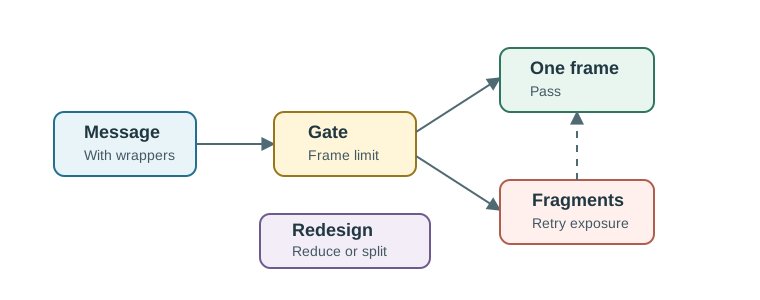
Under the Hood derives capacity, fragmentation, and energy costs.

  • Overhead analysis starts with one payload and the headers it must carry through the real stack.
  • Separate payload bytes, transport headers, security records, fragmentation, acknowledgements, and control traffic before comparing protocols.
  • The packet budget then shows which cost is measured, which is assumed, and which deployment limit could change the answer.
iotclass.org

Major section

Overview: Overhead Analysis Starts With A Message Budget
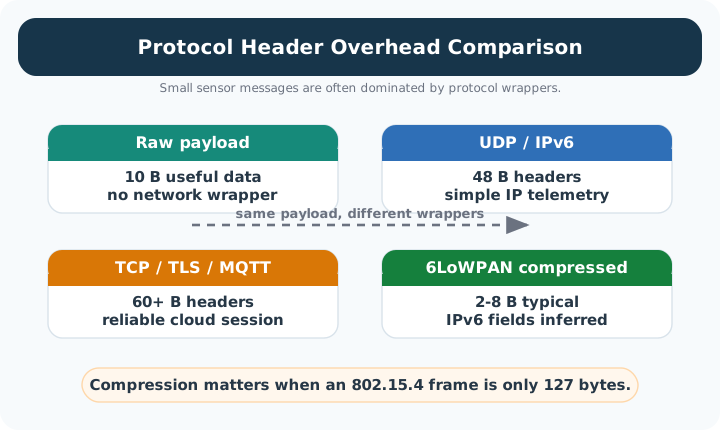
The visual establishes the denominator for the packet-budget decisions that follow.

  • The comparison shows how wrapper choices can dominate a small measurement and why the chapter evaluates complete message paths rather than protocol names.
Small sensor messages are dominated by protocol wrappers: a 10-byte payload can carry 48 to 60-plus bytes of headers, which is why 6LoWPAN header compression matters when the whole 802.15.4 frame is only 127 bytes.
iotclass.org

Major section

Practitioner Pattern: Build The Packet Budget Before Comparing Protocols
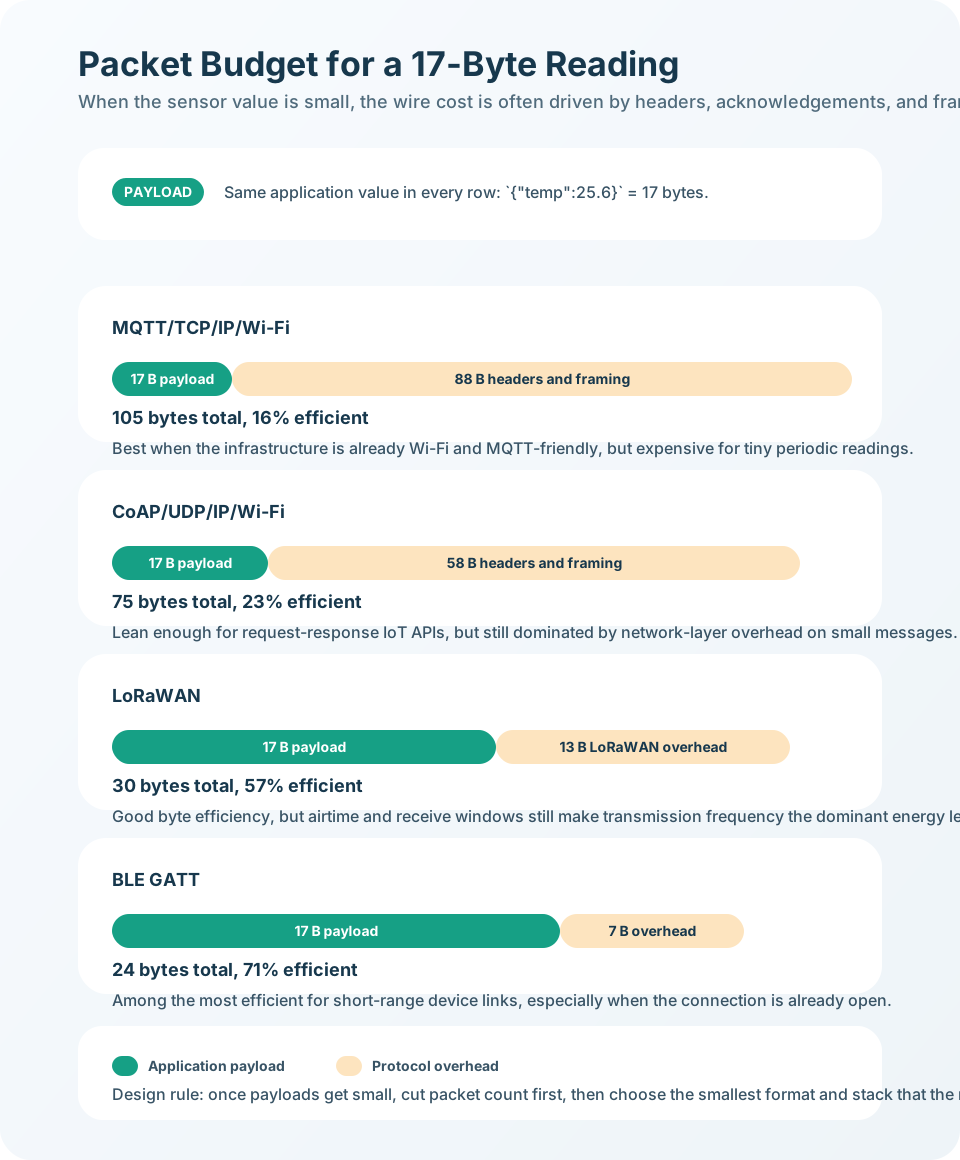
A practical overhead review uses the same payload and the same evidence categories for every candidate.

  • Fragmentation changes more than byte count; it can add state, retries, queue pressure, and a harder failure mode for constrained devices.
  • The exact numbers are illustrative for that budget, not universal protocol constants.

Key terms

Byte efficiency
Byte efficiency is not the only outcome; crossing a frame limit changes the failure mode.

Numbers to remember

12 bytesthe useful value is 12 bytes
Packet budget for a small sensor reading
iotclass.org

Major section

Practitioner Pattern: Build The Packet Budget Before Comparing Protocols (continued)

This sequence connects the illustrative arithmetic to the review method: every candidate must use the same message definition before its airtime or energy consequence can be compared.

  • In the example below, the useful value is 12 bytes, but the transmitted packet budget also includes application typing, transport endpoints, network routing, and link framing.
  • The general comparison now needs a concrete byte ledger.
  • Payload schema, units, rate, or receiver action changes.
iotclass.org

Major section

Practitioner Pattern: Build The Packet Budget Before Comparing Protocols (continued)

The decision point is the ratio and the boundary: if a schema change doubles the payload or a security profile adds another tag, the earlier frame-fit result may no longer apply.

  • Protocol stack, address scope, security mode, or gateway boundary changes.
  • Link layer, MTU, security field, compression context, or message size changes.
  • Byte efficiency is not the only outcome; crossing a frame limit changes the failure mode. Figure: The fragmentation gate checks whether wrapper bytes force shows the decision point that must be checked after the packet budget is complete.
iotclass.org

Major section

Count the Whole Reading before Comparing Header Sizes
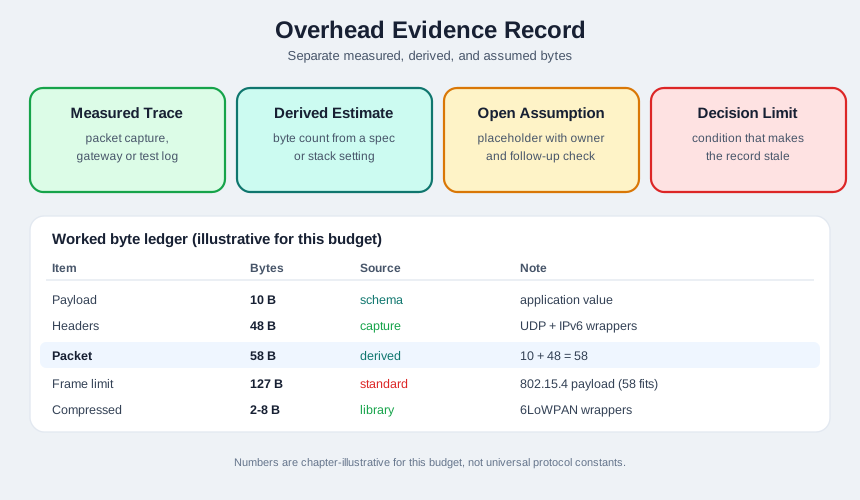
The network-layer packet is 58 bytes.

  • Its header overhead is 48 bytes, so useful content is 10 divided by 58, or about 17.2% of that packet.
  • This analysis has not yet counted link headers, link security or frame-check bytes.
  • The energy analysis needs the actual radio setting and success behaviour.

Numbers to remember

58 bytesThe network-layer packet is 58 bytes.
48 bytesIts header overhead is 48 bytes

Why it matters

Subtracting 58 gives 69 bytes of apparent headroom, but that is not all available to the application because the link wrapper must also fit.

The record separates measured, derived, and assumed bytes, then applies them to a worked byte ledger: a 10-byte payload and 48 header bytes total 58 bytes inside the 127-byte 802.15.4 frame, with 6LoWPAN compressing wrappers to 2 to 8 bytes.
iotclass.org

Major section

Count the Whole Reading before Comparing Header Sizes (continued)

The protocol ledger should reserve each actual field before deciding whether fragmentation is needed.

  • Compression can change the wrapper size only under the contexts and options that the path really supports.
  • The labels prevent an estimate from being reported as a captured packet length.
  • The retry overhead is visible even though the packet's individual header size did not change.
iotclass.org

Major section

Count the Whole Reading before Comparing Header Sizes (continued)

It may share some protocol overhead, but a larger packet can change airtime or cross a fragmentation boundary.

  • Overhead from setup can dominate the compact reading even when its individual data-packet header remains unchanged.
  • This module's transport comparison depends on a complete workload ledger: payload, wrappers, setup, acknowledgements, retries and fragmentation.
  • The resulting overhead calculation can guide a design change without pretending that fewer application bytes automatically mean a cheaper or more reliable radio transaction.
  • Subtracting 58 gives 69 bytes of apparent headroom, but that is not all available to the application because the link wrapper must also fit.
iotclass.org

Deck summary

Key takeaways

A payload is the useful data carried by a message.

  • Under the Hood derives capacity, fragmentation, and energy costs.
  • The visual establishes the denominator for the packet-budget decisions that follow.
  • A practical overhead review uses the same payload and the same evidence categories for every candidate.
  • This sequence connects the illustrative arithmetic to the review method: every candidate must use the same message definition before its airtime or energy consequence can be compared.
iotclass.org

Retrieval practice

Recall check 1 of 3

Packet Pete says: answer from memory, then check your reasoning.

Q1A learner compares two IoT protocols using only one captured data packet from each path. What is the strongest criticism of that overhead analysis?

AIt should choose the protocol with the shortest header diagram even when path traffic is unmeasured.
BIt should ignore packet captures and decide from design preference instead of bounded evidence.
CIt misses control traffic, retries, fragmentation, handoffs, and evidence for byte counts.
DIt should rank radio data rate first and postpone payload and wrapper byte counts.
Show answer

Answer: C Protocol overhead review is path evidence, not a single-packet shortcut.

iotclass.org

Retrieval practice

Recall check 2 of 3

Packet Pete says: answer from memory, then check your reasoning.

Q2A greenhouse 6LoWPAN node adds a timestamp, UDP header, compressed IPv6 header, and security tag to an alarm message. The complete packet now barely exceeds the available IEEE 802.15.4 frame payload. What should the overhead record do next?

AIgnore the excess because payload bytes are the only bytes that affect the application decision.
BMark fragmentation risk, record loss and reassembly behavior, and compare payload, cadence, or security redesign options.
CAccept the path automatically because the security tag is required, even if every alarm fragments.
DDrop packet-budget evidence and compare only user-visible latency before release.
Show answer

Answer: B A fragmentation boundary is a gate because it changes loss behavior, reassembly state, and retest requirements.

iotclass.org

Retrieval practice

Recall check 3 of 3

Packet Pete says: answer from memory, then check your reasoning.

Q3Which overhead-record statement is safest for a constrained IoT review?

AThis protocol is always the lowest-overhead choice because one captured packet was small and no retry was seen.
BThe overhead result is final because the payload schema is stable, even if security or gateway behavior changes.
CEstimated wrapper sizes do not need labels when later reviewers can infer the protocol family.
DThis payload and path fit measured wrappers, control traffic, and frame limit; retest if payload or security changes.
Show answer

Answer: D A safe overhead conclusion is bounded by payload, path, evidence confidence, and retest conditions.

iotclass.org

Print reference

Answers

Answer key.

  1. C · Protocol overhead review is path evidence, not a single-packet shortcut.
  2. B · A fragmentation boundary is a gate because it changes loss behavior, reassembly state, and retest requirements.
  3. D · A safe overhead conclusion is bounded by payload, path, evidence confidence, and retest conditions.
iotclass.org