IoT Interfaces, Location and Privacy · Study deck
IoT Privacy: Purpose and Data Boundaries
A room sensor can reveal far more than its stated purpose.
UX Uma is your guide for this deck.

After studying this chapter
Learning objectives
You will be able to:
- Explain: A connected device may keep sensing after the app is closed, after a guest leaves, after a caregiver changes, after a tenancy changes, or after a firmware update adds a new feature.
- Explain: For each path, decide whether the product can use local processing, aggregation, coarse location, short retention, encrypted storage, or role-limited access before collecting a more sensitive stream.
- Explain: A strong card names the data category, purpose, benefit, retention period, recipient, default state, consequence of refusal, and where the user can change the choice later.
- Design effective consent mechanisms for IoT devices and applications
Major section
Start Simple
One person may agree to room alerts but not saved audio or partner analysis.
- A button marked off is useful only when sensing, storage, sharing, and later use follow that choice.
- A changed screen is not proof if the old path still runs.
- This opening does not settle every legal basis or household dispute.
Major section
Start Simple (continued)
A queued event must not slip through under an old choice.
- Under the Hood examines enforceable flags, hidden copies, withdrawal races, lawful bases, evidence, and the limits of a one-time prompt.
- After a stop, create one event at the device.
- One person's choice must not silently erase the rights of the other.
Major section
Key Concepts
Informed Consent: User agreement that is specific, freely given, and based on a clear explanation of data collection purposes.
- Data Minimisation: Principle requiring only the minimum data necessary for a stated purpose to be collected.
- Consent Fatigue: User tendency to click 'accept all' on privacy dialogs without reading them, caused by excessive or poorly designed consent requests.
- Purpose Limitation: GDPR principle requiring data collected for one purpose not to be used for a different, incompatible purpose.
Major section
Consent as Product State
IoT consent has to survive beyond setup.
- A connected device may keep sensing after the app is closed, after a guest leaves, after a caregiver changes, after a tenancy changes, or after a firmware update adds a new feature.
- A thermostat may need temperature readings to control heating, but not detailed occupancy history for advertising.
Major section
Consent as Product State (continued)
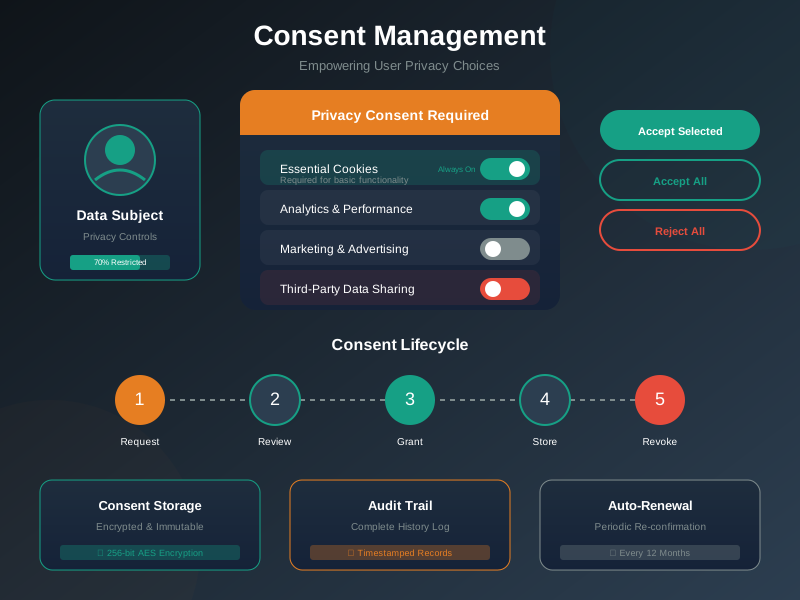
The user experience should make consent visible as a state that can be granted, limited, paused, withdrawn, exported, or deleted.
- A smart speaker may need local wake-word detection for voice control, but not indefinite retention of raw audio.
- A change log preserves later revisions.
- Those categories should not be bundled into one "accept" decision.
Major section
Consent as Product State (continued)
In the example, room alerts are allowed while saved audio is blocked; a separate partner analysis use cannot inherit permission from core monitoring.
- A camera doorbell may need event recording for security, but should still explain capture, retention, sharing, and bystander impact.
- The product should also distinguish who is affected.
- The design record should state the default.
Major section
Consent as Product State (continued)
The interface may need signage, a guest mode, household-member invitations, administrator controls, worker notices, or limits on where sensors can be placed.
- A user grants a specific use, the system records who chose it and when, and enforcement gates decide what may run.
- A useful consent design therefore starts with a data-purpose inventory rather than a legal screen.
- Consent is weaker when it assumes only the purchaser exists.
Major section
Consent by Roles and Data Paths
One "accept all" screen cannot carry those different responsibilities.
- For each path, decide whether the product can use local processing, aggregation, coarse location, short retention, encrypted storage, or role-limited access before collecting a more sensitive stream.
- The best consent flow is usually paired with data minimization so the product does not ask users to accept avoidable risk.
- During onboarding, the user might grant required permissions and decline optional analytics.
Major section
Consent by Roles and Data Paths (continued)
A strong card names the data category, purpose, benefit, retention period, recipient, default state, consequence of refusal, and where the user can change the choice later.
- In settings, they should be able to pause microphone upload, disable precise location, revoke a partner integration, export access logs, and delete history.
- In a household or workplace, an administrator may invite users, but each person may need their own notice and control for personal data.
- In support, a temporary diagnostics grant should expire automatically and appear in the access history.
- That matrix gives engineering, legal, support, and design teams the same source of truth.
Deck summary
Key takeaways
One person may agree to room alerts but not saved audio or partner analysis.
- A queued event must not slip through under an old choice.
- Informed Consent: User agreement that is specific, freely given, and based on a clear explanation of data collection purposes.
- IoT consent has to survive beyond setup.
- The user experience should make consent visible as a state that can be granted, limited, paused, withdrawn, exported, or deleted.
Retrieval practice
Recall check 1 of 4

UX Uma says: answer from memory, then check your reasoning.
Q1A parent disables optional saved audio on a baby monitor. What would show that withdrawal changed the product?
Show answer
Answer: B The chapter follows the choice through sensing, services, reports, and partner copies.
Retrieval practice
Recall check 2 of 4
UX Uma says: answer from memory, then check your reasoning.
Q2A household camera captures a visitor who does not use its app. What makes the consent design harder than a website prompt?
Show answer
Answer: C The chapter highlights continuous sensing and people in range of shared devices.
Retrieval practice
Recall check 3 of 4
UX Uma says: answer from memory, then check your reasoning.
Q3A thermostat needs room temperature for heating, while marketing asks for a full occupancy history. Which collection plan fits the stated purpose?
Show answer
Answer: D Control needs temperature; the extra history needs its own justified purpose and boundary.
Retrieval practice
Recall check 4 of 4
UX Uma says: answer from memory, then check your reasoning.
Q4A household requests an export and deletion after closing its account. Which test proves the request reached the product’s data path?
Show answer
Answer: A The rights flow must follow data and preserve a usable export before deletion is confirmed.
Print reference
Answers
Answer key.
- B · The chapter follows the choice through sensing, services, reports, and partner copies.
- C · The chapter highlights continuous sensing and people in range of shared devices.
- D · Control needs temperature; the extra history needs its own justified purpose and boundary.
- A · The rights flow must follow data and preserve a usable export before deletion is confirmed.