UX Design · Study deck

IoT Privacy: Consent Controls and Minimization

A consent screen is weak if the device ignores the choice.

UX Uma is your guide for this deck.

privacyuserconsent
UX Uma, the module guide, in a scene from this chapter.
iotclass.org

After studying this chapter

Learning objectives

You will be able to:

  • Explain: When a firmware update adds person detection, a new analytics partner, or a longer retention period, the system should know whether existing consent covers the change or whether the user must make a new choice.
  • Explain: The implementation goal is a provable chain from user choice to system behavior: what was allowed, what was blocked, what was deleted, and which evidence shows the product followed the user's decision.
  • Explain: If an MQTT broker publishes presence data to a retained topic after consent is withdrawn, the dashboard and downstream subscribers may continue seeing stale personal data.
iotclass.org

Major section

Enforceable Consent Flags

Implementation should not rely on copy alone.

  • Firmware can disable raw microphone upload when only local wake-word detection is allowed.
  • A gateway can aggregate occupancy before publishing an MQTT topic.
  • A mobile app can respect Android or iOS permission state before starting background location.
  • Consent flags should be evaluated where data is created and where it is reused.

Why it matters

Versioning matters because consent language and features change.

iotclass.org

Major section

Enforceable Consent Flags (continued)

A cloud job can apply TTL deletion, revoke OAuth scopes, remove APNs/FCM notification tokens, delete device-shadow history, and mark export or erasure requests complete only after downstream processors respond.

  • Cloud gate:: API authorization, role-based access control, retention job, export job, deletion job, support-console permission, and access log.
  • If firmware records audio while a cloud service later discards it, collection still happened.
  • Withdrawal should propagate as a workflow, not a boolean flip.
iotclass.org

Major section

Enforceable Consent Flags (continued)

If an MQTT broker publishes presence data to a retained topic after consent is withdrawn, the dashboard and downstream subscribers may continue seeing stale personal data.

  • If a machine-learning pipeline has already copied events into a feature store, deleting the account record is not enough.
  • The architecture needs collection gates, storage gates, processing gates, sharing gates, and retention gates.
  • Auditors and support teams should be able to reconstruct why data existed at a given time.
iotclass.org

Major section

Enforceable Consent Flags (continued)

When a firmware update adds person detection, a new analytics partner, or a longer retention period, the system should know whether existing consent covers the change or whether the user must make a new choice.

  • If backups or legal holds delay deletion, the dashboard should explain the timeline and limit restore paths so old data is not reintroduced silently.
  • The implementation goal is a provable chain from user choice to system behavior: what was allowed, what was blocked, what was deleted, and which evidence shows the product followed the user's decision.
  • Versioning matters because consent language and features change.
iotclass.org

Major section

Consent Mechanisms for IoT

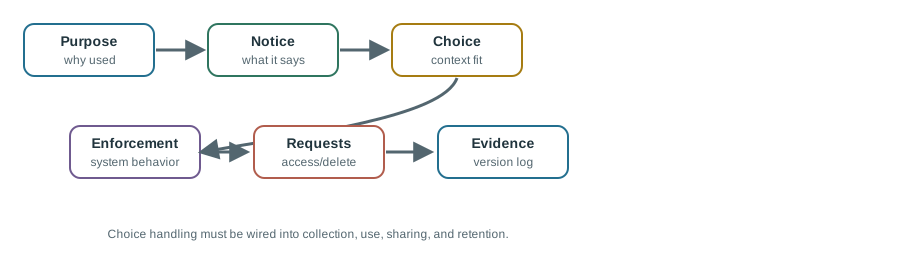
Together, context fit and access/delete frame the iot consent design patterns claim: consent choice handling flow from purpose and notice through choice, enforcement, rights requests, and evidence.

  • For iot consent design patterns, context fit supplies visible evidence; access/delete constrains the decision.
Consent choice handling flow from purpose and notice through choice, enforcement, rights requests, and evidence.
iotclass.org

Major section

Checkpoint: Consent Mechanics

You now know why consent must be freely given, specific, informed, unambiguous, and withdrawable.

  • You now know why pre-selected choices and bundled optional sharing fail the affirmative-action test.
  • You now know how a consent card should name data, purpose, retention, recipient, default, refusal consequence, and change path.
  • The consent interface is only one control surface.
iotclass.org

Major section

Data Minimization Principles

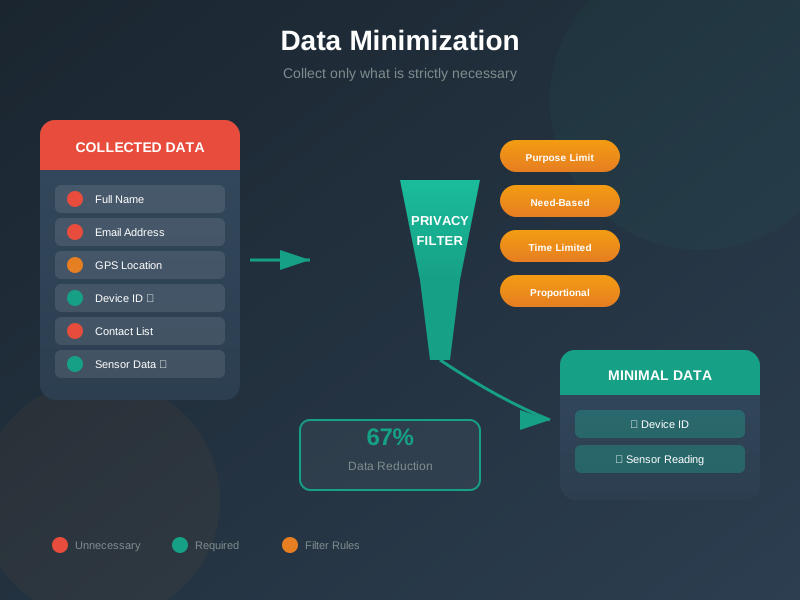
Data minimization is a core Privacy by Design principle requiring IoT systems to collect only the data necessary for their specified purpose.

  • Together,: Unnecessary and: FILTER frame the the data minimization hierarchy claim: data minimization: filtering collected fields down to only what is necessary.
Data minimization: filtering collected fields down to only what is necessary
iotclass.org

Major section

Deep dive: Putting Numbers to It

With an assumed $0.023/GB storage price, annual cost is $32.4 \times 365 \times 0.023 \approx \$272$ per device.

  • GDPR fine exposure model: Under Article 83, fines can reach up to 4% of annual global turnover or €20M, whichever is higher.
  • For a hypothetical €500M IoT company, the upper-bound exposure is $0.04 \times 500M = €20M$.
  • Without product telemetry or usability data, these are assumptions, not evidence.

Numbers to remember

20Mfines can reach up to 4% of annual global turnover or €20M
500Mthe upper-bound exposure is $0.04 \times 500M = €20M$.
iotclass.org

Major section

Deep dive: Putting Numbers to It (continued)

The calculator uses a planning-budget assumption for legal, UX, and engineering work; replace it with a real estimate rather than treating it as a benchmark.

  • Consent withdrawal friction: If consent requires 2 clicks but withdrawal requires 8 clicks, the design conflicts with the "as easy to withdraw as to grant" principle.
  • The calculator uses an assumed per-click completion loss to show why teams should measure withdrawal completion, not just whether a withdrawal control technically exists.
  • Friction ratio: ${frictionRatio.toFixed(1)}x ${frictionRatio > 2? "Review risk - withdrawal should be as easy as consent": "Low friction"}.
iotclass.org

Major section

Checkpoint: Minimization

You now know how to reduce collection by signal, precision, transmission, access, retention, and reuse.

  • You now know why high-frequency readings, raw audio, raw video, location traces, and model updates can expose behavior beyond the stated feature.
  • You now know how edge processing, federated learning safeguards, aggregation, suppression, and deletion windows support consent promises.
  • Minimization reduces avoidable collection.
iotclass.org

Deck summary

Key takeaways

Implementation should not rely on copy alone.

  • A cloud job can apply TTL deletion, revoke OAuth scopes, remove APNs/FCM notification tokens, delete device-shadow history, and mark export or erasure requests complete only after downstream processors respond.
  • If an MQTT broker publishes presence data to a retained topic after consent is withdrawn, the dashboard and downstream subscribers may continue seeing stale personal data.
  • When a firmware update adds person detection, a new analytics partner, or a longer retention period, the system should know whether existing consent covers the change or whether the user must make a new choice.
iotclass.org

Retrieval practice

Recall check 1 of 6

UX Uma says: answer from memory, then check your reasoning.

Q1A smart home company collects temperature, humidity, and motion sensor data from its devices. They want to share aggregated, anonymized neighborhood energy patterns with the local utility company for grid optimization. Under GDPR, which legal basis is most appropriate for this data sharing?

AUse consent as the legal basis because households should choose whether neighborhood energy patterns are shared with the utility
BUse legitimate interest without first testing whether the data is still personal
CNo GDPR basis is needed for truly anonymized data, but re-identification risk must be tested
DUse contract performance because grid optimization supports the energy-saving purpose of the smart home service
Show answer

Answer: C Correct!

iotclass.org

Retrieval practice

Recall check 2 of 6

UX Uma says: answer from memory, then check your reasoning.

Q2A family installs a smart doorbell camera that records video of anyone approaching their front door, including delivery drivers, neighbors, and passersby. Under GDPR, who is considered the data controller for the footage of people who did not consent to being recorded?

AThe smart doorbell manufacturer, because they designed the device and store the footage in their cloud
BThe homeowner, because they installed the device and determine its purpose (security monitoring)
CThe cloud hosting provider, because it manages the storage systems and access controls that protect the recorded footage
DThe delivery drivers and visitors, because they chose to approach a property with visible cameras
Show answer

Answer: B Correct!

iotclass.org

Retrieval practice

Recall check 3 of 6

UX Uma says: answer from memory, then check your reasoning.

Q3A fitness tracker company displays this consent dialog during app setup: 'To use this device, you must agree to share your health data with our analytics partners. [I Agree]'. Two months after GDPR enforcement, they receive a complaint. What is the primary GDPR violation?

AThe main problem is only the missing Decline button, not the sharing condition
BThe consent is bundled with service access, so optional partner sharing is not freely given
CThe main problem is only that analytics partners are unnamed in the dialog
DThe main problem is only that health data needs Article 9 wording, not choice
Show answer

Answer: B Correct!

iotclass.org

Retrieval practice

Recall check 4 of 6

UX Uma says: answer from memory, then check your reasoning.

Q4A smart home platform offers this consent interface during setup: 'Choose your privacy level: [Maximum Privacy - Limited Features] [Balanced - Recommended] [Full Features - More Data Sharing]'. The 'Balanced' option is pre-selected. Does this comply with GDPR consent requirements?

AYes, it provides clear choices with transparent trade-offs between privacy and functionality
BNo, because pre-selecting any option violates the requirement for unambiguous consent through affirmative action
CYes, as long as the 'Maximum Privacy' option allows full device functionality
DNo, because 'Balanced' is a vague term that doesn't inform users of specific data practices
Show answer

Answer: B Correct!

iotclass.org

Retrieval practice

Recall check 5 of 6

UX Uma says: answer from memory, then check your reasoning.

Q5A smart electricity meter company wants to detect which appliances are running in a home to provide energy-saving recommendations. Their engineers propose collecting power consumption at 1-second intervals to enable accurate appliance signature detection. What is the primary privacy concern with this approach?

A1-second sampling is technically unnecessary - 1-minute intervals would be sufficient for appliance detection
BHigh-frequency power data can expose detailed household behavior patterns
CThe data is too large to store efficiently, creating unnecessary infrastructure costs
DUsers didn't consent specifically to appliance detection, only to electricity monitoring
Show answer

Answer: B Correct!

iotclass.org

Retrieval practice

Recall check 6 of 6

UX Uma says: answer from memory, then check your reasoning.

Q6A health monitoring IoT company uses federated learning to improve their heart rate analysis algorithms. User devices train local models on their health data, then send model gradient updates to a central server for aggregation. A privacy researcher claims this approach still has privacy risks. Which concern is most valid?

AFederated learning is perfectly private because raw health records stay on the device
BGradient updates can leak health patterns through inversion or membership-inference attacks
CThe only risk is that the server can count which devices joined training
DThe main issue is consent to AI training, not leakage from model updates
Show answer

Answer: B Correct!

iotclass.org

Print reference

Answers

Answer key.

  1. C · Correct!
  2. B · Correct!
  3. B · Correct!
  4. B · Correct!
  5. B · Correct!
  6. B · Correct!
iotclass.org