IoT Value and Product Strategy · Study deck
IoT Pricing: Revenue Models
"We need to figure out how to let kids use our playground," said Sammy.
Ada is your guide for this deck.

After studying this chapter
Learning objectives
You will be able to:
- Trace pricing strategies and revenue models across its components and failure boundaries.
- Validate tiered pricing roi with a concrete scenario and pass criteria.
- Explain: IoT pricing strategies must balance customer value perception with business sustainability.
- Explain: The enterprise tier is priced for large organisations, and what it sells is service-level commitments, security and dedicated support.
Major section
Pricing Strategies and Revenue Models
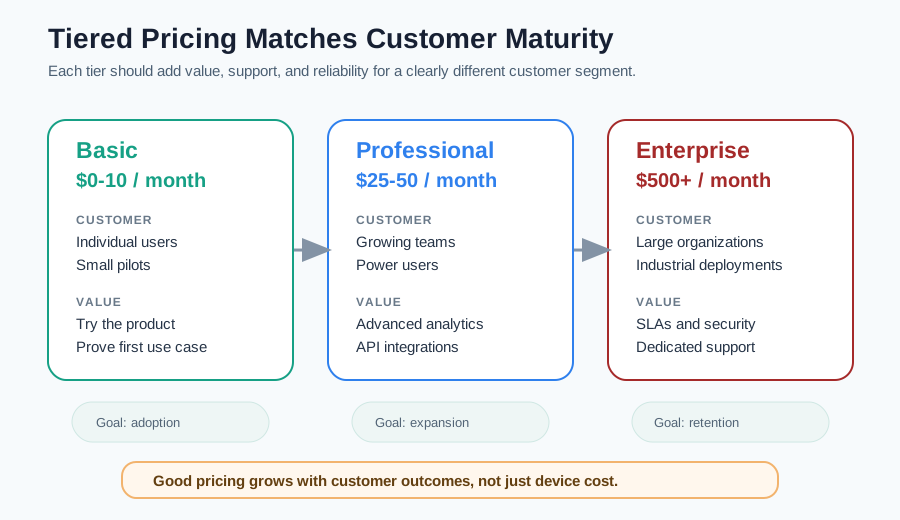
IoT pricing strategies must balance customer value perception with business sustainability.
- Companies employ tiered pricing models that segment customers by needs and willingness to pay.
- The basic tier is priced for an individual or a small pilot, and its job is to let someone prove a first use case.
- The professional tier is aimed at growing teams, and what it adds is analytics and integration rather than more devices.
Major section
Pricing Strategies and Revenue Models (continued)
The enterprise tier is priced for large organisations, and what it sells is service-level commitments, security and dedicated support.
- Each marks a change in who is buying and what they need proved.
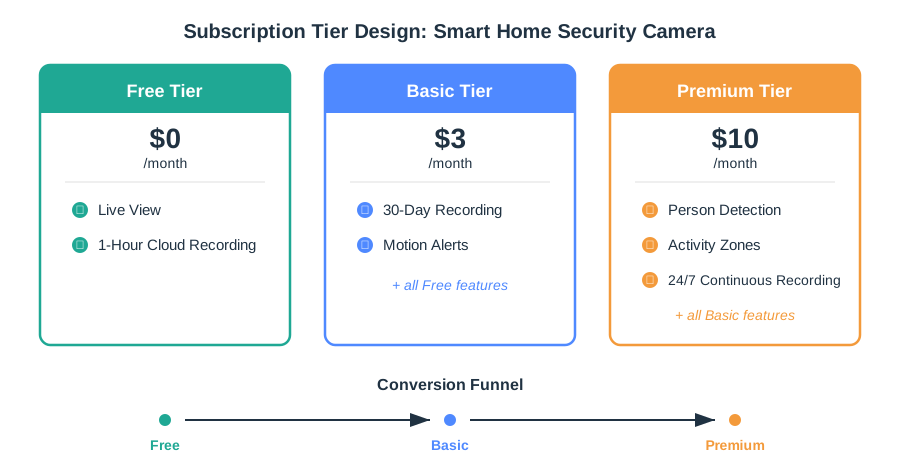
- This diagram shows how a free tier can demonstrate value while reserving longer retention, alerts, and analytics for paid tiers.
- The free tier gives live view and an hour of history, which is enough to prove that the camera and the app work.
Major section
Dynamic Pricing and Market Moats
The baseline-to-treatment panel also has no measured observations, so it cannot yet prove a shift.
- The outcome record separates peak load, total energy delivered, and unfinished sessions; it also asks who could defer.
- Network pricing is a policy mechanism as well as a revenue model.
- That split matters because lower peak load could mean useful charging moved, or that some users lost service.
Major section
Dynamic Pricing and Market Moats (continued)
These dimensions must be reviewed together because a tariff that improves capacity use can still make access less predictable or favor one service over a competitor.
- Blocking, throttling, paid prioritisation, zero-rating, and sponsored data change which traffic is reachable, fast, or visible in the user's bill.
- A historical regulatory proposal is useful for exposing these tensions, not as a statement of current law.
- For a real deployment, record the current jurisdiction, operator terms, affected traffic classes, user disclosure, appeal path, and the owner who will recheck the policy when regulation or commercial arrangements change.
Major section
Dynamic Pricing and Market Moats (continued)
A time-dependent tariff succeeds only if it changes the right behavior.
- A lower peak may mean customers moved flexible work to a quieter interval, but it may also mean they abandoned useful work or could not afford the peak price.
- Total usage can rise while the peak falls when an off-peak discount behaves like a sale, so neither metric is a substitute for the other.
- The product decision is defensible when the experiment shows that demand moved away from the bottleneck without hiding lost service, unfair exclusion, or a rebound peak elsewhere.
Major section
Future Monetization Research Directions
Some IoT monetization ideas are still better treated as research directions than default product patterns.
- The hard question is not only whether a blockchain or payment rail can clear tiny transactions.
- Privacy-preserving monetization is another active design frontier.
- They need provenance, consent, quality scoring, entitlement checks, buyer logs, deletion paths, and clear standards for secure exchange.
Deck summary
Key takeaways
IoT pricing strategies must balance customer value perception with business sustainability.
- The enterprise tier is priced for large organisations, and what it sells is service-level commitments, security and dedicated support.
- The baseline-to-treatment panel also has no measured observations, so it cannot yet prove a shift.
- These dimensions must be reviewed together because a tariff that improves capacity use can still make access less predictable or favor one service over a competitor.
- A time-dependent tariff succeeds only if it changes the right behavior.
Retrieval practice
Recall check 1 of 2

Ada says: answer from memory, then check your reasoning.
Q1A free IoT tier attracts users, but its upgrade offer is vague. What should the pricing design clarify?
Show answer
Answer: D The section makes longer retention, alerts, and analytics visible as upgrade reasons.
Retrieval practice
Recall check 2 of 2
Ada says: answer from memory, then check your reasoning.
Q2A growing business needs advanced analytics, API access, and priority support. Which tier matches the chapter’s framework?
Show answer
Answer: C Professional serves growing businesses with advanced analytics, API access, custom integrations, and priority support plus live chat.
Print reference
Answers
Answer key.
- D · The section makes longer retention, alerts, and analytics visible as upgrade reasons.
- C · Professional serves growing businesses with advanced analytics, API access, custom integrations, and priority support plus live chat.