Capstone & Appendix · Study deck

IoT Mathematics: Linear Algebra and Probability

Several sensor values form a vector, while noise makes each value unsure.

Test Tessa is your guide for this deck.

mathematicalfoundations
Test Tessa, the module guide, in a scene from this chapter.
iotclass.org

After studying this chapter

Learning objectives

You will be able to:

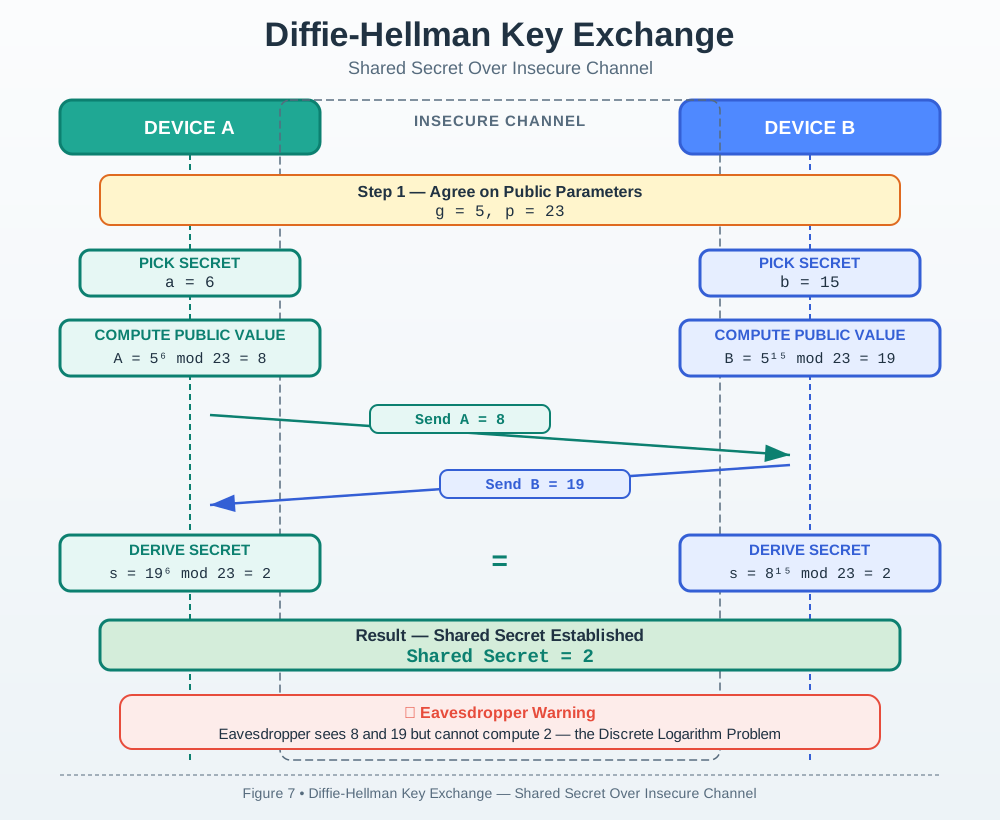
  • Explain: Likewise, an observer may see public values such as 8 and 19, while recovering the private exponents requires solving the discrete logarithm problem for properly chosen large parameters.
  • Explain: Diffie-Hellman relies on forward calculations such as 5^7 mod 23 = 17 being easy while the reverse problem is hard.
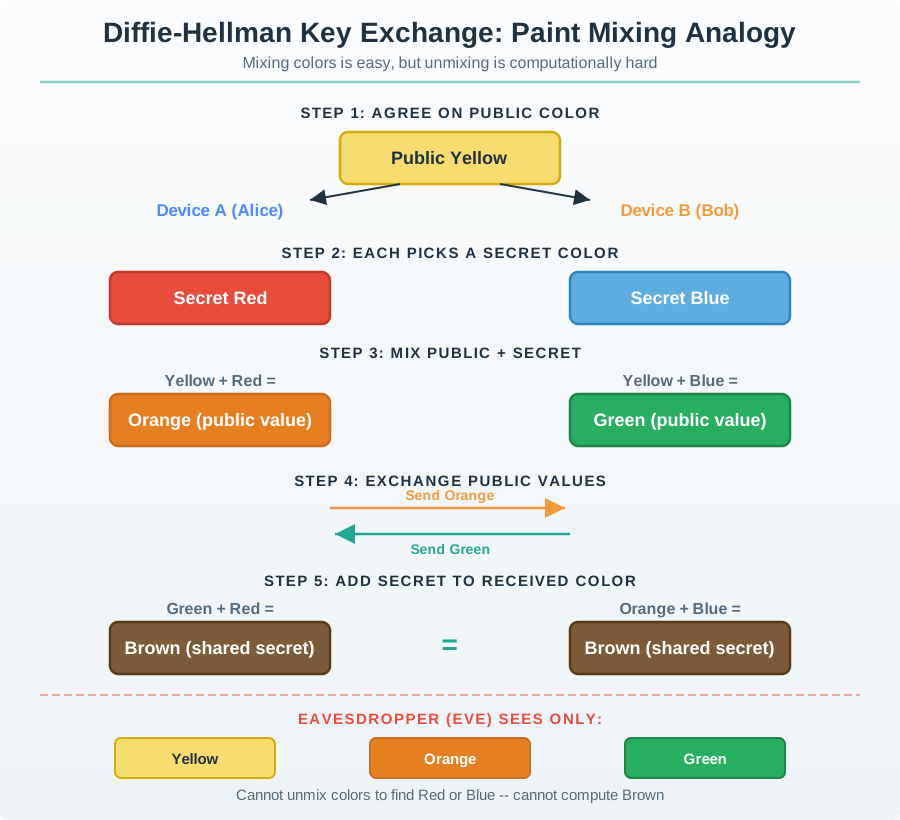
  • Explain: The eavesdropper sees the public starting colour and both exchanged mixtures but cannot reverse them to recover either private colour.
  • Explain: The analogy explains one-way computation, not authentication; a real exchange still needs authenticated peers and safe key handling.
iotclass.org

Major section

The Core Idea

Modular arithmetic is "clock arithmetic." After reaching a maximum value, numbers wrap around to zero.

  • Notation: $a \mod n$ = remainder when a is divided by n.
  • Key Property: Easy to compute forward, hard to reverse.
  • Two IoT devices can agree on a shared secret over an insecure channel.

Why it matters

This "trapdoor" property enables public-key cryptography.

Diffie-Hellman key exchange between two IoT devices
iotclass.org

Major section

The Core Idea (continued)

This "trapdoor" property enables public-key cryptography.

  • The eavesdropper sees the public starting colour and both exchanged mixtures but cannot reverse them to recover either private colour.
  • Likewise, an observer may see public values such as 8 and 19, while recovering the private exponents requires solving the discrete logarithm problem for properly chosen large parameters.
  • The analogy explains one-way computation, not authentication; a real exchange still needs authenticated peers and safe key handling.
iotclass.org

Major section

The Core Idea

Entropy measures information content or uncertainty.

  • More unpredictable data requires more bits to represent.
  • Where $p_i$ is the probability of each outcome.
  • The alarm provides only 0.08 bits of information per reading (very predictable).
  • Key Insight: To double capacity, you need to roughly quadruple SNR.
iotclass.org

Major section

Checkpoint: Security and Signals

That wraparound supports the forward operations used in the key-exchange example.

  • Diffie-Hellman relies on forward calculations such as 5^7 mod 23 = 17 being easy while the reverse problem is hard.
  • Authentication and key handling remain separate requirements.
  • Complex numbers track amplitude and phase, while information theory connects entropy, SNR, bandwidth, and Shannon capacity.
iotclass.org

Deck summary

Key takeaways

Modular arithmetic is "clock arithmetic." After reaching a maximum value, numbers wrap around to zero.

  • This "trapdoor" property enables public-key cryptography.
  • Entropy measures information content or uncertainty.
  • That wraparound supports the forward operations used in the key-exchange example.
iotclass.org

Retrieval practice

Recall check 1 of 2

Test Tessa says: answer from memory, then check your reasoning.

Q1An accelerometer produces an ordered set of axis readings. What does the vector magnitude describe?

AThe combined acceleration magnitude
BThe value of the first axis alone
CThe order in which readings were transmitted
DThe covariance between successive samples
Show answer

Answer: A The chapter uses the square root of summed squared components to describe total magnitude.

Q2A sensor-fusion design stores a covariance matrix. What do its off-diagonal entries describe?

AThe variance of each variable by itself
BThe vector’s total acceleration magnitude
CThe next state without a transition model
DHow variables change together
Show answer

Answer: D The chapter distinguishes cross-variable correlation from diagonal variance.

iotclass.org

Retrieval practice

Recall check 2 of 2

Test Tessa says: answer from memory, then check your reasoning.

Q3Place each mathematical responsibility where it lives so you can trace a decision back through network and signal calculations to bounded device measurements.

ADevice Measurements and Uncertainty
BSignal and Network Calculations
CApplication Models and Decisions
Show answer

Answer: A Mathematical reasoning is an evidence chain: measure with known limits, calculate whether the path preserves what matters, then make a bounded model-based decision.

iotclass.org

Print reference

Answers

Answer key.

  1. A · The chapter uses the square root of summed squared components to describe total magnitude.
  2. D · The chapter distinguishes cross-variable correlation from diagonal variance.
  3. A · Mathematical reasoning is an evidence chain: measure with known limits, calculate whether the path preserves what matters, then make a bounded model-based decision.
iotclass.org