Industrial IoT and Business Operations · Study deck
IoT Go-to-Market: Pricing and Unit Economics
A vibration sensor on a pump can keep sending useful readings while its subscription loses money.
Ada is your guide for this deck.

After studying this chapter
Learning objectives
You will be able to:
- Compare device, subscription, usage, and outcome pricing.
- Calculate LTV, CAC, and payback for an IoT offer.
- Explain: The unique value proposition (UVP), also called the unique selling proposition, states why this IoT product is worth choosing over alternatives.
- Explain: Scenario: Your startup has developed an industrial vibration sensor for predictive maintenance of rotating machinery (motors, pumps, compressors).
Major section
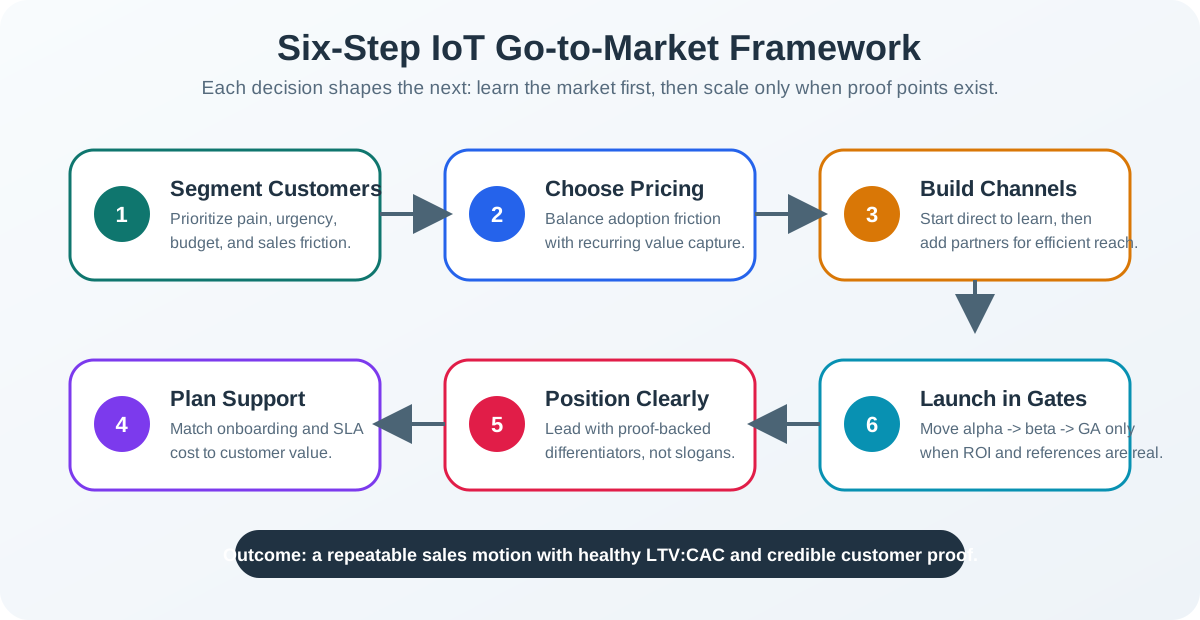
State the Unique Value Proposition Early
The unique value proposition (UVP), also called the unique selling proposition, states why this IoT product is worth choosing over alternatives.
- The source slide uses portability, light weight, and convenience as example benefits, then makes the planning rule explicit: differentiating the idea from competing products deserves time early in commercialization, not after the product is built.
Major section
B2B Industrial Sensor GTM
Scenario: Your startup has developed an industrial vibration sensor for predictive maintenance of rotating machinery (motors, pumps, compressors).
- The sensor uses MEMS accelerometers, edge ML for anomaly detection, and LoRaWAN connectivity.
- You need to develop a comprehensive go-to-market strategy for B2B sales.
- Goal: Design a pricing model, channel strategy, and support structure that maximizes recurring revenue while achieving sustainable customer acquisition costs in the industrial IoT market.
Major section
When Support Changes the Advanced Tier Margin
For 100 sensors, recurring revenue is £3,900 and this contribution is £3,660 per month.
- The support table introduces a second assumption: Priority support costs £3.50 per sensor.
- The revised monthly cost is 0.50 + 0.30 + 0.40 + 3.50 = 4.70 pounds per sensor.
- The difference is £230 each month.
Major section
When Support Changes the Advanced Tier Margin (continued)
A new customer with a complex factory connection may need extra integration work.
- Contribution becomes £34.30 per sensor, or £3,430 across the fleet.
- A sales proposal that promises Priority service while using basic support costs overstates the margin.
- The figures here are model inputs, not supplier quotes or a forecast of demand.
Major section
When Support Changes the Advanced Tier Margin (continued)
Here the support step sends a constraint back to pricing: the promised response needs staff.
- An installer who handles first-line questions may lower supplier workload but charge a fee.
- That fee belongs in the acquisition or running-cost model according to when it is paid.
- Likewise, a free pilot can prove that alarms help a technician, but it cannot establish willingness to pay the full subscription.
Deck summary
Key takeaways
The unique value proposition (UVP), also called the unique selling proposition, states why this IoT product is worth choosing over alternatives.
- Scenario: Your startup has developed an industrial vibration sensor for predictive maintenance of rotating machinery (motors, pumps, compressors).
- For 100 sensors, recurring revenue is £3,900 and this contribution is £3,660 per month.
- A new customer with a complex factory connection may need extra integration work.
- Here the support step sends a constraint back to pricing: the promised response needs staff.
Retrieval practice
Recall check 1 of 2

Ada says: answer from memory, then check your reasoning.
Q1An industrial sensor team plans a B2B launch. Why should its GTM plan coordinate multiple customer roles?
Show answer
Answer: B The introduction links IoT sales to these continuing deployment responsibilities.
Q2A team describes its IoT product as portable and convenient. What should it add to make the claims useful?
Show answer
Answer: B The chapter requires reference points for portability, weight, and convenience.
Retrieval practice
Recall check 2 of 2
Ada says: answer from memory, then check your reasoning.
Q3An IoT offer earns £100 per month and costs £40 per month to serve. CAC is £300. The expected paid life is 20 months. What are simple CAC payback and contribution LTV:CAC?
Show answer
Answer: B Monthly contribution is £60; £300 CAC takes 5 months, and £1,200 contribution LTV gives 4:1.
Print reference
Answers
Answer key.
- B · The introduction links IoT sales to these continuing deployment responsibilities.
- B · The chapter requires reference points for portability, weight, and convenience.
- B · Monthly contribution is £60; £300 CAC takes 5 months, and £1,200 contribution LTV gives 4:1.