Industrial IoT and Business Operations · Study deck
IoT Go-to-Market: Deployment Strategy
A sale is not a launch when each site needs new wiring, training, and support.
Ada is your guide for this deck.

After studying this chapter
Learning objectives
You will be able to:
- Define Target Customer Segments: Identify and prioritize segments based on pain points, willingness to pay, and sales complexity
- Design Pricing Models: Structure hardware and subscription pricing for B2B IoT products using cost analysis and value capture frameworks
- Build Channel Strategies: Plan direct sales, partner channels, and distribution approaches with CAC projections for each channel
- Calculate Unit Economics: Compute LTV, CAC, and LTV:CAC ratios across different channel mixes and pricing tiers
Major section
Start With the Story
A useful plan says why a buyer continues, what the team must operate, and which result stops expansion.
- Sell the Working Service, Not the Box: Picture a small leak detector that works in a demo.
- A signed trial or active device is not proof of a repeatable market.
- The sales promise must match the tested operating boundary.
Major section
Start With the Story (continued)
A housing manager likes the warning, but installation, mobile coverage, staff training, battery visits, false alarms, and support still decide whether the service can be bought and kept.
- This opening does not pick one sales channel or price.
- Practitioner maps the buyer, trial, deployment, and support route.
- If not, the next step is a smaller test, not a larger claim.
Major section
IoT GTM Sells Deployment
A go-to-market strategy for IoT must explain how the product is bought, installed, connected, operated, supported, and expanded.
- The customer is rarely buying only a sensor or dashboard.
- This makes GTM more constrained than ordinary software launch planning.
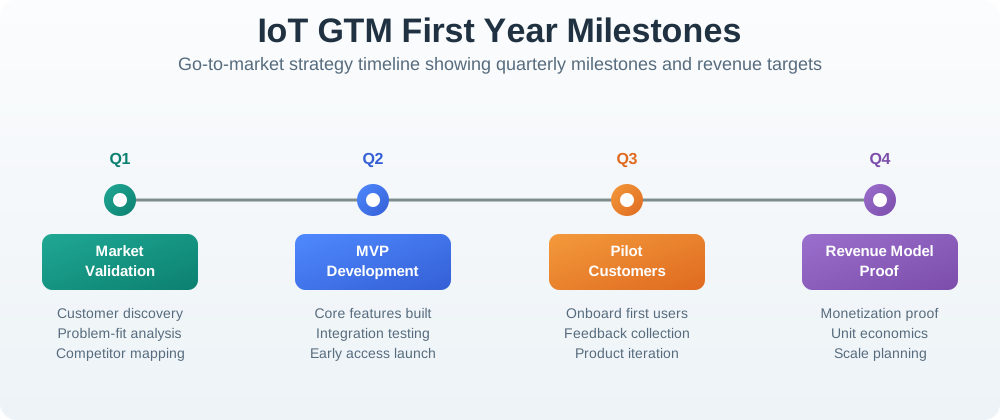
- It asks who has the painful job, using customer discovery, problem-fit work, and a map of rivals.
Major section
IoT GTM Sells Deployment (continued)
The sequence also protects cash.
- Hardware lead times, certification, installation access, network approvals, cybersecurity review, procurement, data processing terms, training, field support, and integration with existing systems can all determine whether a customer can actually adopt the product.
- Market validation should prove the buyer and the painful job.
- MVP work should prove installation and data reliability.
Major section
Map Buyer and Support Path
The economic buyer may care about ROI and risk.
- The technical buyer may care about APIs, security, data residency, and integration.
- The operator may care about setup time, false alarms, mobile workflow, and maintenance.
- Procurement, legal, facilities, IT, OT, cybersecurity, and finance may each add requirements before a deployment can scale.
Major section
Map Buyer and Support Path (continued)
The installer needs mounting instructions, power assumptions, gateway placement rules, and rollback steps.
- A pilot can test site access, installation time, cellular or Wi-Fi coverage, gateway reliability, cloud integration, dashboard use, alert response, and support burden.
- A partner pilot can test whether system integrators or distributors can sell and install the product without the founding team in every room.
- The operator needs alert thresholds, escalation timing, mobile access, and false-positive review.
Major section
Map Buyer and Support Path (continued)
Early launches should reduce uncertainty before spending heavily on sales.
- The technical buyer needs a security packet, network ports, data schema, API limits, identity model, and integration owner.
- When any of those owners lacks a clear task, the launch risk moves from product-market fit into execution friction.
- Validate deployment friction: Measure install time, required permissions, network approvals, onboarding steps, support tickets, and time to first useful alert.
Major section
GTM Links Pipeline and Operations
A system integrator needs installation guides, training, demo hardware, margin structure, escalation paths, and configuration tooling.
- IoT GTM should be instrumented across CRM, billing, product telemetry, and support systems.
- Security and procurement can be part of the sales motion.
- Partner channels need operating rules.
- A distributor needs SKU, inventory, warranty, return, and support boundaries.
Major section
GTM Links Pipeline and Operations (continued)
A marketplace listing needs packaging, metering, billing handoff, and buyer support ownership.
- A lead source, segment, sales stage, pilot start, device shipment, activation, first data received, first alert, support ticket, invoice, renewal, expansion, and churn reason should connect to the same customer and account model.
- The technical system should preserve those GTM facts as account-level telemetry, not ad hoc spreadsheet notes.
- Billing then records plan, discounts, usage overages, and expansion modules.
Major section
Go-to-Market Strategy Basics
Rule of thumb: A common planning target is LTV of at least 3x CAC.
- At $30,000 CAC, that means $90,000 LTV; check gross margin, fixed costs and cash payback before scaling.
- The beginner version gives the vocabulary.
- The rest of the chapter applies the same rule to an industrial sensor launch where each segment, price, channel, and gate has to survive real numbers.
Major section
For Kids: Meet the Sensor Squad!
The Sensor Squad Opens a Shop!: Temperature Terry, the LED, the microcontroller, and the battery had invented an amazing Smart Plant Pot that could tell you when your plant needed water, sunlight, or food.
- But the microcontroller shook his head. "We only have enough Smart Plant Pots for 20 customers.
- We need to pick the RIGHT customers first.".
- "Let's start with plant shops!" said Sammy. "They already love plants, and if their customers are happy, the shops will order more!".
Deck summary
Key takeaways
A useful plan says why a buyer continues, what the team must operate, and which result stops expansion.
- A housing manager likes the warning, but installation, mobile coverage, staff training, battery visits, false alarms, and support still decide whether the service can be bought and kept.
- A go-to-market strategy for IoT must explain how the product is bought, installed, connected, operated, supported, and expanded.
- The sequence also protects cash.
- The economic buyer may care about ROI and risk.
Retrieval practice
Recall check 1 of 3

Ada says: answer from memory, then check your reasoning.
Q1A sensor has interested buyers, but installation access and network approval remain unresolved. What should the launch plan include?
Show answer
Answer: D IoT adoption depends on those deployment obligations as well as product capability.
Retrieval practice
Recall check 2 of 3
Ada says: answer from memory, then check your reasoning.
Q2A buyer says a rival sensor is cheaper. Which response is a credible position?
Show answer
Answer: A A measured buyer outcome explains why the offer can be worth more.
Retrieval practice
Recall check 3 of 3
Ada says: answer from memory, then check your reasoning.
Q3An installer joins a pilot after the technical buyer approves it. What evidence does the installer still need?
Show answer
Answer: B The chapter gives installers acceptance criteria distinct from buyer and operator needs.
Print reference
Answers
Answer key.
- D · IoT adoption depends on those deployment obligations as well as product capability.
- A · A measured buyer outcome explains why the offer can be worth more.
- B · The chapter gives installers acceptance criteria distinct from buyer and operator needs.