Electronics & Circuits · Study deck
IoT Electricity: Divider Analysis and Applications
A sensor input can be damaged when a divider is chosen by ratio alone.
Voltage Vera is your guide for this deck.

After studying this chapter
Learning objectives
You will be able to:
- Calculate LED current limiting resistor values using Ohm's Law to prevent component damage in IoT circuits
- Design voltage dividers to interface 5V sensors with 3.3V microcontrollers using resistor ratio calculations
- Analyze power budget for battery-powered IoT devices by calculating duty cycles and average current consumption
- Build series and parallel resistor networks and measure voltage/current distribution using multimeters
Major section
For Beginners: Passive Components
Resistors, capacitors, and inductors are the three basic building blocks found in almost every electronic circuit.
- A resistor is like a narrow section of pipe that limits water flow (limits electrical current).
- A capacitor is like a small tank that stores and releases water (stores and releases electrical charge).
- An inductor is like a heavy flywheel that resists changes in flow.
Major section
Phoebe's Field Notes: Why the Same Three Laws Size the Board

The mathematical gist.: Mixed-rail battery life is energy bookkeeping: \(P_{avg}=\sum V_iI_i(t_i/T)\), then t=E_{battery}/P_{avg}.
- This chapter's 92.4 mA 3.3 V load uses about 305 mW.
- Passive components don't require external power and don't generate power.
Major section
IoT Voltage Dividers
A voltage divider is one of the most fundamental circuits in IoT systems, allowing you to interface sensors operating at different voltages with microcontrollers.
- Step 4: Account for Loading Effects: The MCU input pin has input impedance (typically >100kΩ for GPIO, ~1MΩ for ADC).
Major section
Real-World Applications in IoT
The next question is how the same current, voltage, and resistance checks show up in ordinary IoT outputs and buses.
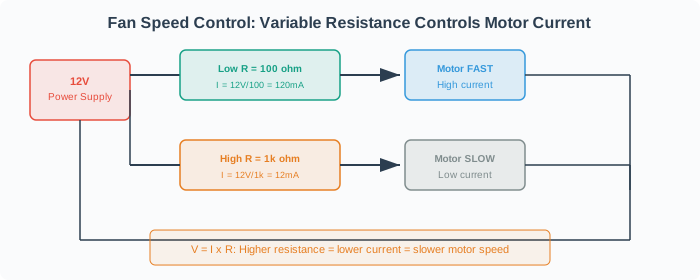
- At: Low R = 100 ohm, the annotation: I = 12V/100 = 120mA explains why: Motor FAST is the resulting state: less series resistance permits more current.
- Problem:: LEDs will burn out if connected directly to power supply.
Deck summary
Key takeaways
Resistors, capacitors, and inductors are the three basic building blocks found in almost every electronic circuit.
- The mathematical gist.: Mixed-rail battery life is energy bookkeeping: \(P_{avg}=\sum V_iI_i(t_i/T)\), then t=E_{battery}/P_{avg}.
- A voltage divider is one of the most fundamental circuits in IoT systems, allowing you to interface sensors operating at different voltages with microcontrollers.
- The next question is how the same current, voltage, and resistance checks show up in ordinary IoT outputs and buses.
Retrieval practice
Recall check

Voltage Vera says: answer from memory, then check your reasoning.
Q1A voltage divider uses 1kΩ (R1) and 3kΩ (R2) resistors to divide a 12V input. What is the output voltage across R2?
Show answer
Answer: C V_out = V_in × R2 / (R1 + R2) = 12V × 3kΩ / (1kΩ + 3kΩ) = 12V × 3/4 = 9V.
Q2Three resistors (100Ω, 220Ω, 330Ω) are connected in series. What is the total resistance?
Show answer
Answer: C For resistors in series, the total resistance is the sum: R_total = R1 + R2 + R3 = 100Ω + 220Ω + 330Ω = 650Ω.
Print reference
Answers
Answer key.
- C · V_out = V_in × R2 / (R1 + R2) = 12V × 3kΩ / (1kΩ + 3kΩ) = 12V × 3/4 = 9V.
- C · For resistors in series, the total resistance is the sum: R_total = R1 + R2 + R3 = 100Ω + 220Ω + 330Ω = 650Ω.