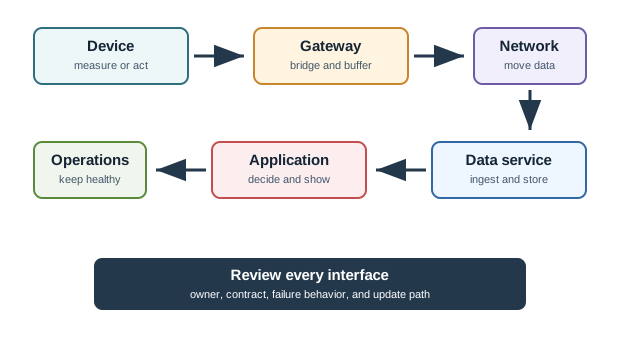
An IoT service depends on connected layers, accountable owners, and evidence across its whole lifetime.
Physics Phoebe is your guide for this deck.
ecosystem
After studying this chapter
Learning objectives
A useful ecosystem review connects the message path with ownership and evidence.
A physical event can be followed through the complete service.Devices, connectivity, platform services, and applications each contribute to the useful result.
Assign responsibility to layers and the handoffs between them.An unowned interface can pass failures between teams instead of getting them fixed.
Interoperability is checked with captured exchanges and shared schemas.A standard label alone does not prove that versions, profiles, and data models agree.
Plan how devices join, change, and leave.Provisioning, updates, and retirement need owners before the deployment grows.
Major section
Follow the door alert
Follow one door alert from its physical trigger to a useful response.
A door sensor starts an event that someone must answer.The physical trigger needs a complete route before the phone alert becomes useful.
Each service adds a capability and another possible failure point.Adding services also introduces cost and trust decisions along the alert path.
Name an owner and success check at every handoff.Each team needs evidence that the next layer received and interpreted the event.
Lost-link and service-outage tests expose failures in the path.Save the results for a dead device, disconnected link, and unavailable service.
A flashing door sensor cannot guarantee the manager receives a phone alert. Delivery needs a working link, an interpreting service, and a reachable application. A lost gateway link blocks the later steps despite successful detection; a working device does not prove a working service.
Major section
Explain what makes a thing connected
Computation and internet communication connect physical things to a wider system.
Computation and internet communication extend an everyday object's role.A plug, washing machine, or recycling bin qualifies when it can compute and reach the network.
Internet access can be direct or through a gateway.The connected thing does not need its own direct link to the wider service.
A wireless sensor network usually serves one application.IoT can support heterogeneous applications sharing the same infrastructure.
Ecosystem layers remain useful as definitions and technology change.Layers, owners, and interfaces describe how the operated system holds together.
Major section
Trace the ecosystem stack
This stack maps an IoT event upward and control downward; begin at the physical world.
Devices are where physical events become measurements or actions.The sensor's event starts below the application that later displays its result.
Follow telemetry upward through Connectivity and Platform to Applications.Links carry the data; services validate and store it before a user decision.
Commands and updates travel down through the boundary contracts.Configuration, credentials, and firmware need a return path toward the deployed device.
The whole stack sits inside operations and governance.Every layer and interface needs an accountable owner, failure behavior, and managed change.
Layered IoT ecosystem diagram anchored by the physical world below and user or business outcomes above. Four stacked layers (Devices, Connectivity, Platform, and Application) carry telemetry and events upward and configuration, credentials, commands, and firmware downward. An optional gateway or edge tier straddles the Devices-to-Connectivity boundary rather than appearing as a fifth layer. People, operations, and governance wrap the whole stack. Each layer has an accountable owner, and each inter-layer boundary is marked as an owned contract requiring evidence for protocol and data-model alignment, identifiers and credentials, offline and failure behaviour, and the change or update path.
Draw data and ownership paths before assigning jobs. A broken sensor-to-gateway handoff can erase the service outcome. Verify the final alert across accountable handoffs, and distinguish an application failure from a sensing failure.
Activity 1 · Draw it
✎ Trace the door alert
I want you to make every handoff in the door alert visible.
Draw the door alert through Devices, Connectivity, Platform, and Application. Add an upward event arrow and a downward configuration arrow. Mark an owner and a success check at each boundary.
3 minutes · Pen and paper · Answer: Activity 1
Your answer
Major section
Name the maintenance owner at each layer
The visible product depends on different maintenance duties at every layer.
Device ownership includes firmware, power settings, and field replacement.A prototype's behavior must still be supported after the equipment is installed.
Network ownership includes coverage, outages, and recovery paths.Lab connectivity cannot establish the field link's offline behavior and reliability.
Platform ownership includes validation, access rules, and recovery.Schemas, retention, backup, and restore evidence support those responsibilities.
Application ownership includes useful alerts and missing-reading behavior.The workflow must help users make the intended decision when the service fails.
Major section
Agree on the interface contract
A handoff works when both teams agree on meaning, trust, failure behavior, and change.
Agree on protocol versions and data fields before connecting layers.Adjacent teams need evidence that each side interprets the exchange in the same way.
Device identifiers and credentials must agree across the boundary.Identity handling belongs with the protocol and data-model contract.
Specify offline behavior so delayed information can be recognized.Missing readings and retry paths need an agreed response when a link fails.
Review interface changes together.Firmware, schema, or credential updates can break a previously working field exchange.
Major section
Check the system beyond its working parts
Independent component success does not establish that the complete service works.
An optional gateway can bridge Devices and Connectivity.It sits within or across that boundary rather than becoming a fifth reference layer.
A working sensor does not establish network or platform health.Each lower service still needs its own owner and failure evidence.
A polished dashboard can hide unreliable readings.A clean interface cannot repair lost connectivity or an unowned maintenance problem.
Validate the full event path before treating a prototype as ready.The operated service needs both useful delivery and support across its lifetime.
Major section
Follow participants and value flows
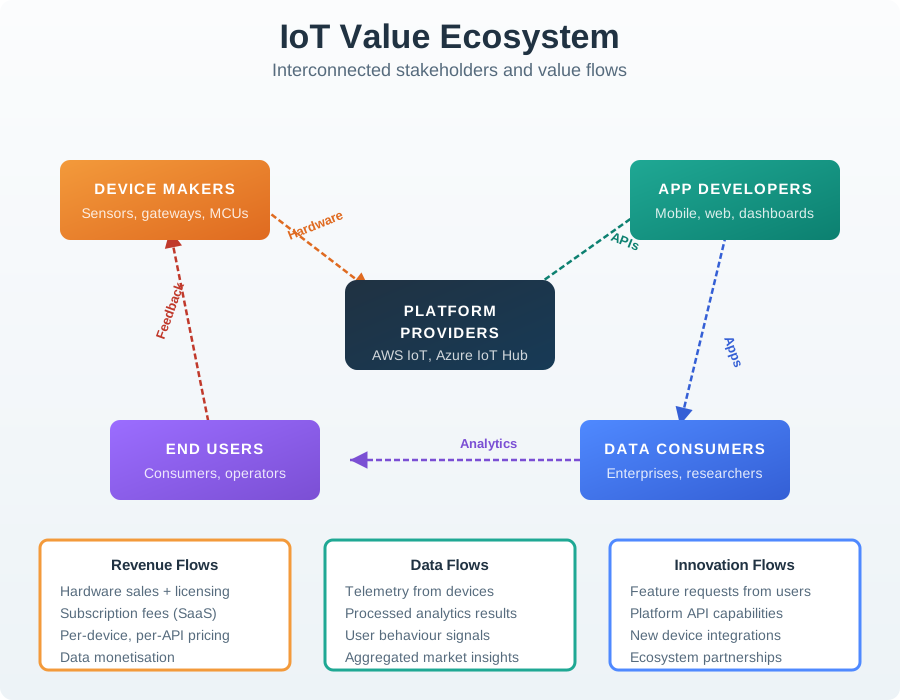
This ecosystem map links participants and value flows; start with hardware entering the central platform.
Device makers supply hardware toward the central platform.The upper-left participants contribute the physical products that make the service possible.
Follow APIs to app developers and analytics to data consumers.These paths show different uses of the central platform's capabilities.
End-user feedback flows back into the ecosystem.The service's users contribute information that influences what participants provide.
The lower boxes separate revenue, data and innovation flows.They identify what each participant contributes and receives beyond the hardware connection.
Stakeholder reviews make ownership visible across hardware, connectivity, platform services, integration, operations, and user value.
Major section
Ask for evidence behind each ownership claim
An ecosystem review turns each ownership claim into a checkable record.
Firmware records and local logs support device behavior claims.Sensor range and power mode help determine whether the field result matches the prototype.
Field coverage and offline evidence bound the network claim.Capacity, latency, security, and failure behavior belong with the coverage assumptions.
Review schemas, retention, access rules, and restore evidence.The platform must ingest, validate, store, and expose data in a recoverable way.
Alert workflows and audit trails must support the intended decision.Application evidence includes failure states as well as the successful user path.
Major section
Follow responsibility beyond launch
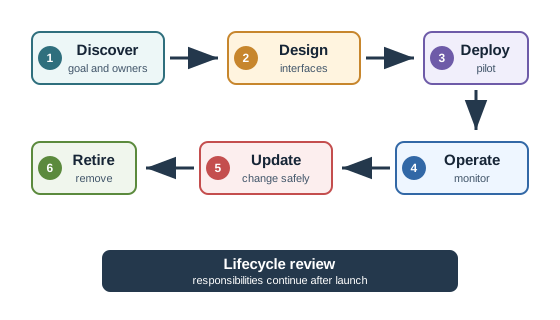
This lifecycle follows responsibility beyond launch; read from Discover through Retire.
Discover and Design set the goals and responsibilities.The lifecycle starts with the system's purpose and the owners who will support the system.
Follow Deploy into Operate, where support continues after launch.Monitoring, incident response, and replacement remain part of the service.
The Update stage needs a safe path for change.Firmware, schemas, and credentials must change without breaking deployed devices.
Finish at Retire, where removal needs accountable owners.Data, physical assets, and credentials leave the system while prior access is revoked.
Lifecycle ownership continues after launch; ecosystem reviews keep discovery, design, deployment, operation, update, and retirement responsibilities connected.
Major section
Test the actual implementations together
Interoperability requires evidence from the specific implementations that will operate together.
A shared standard can still allow incompatible implementations.Different versions, optional profiles, or data models can prevent useful exchange.
Captured exchanges check agreement on protocol details.Keep the versioned specification beside evidence from the devices that will operate together.
Schema tests check fields, units, and identifiers.Accepted data can still be interpreted wrongly if those details do not match.
Provisioning and revocation records check lifecycle trust.Retired devices must not retain access simply because their old identity still exists.
A device-only review misses ecosystem layers and interfaces. Matching standard names can hide incompatible versions, profiles, or data models. Without portability and retirement plans, supplier changes and clean shutdown fail. Owned interfaces and lifetime governance hold the layered model together.
Activity 2 · Predict
✎ Explain the incompatible pair
I want you to test the compatibility claim before accepting the labels.
Two devices claim the same standard but cannot exchange useful data. Write possible protocol and data-model causes. For each cause, name evidence you would request before accepting compatibility.
3 minutes · Pen and paper · Answer: Activity 2
Your answer
Major section
Own joining, operation, updates, and retirement
Lifecycle ownership makes change and removal part of the original system design.
Provisioning gives joining devices identity, keys, and configuration.The platform claim needs a visible issuer, owner, and record of that process.
Operations staff monitor health and replace failed equipment.Incident response remains a responsibility after the first successful reading.
Update plans keep deployed firmware, credentials, and schemas compatible.Safe change must reach field devices without breaking the service they support.
Retirement removes assets and revokes previously granted access.Data and credentials need an end-of-life plan alongside physical device removal.
Governance names owners for security updates, retention, and a portable supplier exit. Health checks and fault response expose the live path. Firmware, data-model, and key updates must protect older devices. Retirement removes hardware and data, revokes access, and retains required records; launch is only one lifetime handoff.
Major section
Close the governance gaps
Governance closes the gaps that technical component checks can leave unresolved.
Review every layer instead of treating device success as system readiness.The weakest layer or least-owned interface can still break the complete service.
Resolve unowned interfaces before incidents pass between teams.Each handoff needs a named responsibility for maintenance and failure response.
Keep a portable exit path for supplier changes.Export formats and adapter boundaries help avoid stranding devices on one integration path.
Assign security updates and data retention decisions before growth.Unanswered governance questions can leave an installed system without support or a clean exit.
Every interface needs an owner, failure plan, and proof that duties survive team or vendor changes. Rehearse a supplier change; record unnamed teams and undocumented settings before scaling. Seek a specific repairable weakness rather than a longer diagram.
Deck summary
Key takeaways
Review the complete operated system, from the first event to the final retirement.
An IoT service needs working layers and owned interfaces over time.The device, links, platform, application, and operators jointly produce the useful outcome.
Telemetry and return control paths need clear contracts.Both directions must preserve meaning, identity, offline behavior, and managed change.
Real interoperability tests strengthen a standard-based compatibility claim.Versions, profiles, and data models need evidence from the actual implementations.
Provisioning, updates, portability, and retirement belong in the initial review.A complete plan covers the first joining device and the final revoked credential.
Standards reduce integration risk; test versions, profiles, and data models together. Devices, connectivity, platform, and application depend on operations and people. The weakest layer or least-owned interface limits reliability, so every layer needs an owner and failure plan.
Retrieval practice
Recall check 1 of 4
Physics Phoebe says: answer from memory, then check your reasoning.
Q1Why can a polished dashboard still fail as an IoT solution?
ADashboards are presentation-only and never belong in IoT systems
BAll layers below the app need owners, interfaces, and failure plans
CThe dashboard proves devices, links, and platform services are healthy
DOnly the device layer matters; connectivity and operations are optional
Show answer
Answer: B The application is one layer; a missing or unowned layer beneath it can break the whole system.
Retrieval practice
Recall check 2 of 4
Physics Phoebe says: answer from memory, then check your reasoning.
Q2A sensor prototype works perfectly in the lab, but nobody owns field replacement, credential revocation, or update scheduling. What kind of problem is this?
AA device calibration error
BAn ecosystem ownership gap
CA dashboard layout issue
DA connectivity bandwidth issue
Show answer
Answer: B The device works technically, but the system lacks owners for lifecycle and operational responsibilities.
Retrieval practice
Recall check 3 of 4
Physics Phoebe says: answer from memory, then check your reasoning.
Q3A sensor service is ready to scale, but no team owns data retention or an exit from its platform vendor. What is the best review finding?
AThe missing policy is harmless because device readings already arrive.
BThe device radio should be replaced to solve the policy gap.
CThe dashboard team can decide silently after a vendor change.
DThe deployment has a governance gap that needs named owners and an exit rule.
Show answer
Answer: D Retention and portability duties must have owners before the service grows.
Retrieval practice
Recall check 4 of 4
Physics Phoebe says: answer from memory, then check your reasoning.
Q4Two devices both claim to support the same standard, yet they fail to exchange data correctly. What is the most likely explanation?
AStandards have no effect on interoperability at all
BA version, profile, or data-model mismatch
COne device must have a hardware fault
DThe application layer is missing
Show answer
Answer: B Conformance to a standard does not guarantee that two implementations chose compatible versions, profiles, and data models, so the standard name alone is not end-to-end proof.
Print reference
Answers
Answer key.
B · The application is one layer; a missing or unowned layer beneath it can break the whole system.
B · The device works technically, but the system lacks owners for lifecycle and operational responsibilities.
D · Retention and portability duties must have owners before the service grows.
B · Conformance to a standard does not guarantee that two implementations chose compatible versions, profiles, and data models, so the standard name alone is not end-to-end proof.
Print reference
Activity 1 answer
Model answer.
Draw it: The sketch connects the door sensor through connectivity to platform processing and the phone alert. Events move upward; configuration moves downward. Each boundary names an accountable role and evidence that the next layer received and interpreted the message.
Print reference
Activity 2 answer
Model answer.
Predict: Versions or optional profiles may differ, requiring a versioned specification and captured exchange. Fields, units, or identifiers may differ, requiring a shared schema and validation tests. The common standard label alone does not establish interoperability.