Smart Places and Infrastructure · Study deck
IoT Domains: Constraints and Collection Paths
A farm sensor may wait minutes; a safety stop may not.
Ada is your guide for this deck.

After studying this chapter
Learning objectives
You will be able to:
- Explain: Wildlife conservation can require the sensing system to move with the subject: a collar combines location, motion, biometric, storage, compute, and radio functions so researchers can observe movement and condition between direct sightings.
- Explain: Marine monitoring can follow sea turtles, coral reefs, or mercury exposure in fish across migration, pollution, breeding, and nesting studies, but underwater communication moves the design toward sonar or long-wave links.
- Explain: It should name the primary user, the operational decision, the physical environment, the integration target, the data owner, the support team, the success metric, and the unacceptable failure mode.
Major section
Compare Domains by Constraints
The right answer often changes before hardware is discussed.
- Real technologies make the tradeoffs visible.
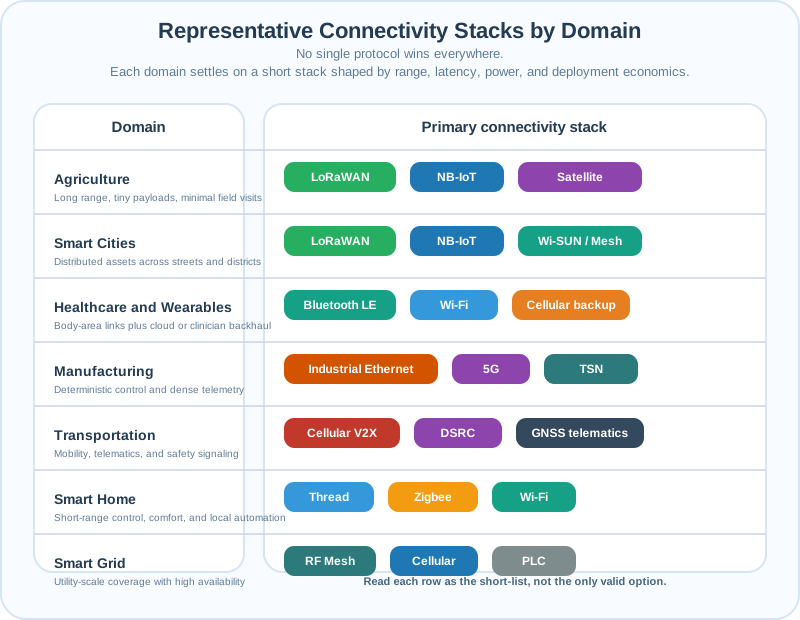
- LoRaWAN can suit low-rate farm or city sensors where battery life and range matter.
- NB-IoT or LTE-M can help when managed cellular coverage and carrier operations are acceptable.
- A useful practitioner artifact is a one-page domain profile.
Major section
Compare Domains by Constraints (continued)
Engineering can explain protocols, payloads, uptime, and integration cost.
- It should name the primary user, the operational decision, the physical environment, the integration target, the data owner, the support team, the success metric, and the unacceptable failure mode.
- The final review should be cross-functional.
- Operations can explain who acts on alerts and who maintains devices.
Major section
Compare Domains by Constraints (continued)
Legal, privacy, safety, or compliance staff can explain retention, consent, audit, and incident obligations.
- For a city deployment that may mean a public works dispatcher, a GIS asset registry, an open-data rule, and a field maintenance SLA.
- For a hospital device it may mean a nurse workflow, an EHR interface, a clinical safety review, and privacy controls.
- Finance can decide whether the value of the changed decision justifies the ongoing service cost.
Major section
Compare Domains by Constraints (continued)
For a factory it may mean a maintenance planner, an MES or CMMS integration, a plant-network boundary, and a production downtime threshold.
- A fleet pilot should prove location quality, driver workflow, tire-pressure or temperature sensor durability, cellular coverage gaps, and repair handoff.
- A precision agriculture pilot should prove gateway placement, battery life through the crop cycle, sensor calibration, and whether operators actually change irrigation or treatment.
- A healthcare pilot should prove alert routing, device cleaning, data minimization, identity matching, and what happens when a reading is outside expected clinical context.
Major section
Telemetry Semantics Differ
A temperature reading means different things in different domains.
- In a smart building, it may tune comfort and energy use.
- In a cold-chain route, it may decide whether a shipment is usable.
- In a factory, it may forecast bearing failure.
- In healthcare, it may trigger escalation rules and record retention requirements.
Major section
Telemetry Semantics Differ (continued)
A temperature event may need device identity, asset identity, location, unit, timestamp source, calibration version, firmware version, quality flag, enclosure state, and the rule that interpreted the value.
- Even the same transport protocol can carry different obligations depending on who relies on the result.
- The data contract should therefore carry domain context, not just a value.
- Industrial deployments may encode asset and tag meaning through OPC UA information models or MQTT Sparkplug B birth certificates.
Major section
Telemetry Semantics Differ (continued)
A vehicle-safety signal may be evaluated at the edge because the response window is short.
- A temperature event may need device identity, asset identity, location, unit, timestamp source, calibration version, firmware version, quality flag, enclosure state, and the rule that interpreted the value.
- Healthcare integrations may need patient or device identity to map safely into HL7 FHIR resources.
- Trust: Track calibration, firmware version, operator override, and missing-data behavior when decisions depend on the reading.
Major section
Telemetry Semantics Differ (continued)
Smart-city systems may need geospatial identifiers, public-release rules, and retention metadata before an observation can be shared beyond the operating team.
- A smart-building trend may be downsampled for energy analysis, while a regulated cold-chain record may need immutable audit history and exception review.
- A soil-moisture reading may be most meaningful when joined with soil type, crop stage, valve state, rainfall, and forecast data.
- A vibration feature may need machine speed, bearing type, maintenance history, and production schedule before anomaly detection is useful.
Major section
Checkpoint: Domain Fit
You now know why the same sensor reading can carry different meaning in a building, clinic, factory, vehicle, or field.
- You now know why a domain profile must name the operator, decision, environment, integration target, and unacceptable failure mode.
- You now know why generic device platforms still need domain schemas that preserve units, identity, quality, ownership, and calibration.
- With the domain-fit lens in place, the next step is to group domains into memorable families before comparing their technical envelopes.
Major section
The Five Pillars of IoT Impact
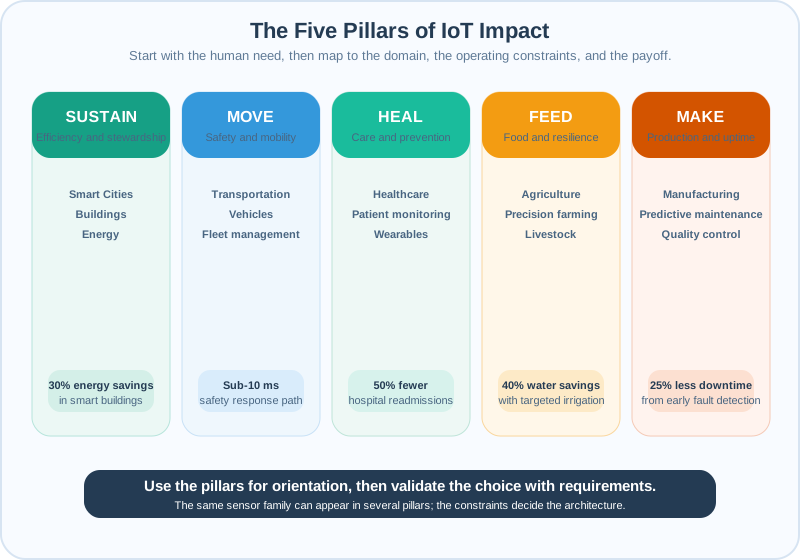
Sustain links buildings and energy to lower consumption, while Move makes response time central to transport safety.
- Heal shifts the outcome to patient care, Feed to water and farm resources, and Make to downtime and quality.
Major section
IoT Application Domains Taxonomy
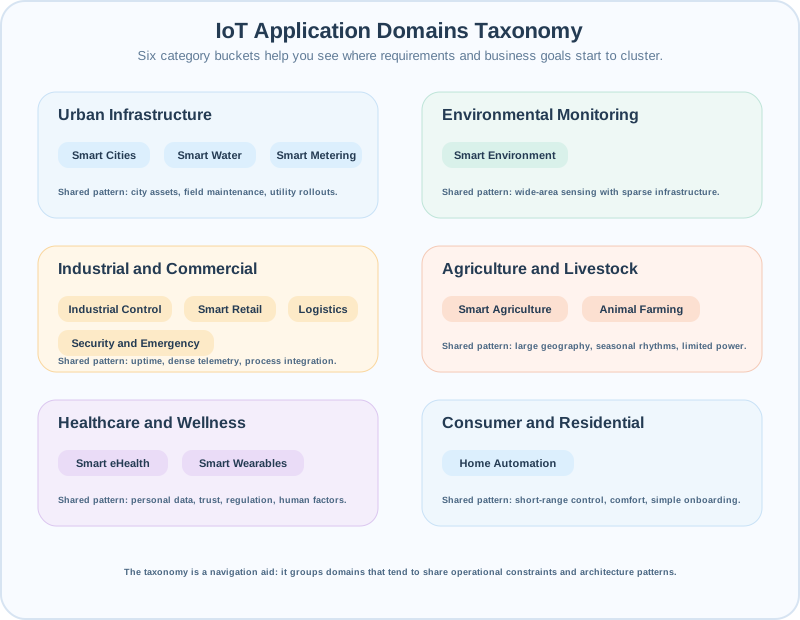
Understanding how the 13 application domains listed here relate to each other helps in selecting appropriate technologies and architectures.
- The domains can be organized into six major categories based on their primary focus and requirements.
- The numeric constraint profiles are illustrative chapter-level comparisons, not requirements that apply to every installation.
Major section
Environmental Monitoring Beyond Fixed Infrastructure
Continuous records can expose changes in migration, population density, social interaction, injury, illness, or trapping early enough for a conservation team to investigate.
- Environmental monitoring is not limited to fixed weather, fire, or pollution stations.
- The purpose is not merely to accumulate positions.
- Other environmental targets change the path again.
Major section
Environmental Monitoring Beyond Fixed Infrastructure (continued)
Wildlife conservation can require the sensing system to move with the subject: a collar combines location, motion, biometric, storage, compute, and radio functions so researchers can observe movement and condition between direct sightings.
- Marine monitoring can follow sea turtles, coral reefs, or mercury exposure in fish across migration, pollution, breeding, and nesting studies, but underwater communication moves the design toward sonar or long-wave links.
- The domain label stays the same while the collection mechanism changes with the environment.
- The source example makes the operating constraint concrete.
Major section
Under the Hood: Store, Gossip, Collect
When a collar is outside direct receiver range, it can retain observations in local storage.
- During an encounter, peer-to-peer communication can opportunistically gossip and replicate information across collars.
- A later plane flyover can then listen for pings with a directional antenna and collect records from collars in radio range.
- Replication does not create continuous connectivity; it changes which collar may eventually carry a copy to a collection opportunity.
Major section
Domain Requirements at a Glance
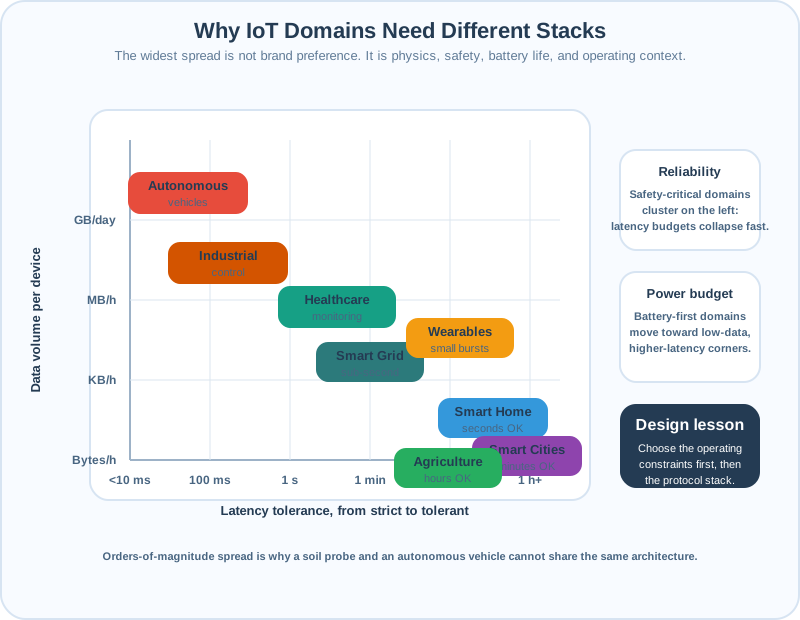
Each application domain has fundamentally different technical requirements.
- Smart cities and agriculture occupy the tolerant, low-data region, where long battery life and wide coverage may matter more than milliseconds.
- The spread explains why a platform chosen for one domain can be wasteful or unsafe in another: compare the requirement pair before choosing the stack.
Deck summary
Key takeaways
The right answer often changes before hardware is discussed.
- Engineering can explain protocols, payloads, uptime, and integration cost.
- Legal, privacy, safety, or compliance staff can explain retention, consent, audit, and incident obligations.
- For a factory it may mean a maintenance planner, an MES or CMMS integration, a plant-network boundary, and a production downtime threshold.
- A temperature reading means different things in different domains.
Retrieval practice
Recall check 1 of 2

Ada says: answer from memory, then check your reasoning.
Q1A team compares vaccine tracking with greenhouse irrigation. What should it do before choosing a platform?
Show answer
Answer: C Domain profiles include latency, battery, ownership, integration, and missed or false alerts.
Q2A temperature event moves from a building system into a cold-chain workflow. What needs review beyond the value?
Show answer
Answer: D The chapter ties sampling, calibration, ownership, retention, and fallback to the use case.
Retrieval practice
Recall check 2 of 2
Ada says: answer from memory, then check your reasoning.
Q3A wildlife collar is often beyond a direct receiver. Which collection plan fits that limit?
Show answer
Answer: C Storage and relay preserve observations across contact gaps.
Print reference
Answers
Answer key.
- C · Domain profiles include latency, battery, ownership, integration, and missed or false alerts.
- D · The chapter ties sampling, calibration, ownership, retention, and fallback to the use case.
- C · Storage and relay preserve observations across contact gaps.