Connected Product and Service Design · Study deck
IoT Design Models: Orientation and Evidence
A design model is useful when it makes a hidden choice easy to inspect.
UX Uma is your guide for this deck.

After studying this chapter
Learning objectives
You will be able to:
- explain why IoT teams use design models before choosing components and implementation patterns
- distinguish product promise, system boundary, architectural view, design evidence, and cross-cutting concern
- identify when a simple model is enough and when additional views are needed
- spot over-modeled diagrams that hide ownership, failure behavior, or user impact
Major section
Start Simple
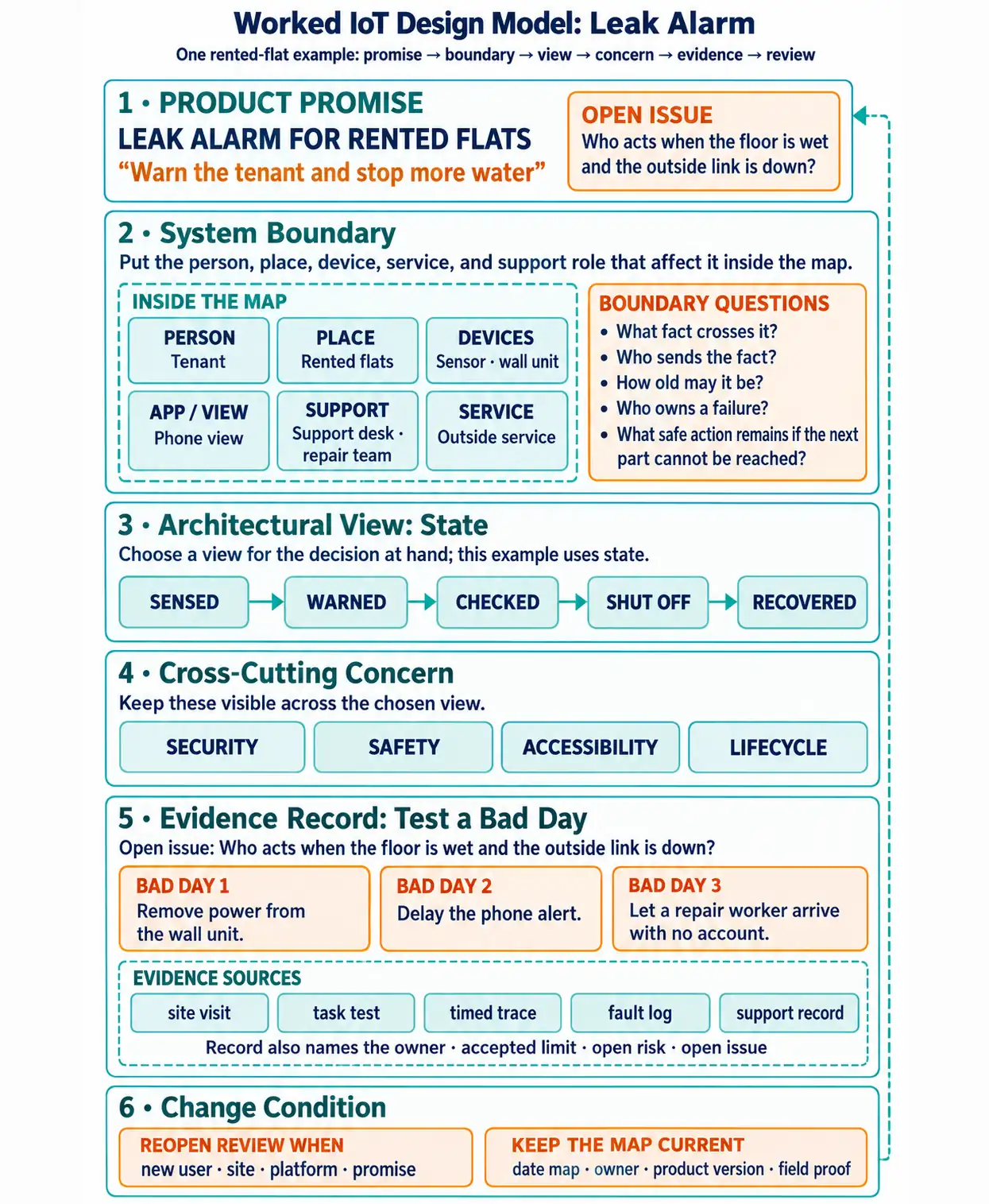
The product has a sensor, wall unit, phone view, support desk, repair team, and outside service.
- These notes make the lines useful.
- A state view can show sensed, warned, checked, shut off, and recovered.
- A time view can show how long each step may take.
- One drawing need not answer every question.
Major section
Start Simple (continued)
It may be a site visit, task test, timed trace, fault log, or support record.
- At release, use the same map to rehearse setup, normal use, loss of a link, repair, account change, and end of service.
- A later team should know which product version and field proof it describes.
- Practitioner matches each view to a risk.
Major section
Start Simple (continued)
Old maps are useful history, but they must not look current.
- This light map cannot replace detailed design or field proof.
- Under the Hood shows how vague state names and hidden ownership can make a tidy model unsafe.
- A design model is a way to make the product promise discussable.
Major section
Choose Models for Decisions
An IoT design model is useful when it helps a team decide what belongs in the product, what each part owns, and what must still work when the network, account, device, or support path fails.
- The model is not the product architecture by itself; it is the lens that makes one decision easier to review.
Major section
Choose Models for Decisions (continued)
For an introductory review, start with the lightest model that can protect the user promise.
- Different questions need different views.
- A C4 context diagram can show people, devices, cloud services, and external systems.
- A UML sequence diagram can reveal setup and command timing.
- A state machine can show stale, offline, denied, overridden, and recovered states.
Major section
Choose Models for Decisions (continued)
A deployment view can expose gateway, edge, cloud, and support boundaries.
- A useful introductory model also names the evidence that would change the decision.
- If field testing shows that the room is often occupied while the sensor is blocked, the model must reopen the promise.
- If support cannot tell whether a gateway, account, or dashboard is at fault, the model must reopen the boundary and observability record.
Major section
Practitioner: Match the View to the Risk
If account transfer is unclear, model identity and ownership.
- If a dashboard can show stale data, model state and freshness.
- If the device may work in Apple Home, Google Home, Alexa, and the vendor app, model where Matter, cloud APIs, and support tools agree or disagree.
- AsyncAPI can describe MQTT topic contracts.
Major section
Practitioner: Match the View to the Risk (continued)
OpenAPI can document service boundaries.
- In practice, the first artifact is often a compact decision record plus one view.
- For provisioning, it may be a sequence diagram showing installer, device, gateway, identity service, and support handoff.
- A Matter cluster or OPC UA information model can clarify capability and data semantics.
Major section
Practitioner: Match the View to the Risk (continued)
For field deployment, it may be a deployment map that separates local network, gateway, broker, cloud API, notification service, dashboard, and support tooling.
- A SysML block diagram can help hardware/software boundary reviews.
- The artifact is valuable only if it changes a decision or exposes a missing owner.
- Without those fields, the team may approve a diagram that cannot explain why the user saw the wrong state.
Major section
State Ambiguity Breaks Models
The hard part of IoT modeling is not drawing boxes.
- Device firmware, gateway cache, cloud rules, notification queues, mobile app storage, and support tools can all hold different versions of the same product state.
- That ambiguity is technical and organizational.
- A strong model shows the source of truth for each state and the path for recovery.
Major section
State Ambiguity Breaks Models (continued)
It also shows which paths remain local when identity services, brokers, or cloud dashboards are unavailable.
- The model should make authority, time, and replay explicit.
- Authority says whether the device, gateway, cloud, app, or support workflow owns a state transition.
- Replay says how the team can reconstruct the path from sensor event to dashboard display during an incident.
- Model drift: Revisit the model when firmware, broker topics, APIs, access rules, deployment topology, or support process changes.
Major section
Design Model Orientation
An: Evidence Record then names the source, owner, risk, and trade-off; the final: Change Condition ensures new users, sites, platforms, or promises can reopen the model.
- Product promise: the user-facing outcome the system claims to support.
- System boundary: the devices, gateways, apps, cloud services, people, support tools, and external systems in scope.
Deck summary
Key takeaways
The product has a sensor, wall unit, phone view, support desk, repair team, and outside service.
- It may be a site visit, task test, timed trace, fault log, or support record.
- Old maps are useful history, but they must not look current.
- An IoT design model is useful when it helps a team decide what belongs in the product, what each part owns, and what must still work when the network, account, device, or support path fails.
- For an introductory review, start with the lightest model that can protect the user promise.
Retrieval practice
Recall check
UX Uma says: answer from memory, then check your reasoning.
Q1A team is choosing the first design model for a connected storage-room monitor that may show stale motion as availability. Which model record makes the decision reviewable?
Show answer
Answer: B A reviewable introductory design model ties the product promise, boundary, view, state ownership, failure behavior, concerns, evidence, owner, and change condition together before the model is trusted.
Print reference
Answers
Answer key.
- B · A reviewable introductory design model ties the product promise, boundary, view, state ownership, failure behavior, concerns, evidence, owner, and change condition together before the model is trusted.